
Read time :
GTM Strategy: How Closed Revenue Data Powers Better Lookalike Audiences for GTM Teams
Learn how to build higher-converting lookalike audiences using closed-won CRM revenue data instead of leads. A step-by-step guide for B2B GTM teams.

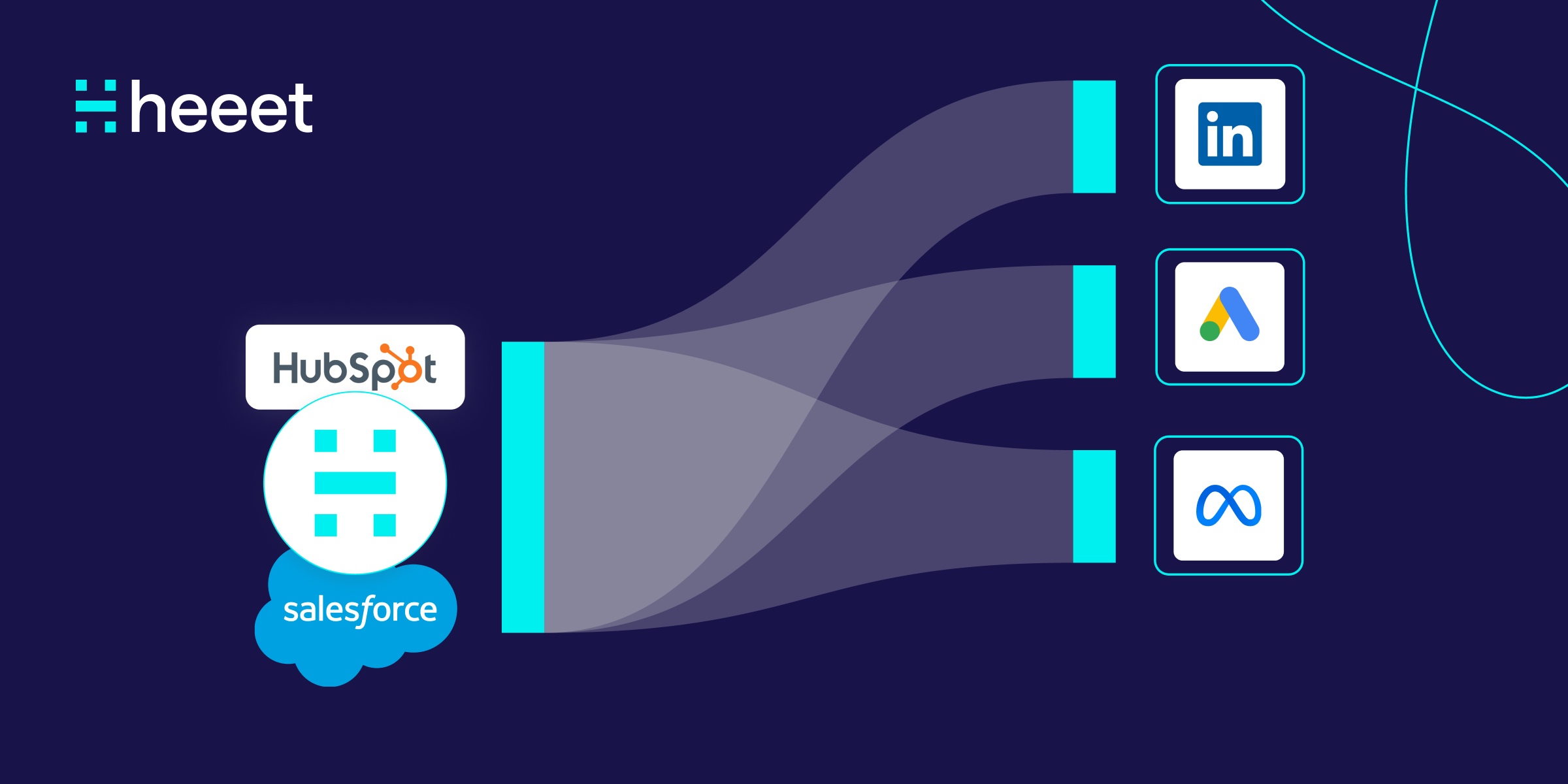

Your best customers share patterns. The companies that close fastest, spend the most, and stick around longest share common characteristics. Yet most B2B teams build lookalike audiences from leads who never made a purchase.
Revenue-based lookalikes flip the approach. Instead of modelling on form fills and website visits, you seed ad platforms with closed-won customer data from your CRM. The algorithm then finds prospects who resemble those who have already purchased, not those who have browsed and bounced.
This guide covers how to extract revenue data from Salesforce or HubSpot, sync it with ad platforms, and build lookalike audiences that convert at higher rates than traditional lead-based targeting.
What Are Revenue-Based Lookalike Audiences
Revenue-based lookalike audiences use closed-won customer data from your CRM as the seed for ad platform targeting. Instead of uploading website visitors or MQLs, you feed LinkedIn or Meta a list of customers who have already purchased. The algorithm then finds prospects with characteristics similar to those of people who converted into paying customers.
Traditional lookalikes rely on early-funnel signals. Someone downloaded an ebook? They’re in the seed. Visited your pricing page? Added to the list. The problem: browsing behaviour doesn’t predict buying behaviour. Revenue-based seeds flip the approach entirely by starting with outcomes and working backward.
A traditional seed says, “find more people who browse.” A revenue seed says, “Find more people who buy.”
Why Closed Revenue Data Creates Higher-Converting Lookalikes
The Problem with Lead-Based Seed Audiences
Leads don’t equal buyers. Most B2B companies convert 1-5% of MQLs into closed revenue. Building lookalikes from that pool means you’re modelling on 95%+ of people who never purchased.
The math works against you. If your seed contains mostly non-buyers, the algorithm optimizes for finding more non-buyers. You get efficient lead generation and inefficient pipeline creation. Clicks look great. Revenue doesn’t follow.
This isn’t theoretical. B2B companies running paid search and social campaigns regularly discover that their ads attract the wrong audience segment entirely. For example, one fintech company targeting enterprise merchants found that their Google Ads and paid search campaigns kept generating SME leads, a segment they didn’t even serve. The volume looked healthy in the ad platform. The CRM told a different story: almost none of those leads matched the company’s ICP. Without revenue data closing the loop, their lookalike seeds would have been built on prospects who could never buy.
It’s like asking someone to find you more window shoppers when you want paying customers.
How Revenue Data Filters for Actual Buying Signals
Closed-won deals contain validated purchase behaviour. Revenue data captures firmographic patterns, buying committee structures, deal velocity, and timing signals that correlate with real decisions.
Revenue data answers different questions from lead data:
- Firmographics: What company sizes and industries convert?
- Behavior: What content engagement preceded closed deals?
- Timing: How long did successful deals take to close?
- Value: Which segments produce the highest ACV?
When you seed with revenue information, platforms model on signals that matter. The resulting audience resembles your best customers, not your most engaged tire-kickers.
There’s another dimension most teams miss. Marketing often loses all visibility after the MQL handoff. Here at Heeet, we often have the same conversation with B2B marketing teams: marketing generates leads, hands them to sales, and then the funnel goes dark. Nobody tracks which campaigns, events, or content continue to influence open opportunities. That post-MQL blind spot means lead-based seeds are built on partial data. You’re modelling on the top of the funnel while ignoring the signals that correlate with closed revenue further down.
The Conversion Gap Between Revenue and Lead Lookalikes
The downstream impact compounds as it flows through your funnel. Revenue-seeded lookalikes typically produce higher-quality leads that convert to opportunities at better rates. Sales cycles often shorten as prospects better align with your ICP.
Your cost per opportunity drops even if your cost per lead stays flat. Pipeline quality improves without increasing headcount or budget.
Key Components of Go-to-Market Lookalike Audiences
Seed Data Quality and Revenue Segmentation
Seed quality determines lookalike quality. Garbage in, garbage out applies here with particular force.
Start by segmenting your closed-won data. Not all customers are equal. A $10K deal and a $500K deal represent different buyer profiles. Mixing them dilutes your targeting precision. This may be the difference between your standard clients and enterprise accounts.
Consider segmenting by deal size, product line, customer LTV, or sales cycle length. Each segment can power a distinct lookalike for different campaign objectives. Companies with multiple product lines see this play out clearly. A campaign for one product often influences pipeline for a completely different product line. If you don’t segment your seeds by product, you miss these cross-product signals and end up building lookalikes that blur your targeting.
Audience Size and Precision Trade-offs
Lookalike platforms let you control audience size by selecting a percentage. Smaller percentages (1-3%) produce audiences most similar to your seed. Larger percentages (5-10%) expand reach but reduce precision.
For revenue-based seeds, starting small usually makes sense. You’ve already filtered for quality. Expanding too quickly reintroduces noise.
Platform-Specific Lookalike Features for B2B
Each ad platform handles lookalikes differently. LinkedIn calls them Predictive Audiences and excels at professional targeting. Meta’s Lookalike Audiences offer broader reach with strong matching algorithms. Google’s Similar Segments work across search and display.
How to Build Lookalike Audiences from CRM Revenue Data
1. Define Your Highest-Value Customer Segments in the CRM
Open your CRM and filter closed-won opportunities. Start with your top 20% by deal value or customer lifetime value. Apply additional filters based on your ICP: industry vertical, company size, geography, and product purchased.
Export company domains or professional email addresses, depending on platform requirements. Most B2B teams find 300-1,000 records sufficient for initial testing.
2. Sync Revenue Data to Ad Platforms Automatically
Manual CSV exports work but create maintenance headaches. Every time a new deal closes, your seed becomes stale. Automation solves this problem.
CRM-native integrations can sync audience segments directly to ad platforms. When a deal closes, the customer is automatically added to your seed audience. No manual work. No data lag.
Heeet’s Audience Activation, for example, syncs Salesforce segments to Google, Meta, LinkedIn, and TikTok without exporting data outside your CRM.
The automation piece matters more than most teams realize. Enterprise companies running dozens or even hundreds of ad accounts across multiple platforms face a synchronization nightmare with manual exports.
One global tech company with roughly 100 Google Ads accounts had resigned itself to the idea that connecting ad data to CRM outcomes simply wasn’t possible at their scale. Their performance marketers knew which ads generated clicks, but no one could tell Google’s algorithm which clicks translated into revenue. Automated CRM-to-ad-platform syncs eliminate that gap. When an opportunity closes, the data flows to your ad platforms, feeding both your offline conversion signals and your lookalike seeds simultaneously.
3. Configure Lookalike Parameters by Platform
Each platform requires a slightly different setup. On LinkedIn, upload your matched audience and select “Create Predictive Audience.” Choose your target location and let the algorithm build.
On Meta, upload your custom audience and select “Create Lookalike.” Start with 1% in your primary market. Expand only after validating performance. On Google, similar segments generate automatically from your customer match lists.
4. Exclude Existing Customers and Unqualified Segments
Suppression lists prevent wasted spend. Upload your current customer list as an exclusion. Add closed-lost accounts if they represent poor-fit prospects rather than timing issues.
Consider excluding current customers, active pipeline, disqualified leads, and competitors. Every dollar spent on excluded segments is a dollar not spent on net-new acquisition.
CRM-native activation also automatically builds these exclusion audiences. The same triggers that push closed-won data to your lookalike seeds can push closed-lost, disqualified, or existing customer data into suppression audiences. Define the rules once; your exclusions update themselves.
5. Launch and Measure Against Revenue Outcomes
Here’s where most teams stumble. They launch lookalike campaigns and measure clicks, impressions, or even leads. None of those metrics validate whether revenue-based seeding works.
Measure what matters: pipeline influenced, cost per opportunity, close rates, and deal velocity. Connect your ad platforms back to CRM revenue data. Closed-loop attribution reveals which seeds and platforms produce real results.
The disconnect between ad platform metrics and CRM revenue is one of the most consistent pain points B2B paid media teams describe. Your Google Ads dashboard shows strong ROAS. Your Salesforce pipeline report tells a different story. The numbers don’t match because ad platforms measure conversions their way, and your CRM measures them another way entirely. Without a direct connection between the two, you’re optimizing lookalike seeds on platform metrics that don’t reflect business outcomes. The fix is to send offline conversion data from your CRM back to the ad platforms so the algorithm optimizes for what your business cares about: pipeline and closed revenue.
How Go-to-Market Teams Use Revenue-Based Lookalikes
Demand Generation and Paid Media Campaigns
Demand gen teams use revenue-based lookalikes to efficiently scale acquisition. Instead of broad targeting that generates volume, they target prospects who resemble closed customers. Campaign efficiency improves because you’re not paying to reach poor-fit accounts.
The impact compounds when you send CRM conversion data back to ad platforms. Google’s algorithm starts serving ads to people who look like your buyers, not just your clickers. Performance marketers at companies spending six figures monthly on ads have described this as the single biggest unlock: informing the algorithm what a real conversion looks like, then letting it optimize delivery around that signal.
Account-Based Marketing Programs
ABM teams often struggle with list expansion. You’ve identified 500 target accounts. Now what? Revenue-based lookalikes answer the question.
Build a seed from closed-won target accounts. Generate a lookalike. The resulting list contains companies that share characteristics with your best ABM wins.
One challenge that makes this particularly powerful: enterprise deals involve multiple contacts on a single account, each doing independent research. Your SDR’s prospect engages with LinkedIn ads, attends a webinar, and downloads a whitepaper, while three other contacts at that account engage with LinkedIn ads. If your attribution only tracks the contact your SDR reached out to, you miss the full buying committee’s journey.
Revenue-based seeds that account for multi-contact influence at the account level produce lookalikes that reflect how enterprise buying committees behave, not just how individual leads behave.
RevOps and Pipeline Optimization
RevOps teams use lookalike performance data to refine ICP definitions. If certain seed segments produce better lookalikes, that signals something about your ideal customer. TAM calculations become more precise. Territory planning improves.
Sales Enablement and Outbound Prospecting
Sales teams can use lookalike insights to prioritize outbound efforts. Accounts that match your revenue-based lookalike profile deserve more attention than random prospects. Some teams export lookalike audiences and cross-reference them with outbound lists.
Best Practices for Revenue-Based Lookalike Targeting
1. Start with Clean ICP-Aligned Closed-Won Data
Data hygiene matters enormously. Incomplete records, missing fields, and outlier deals degrade lookalike quality. Remove anomalies before building seeds. That one-off enterprise deal that doesn’t represent your typical customer? Exclude it.
2. Segment Seed Audiences by Deal Size or Customer LTV
One generic seed limits your flexibility. Create multiple seeds for different campaign objectives. An enterprise seed powers ABM expansion. A mid-market seed fuels volume acquisition.
3. Refresh Seed Audiences as New Deals Close
Stale seeds miss recent buying patterns. Markets shift. Customer profiles evolve. Automated syncs solve this problem by updating audiences whenever new revenue data is added to your CRM.
4. Layer Intent Signals for Better Timing
Lookalikes tell you who to target. Intent data tells you when. A prospect who resembles your best customers and is actively researching solutions represents a high-priority target.
5. Test Multiple Seed Definitions Against Conversion
Don’t assume your first seed definition is optimal. Test variations. Compare results by pipeline contribution, not surface metrics. Maybe high-ACV customers produce better lookalikes than high-volume customers.
Privacy and Compliance for CRM-Based Audience Activation
GDPR and Data Minimization Requirements
GDPR requires limiting data sharing to what’s necessary for the stated purpose. When syncing CRM data to ad platforms, you’re sharing customer information with third parties. First-party data used for audience matching can remain compliant when handled properly.
Server-Side vs Cookie-Based Tracking Approaches
Traditional audience matching relies on cookies and browser-based tracking. Privacy regulations and browser restrictions have significantly degraded this approach. Server-side tracking bypasses browser limitations. Data flows directly from your systems to ad platforms without depending on client-side cookies.
Cookie-less, server-side approaches address a growing concern across B2B buying committees. During vendor evaluations, privacy and data handling questions come up early and often. Prospects want to know where their data lives, whether any fingerprinting occurs, and whether the solution stores data on external servers. A tracking approach that sends data directly to your own CRM instance, not to a third-party platform, removes a major procurement objection and keeps your compliance team comfortable.
Keeping Customer Data Inside the CRM
Some audience activation approaches export customer data to external platforms. CRM-native activation keeps data inside your existing system. Heeet’s approach syncs audience segments to ad platforms without hosting customer data externally. Your CRM remains the single source of truth.
Common Mistakes That Reduce Lookalike Conversion Rates
1. Using MQLs Instead of Closed Revenue as Seeds
MQLs represent engagement, not purchase intent. Seeding with them produces lookalikes optimized for engagement, not conversion.
2. Building One Generic Lookalike for All Campaigns
Different campaigns serve different objectives. A single lookalike can’t optimize for both enterprise acquisition and SMB volume.
3. Ignoring Audience Freshness and Stale Data
Markets change. Customer profiles evolve. A seed built on last year’s data may not reflect current buying patterns.
4. Forgetting to Exclude Current Customers
Showing acquisition ads to existing customers wastes budget and creates poor experiences.
5. Measuring Clicks Instead of Pipeline Contribution
Vanity metrics don’t validate the effectiveness of lookalike targeting. A campaign with high CTR and zero pipeline is failing. The most common version of this mistake: paid media teams report strong cost-per-click and conversion rates in the ad platform, while the CRM shows none of those conversions turned into qualified pipeline. Until ad platform data and CRM revenue data are connected, you’re flying blind on whether your lookalike seeds produce business results or just platform activity.
Lookalike Audiences vs Custom Audiences vs Retargeting
Lookalikes expand your reach to new prospects. Custom audiences work existing relationships. Retargeting recaptures lost attention. Together, they cover the full acquisition and retention spectrum.
Connect Revenue Data to Go-to-Market Strategies That Convert
Revenue data transforms lookalike targeting from a volume play into a precision instrument. When your seeds reflect actual buying behavior, your campaigns find prospects who convert.
The mechanics aren’t complicated. Export your best customers. Sync to ad platforms. Build lookalikes. Measure by pipeline, not clicks. Iterate based on results.
What makes this approach powerful is the foundation: CRM revenue data as the single source of truth. No guessing about who your best customers are. No modeling on behaviors that don’t predict purchase.
Book a demo to see how Heeet’s Audience Activation syncs Salesforce segments directly to ad platforms without exporting data outside your CRM.
FAQs About Building Lookalike Audiences from Revenue Data
What minimum seed audience size do I need for effective revenue-based lookalikes?
Each platform has different minimums. LinkedIn requires 300 matched records. Meta works with as few as 100. Google needs 1,000 for similar segments. Aim for 300-1,000 matched records for reliable modeling.
How often should I refresh my closed-won seed audience?
Refresh whenever significant new revenue data accumulates, typically monthly or quarterly depending on deal velocity. Automated syncs from your CRM eliminate manual effort.
Can I build lookalikes from lost deals to identify accounts to exclude?
Yes. Creating suppression audiences from closed-lost deals or disqualified accounts helps you avoid targeting prospects with similar characteristics.
Do revenue-based lookalike audiences work for ABM with small target account lists?
They can expand limited ABM lists by finding accounts that resemble your best customers. Very small seeds may not produce reliable lookalikes, though. Combine with firmographic filters to maintain targeting precision. The most effective ABM lookalikes account for the full buying committee’s engagement, not just the primary contact, because enterprise deals involve multiple people researching independently before a single opportunity opens.
Which advertising platform produces the best B2B lookalike results?
LinkedIn typically performs best for B2B due to professional data matching. But results vary by industry and ICP. Test across platforms and measure by pipeline contribution rather than surface-level engagement metrics.
Other articles


.svg)
Êtes-vous prêt à suivre les prospects du lead à la clôture avec Heeet ?
Heet permet aux spécialistes du marketing et des ventes des entreprises informatiques et de sécurité de transformer leurs conjections en décisions éclairées qui génèrent des revenus tout en respectant les mêmes normes techniques de sécurité que celles que vous offrez à vos clients.