
Read time :
10 Best Content ROI Tools to Prove Marketing Impact and Boost Growth
This guide is intended to help B2B CMOs, marketing leaders, and SEO professionals understand which tools on the market can help them connect their content to the ROI that drives the need to show iternally. It’s about giving you the rundown of features, available pricing and an overall idea of which tool can steer your content on course to drive ROI.


This guide is intended to help B2B CMOs, marketing leaders, and SEO professionals understand which tools on the market can help them connect their content to the ROI that drives the need to show iternally. It’s about giving you the rundown of features, available pricing and an overall idea of which tool can steer your content on course to drive ROI.
Let’s set the stage. You publish more than 50 blog posts a quarter. Leadership doesn’t want to track numbers and asks you again which content generated revenue. Your analytics suite shows surface-level metrics, which are no doubt important, but can’t be linked to pipeline with the tools currently at your disposal. Only 21% of B2B content drives pipeline, emphasizing marketing’s frequent disconnect from business outcomes.
Most marketing teams struggle to link content activity to business results. The right tools connect assets to pipeline and deals. By the end, you'll know which tool proves your content's value and helps defend your budget. Next, you'll find the best content ROI tools, what to look for, and how to measure ROI. Start now to boost your content's business impact.
What is content marketing ROI
Content ROI tools are platforms that connect every content touchpoint to dollars in your CRM, showing how blog posts, guides, and videos directly contribute to revenue. They measure content revenue by tracking user interactions throughout the buyer journey. Web analytics platforms like Google Analytics 4 handle general site activity. Integrated services like HubSpot connect content to CRM data for revenue attribution. Most specialized tools in the content realm focus on SEO-driven ROI, while others like HockeyStack, Dreamdata, and Heeet map full account-level journeys.
Content marketing ROI is the financial return your blog posts, videos, guides, and other assets generate relative to the cost of creating them. The idea is simple, but putting it into practice is not.
Here's the issue: prospects may interact with several pieces of content before speaking to sales. Without measurement, content seems like a cost rather than a revenue driver. Proper tools clarify this.
Why measuring content marketing ROI drives business growth
Picture the boardroom conversation: The CFO asks, "All these investments we make in content. what tangible value does it bring? can someone explain this to me?" With the right measurement, you can answer that question on the spot. Budget conversations get easier when you can show exactly which content investments pay off in dollars. Leadership wants numbers, not assumptions, especially when 56% of B2B marketers struggle to connect content efforts to ROI. When you can point to specific assets that generated the pipeline, justifying your budget becomes not only possible but compelling.
Besides budget defence, measurement shows where to focus. Data may reveal that technical guides outperform thought leadership. Without it, you miss such insights. Shared visibility aligns marketing and sales, improving asset requests and understanding buyers. Measure ROI to align teams and gain valuable insights.
What to look for in content ROI tools
Native CRM and marketing platform integrations
A content ROI tool must sync with Salesforce, HubSpot, or other CRMs so attribution data lives where your teams work. Without native integrations, you risk manual work, privacy issues, and errors. Native syncing reduces effort and risk.
The best integrations write attribution data directly into your CRM, so sales and marketing work from the same data. This ensures everyone trusts the numbers without needing to confirm or reconcile later. Tools that keep data outside the CRM create silos and make reconciliationharder, so teams waste valuable time double-checking numbers.
Multi-touch attribution capabilities
Content rarely converts on the first touch. 96% of prospects research independently before engaging sales, often interacting with your brand a dozen times before becoming a customer. Multi-touch attribution credits all touchpoints along the journey rather than giving all the glory to the last click.
Look for tools that offer flexible attribution models, each answering a specific business question. For example, a first-touch model answers the question, "Which piece of content opened the door with this prospect?" A last-touch model addresses the question, "Which asset finally convinced them to convert?" U-shaped attribution asks, "What content started and nurtured the buyer's journey?" Time-decay models reveal, "Which touchpoints became more influential as the deal closed?" Your sales cycle may call for one approach at the start, and a different one after form fill to track continued marketing and sales engagement until the final sale. The best tools let you switch between models easily so you can find the best fit for your business and answer the questions leadership is actually asking.
Full customer journey tracking
Choose tools that show every engagement, from anonymous visitor to closed deal. If you only see part of the journey, your insights will be incomplete. Aim for a full view across paid, organic, social, and offline channels.
Privacy-compliant cookieless tracking
Every tracking tool comes with it’s limitations. Currently the most industry players still largely uses cookie-based solutions that track touchpoints, however, tools that work without them while maintaining attribution accuracy are being deployed to great success. Java script based solutions that track the anonymous journey of leads and then reveal every touchpoint at once converted retroactively are becoming more widely used. They respect user privacy and are GDPR-compliant thanks to Server-side tracking that uses first-party data and a CRM-native architecture. This keeps your measurement reliable as privacy rules become stricter.
Automated reporting and real-time dashboards
Manual spreadsheets waste time. The best tools generate reports automatically and provide real-time dashboards that anyone on your team can use without extra help.
How we evaluated these tools
We evaluated each platform based on the criteria that matter most for measuring content ROI in B2B marketing. Here is what we considered:
- CRM integration depth: Does the tool write data natively into Salesforce or HubSpot, or does it create a separate database? Native integration means less data reconciliation and a single source of truth for sales and marketing.
- Attribution model flexibility: Can you toggle between first-touch, last-touch, linear, W-shaped, time decay, and custom models? B2B journeys are complex, and different questions require different models.
- Cookieless, privacy-first tracking: Does the tool rely entirely on third-party cookies, or use server-side, first-party data collection that survives browser restrictions and complies with GDPR and CCPA?
- Account-based vs. contact-based: B2B deals involve buying committees. Tools that track at the account level reveal how content influences multi-stakeholder decisions, not solely individual leads.
- Pricing transparency plus accessibility: We noted publicly available pricing, free tiers, and whether the tool is accessible to mid-market teams or exclusively enterprise.
- G2 user ratings and review volume: Real user feedback provides a signal of product maturity, support quality, and satisfaction beyond marketing copy.
No single tool fits every team. The best choice depends on your CRM, sales cycle, budget, and whether you need standalone attribution or integration with your data stack.
10 best content ROI tools for marketing ROI tracking
1. Heeet
Best for: B2B revenue teams on Salesforce or HubSpot that need CRM-native content attribution without a shadow database.
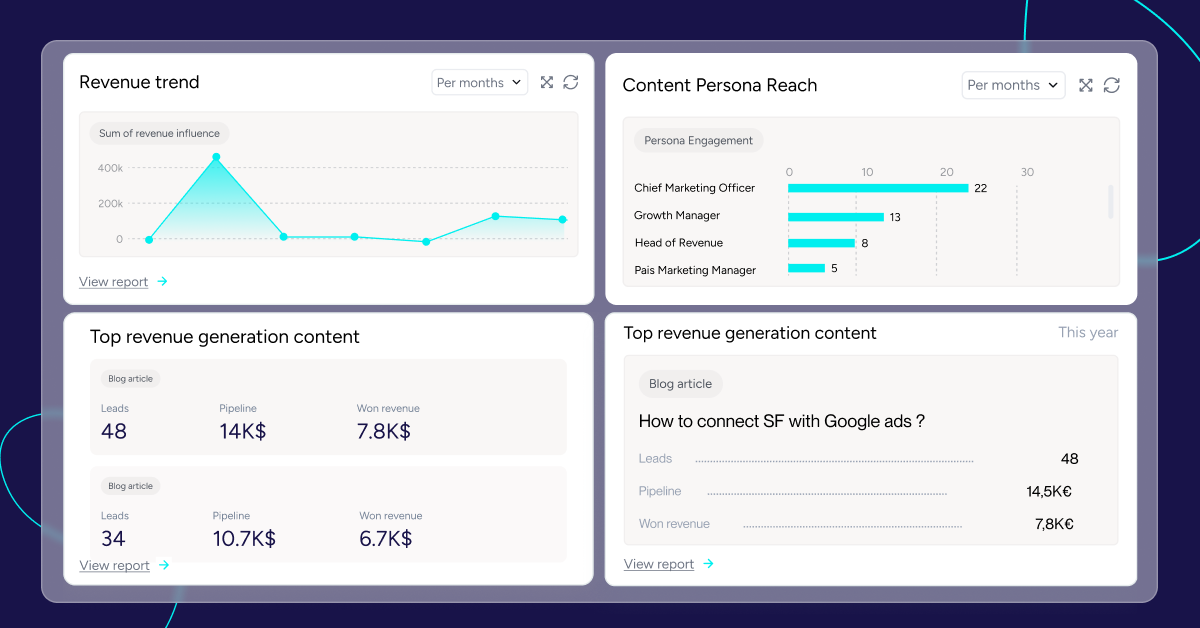
Heeet writes attribution data directly into Salesforce and HubSpot, offering a shared data source for both marketing and sales. Unlike some tools, it uses cookieless, server-side tracking for full journey visibility without third-party cookies. Whereas many platforms require external databases, Heeet operates CRM natively. It can attribute all content types to pipeline and closed revenue, providing a comprehensive approach compared to tools focused only on web analytics or SEO.
- Key strengths: CRM-native architecture (no external database), cookieless tracking by design, multiple attribution models (first-touch, last-touch, linear, W-shaped), audience activation to sync segments to ad platforms, and relatively quick implementation compared to other solutions. According to user reviews, most teams report that initial setup typically takes between one and three days, depending on integration complexity.
- Limitations: Requires Salesforce or HubSpot as your CRM. Newer to market than some established players.
- Pricing: $1490 per month, everything included for Salesforce and HubSpot teams. For other CRMs, contact for pricing
📊 G2 rating: New entrant
2. Google Analytics 4
Best for: Teams starting out with content measurement who need free, foundational traffic and engagement data.
GA4 is free and tracks general site activity, including traffic sources, engagement metrics, and basic conversion tracking. Compared to B2B-specific tools like Heeet, which are CRM-native and account-based, GA4 is session-based and better suited for top-of-funnel measurement. This makes it less ideal for B2B teams that need to track long sales cycles involving multiple stakeholders. In contrast, dedicated B2B ROI tools link content to pipeline and revenue for complex buyer journeys.
Minimum viable setup: Even for resource-strapped teams, setting up simple pageview and goal tracking in GA4 right away gives you a clear, actionable starting point to capture which blog posts led to key conversions or demo requests.
- Key strengths: Free, massive ecosystem of tutorials and integrations, data-driven attribution for Google Ads, event-based tracking model
- Limitations: No native CRM integration, session-based (not account-based), steep learning curve after the Universal Analytics migration, limited multi-touch attribution outside the Google ecosystem
- Pricing: Free (GA4 360 enterprise version starts at ~$50k/year)
📊 G2 rating: 4.5/5 (6,600+ reviews)
3. HubSpot Marketing Hub
Best for: Teams already committed to the HubSpot ecosystem who want built-in attribution alongside marketing automation.
HubSpot provides built-in content analytics and multi-touch attribution in higher tiers. Attribution is integrated with its CRM, email, and automation tools, but is limited to activity tracked inside HubSpot and is contact-based. Choosing HubSpot’s all-in-one platform offers convenience and a unified experience, since all features are natively connected. However, this also means less flexibility if your team wants to incorporate external data sources, custom attribution models, or migrate to other tools later. The upside of convenience comes with a trade-off: ecosystem lock-in. Weigh this strategic consideration carefully, especially if you anticipate changing your tech stack or scaling to more complex analytics needs in the future.
- Key strengths: Native CRM integration, built-in content analytics, multiple attribution models (linear, U-shaped, W-shaped, time decay, first/last touch), all-in-one marketing platform
- Limitations: Attribution limited to the HubSpot ecosystem, contact-based rather than account-based tracking, advanced attribution requires Professional tier ($800+/mo), limited flexibility for custom models
- Pricing: Marketing Hub Professional starts at ~$800/mo. Enterprise from ~$3,600/mo.
📊 G2 rating: 4.4/5 (12,000+ reviews)
4. HockeyStack
Best for: B2B revenue teams focused on account-based marketing who need GTM intelligence beyond basic attribution.
HockeyStack has evolved from attribution to a full GTM intelligence platform. It features multi-touch attribution, account-based journey mapping, cookieless tracking, and AI-driven insights. It integrates with leading CRMs, ad platforms, and ABM tools.
- Key strengths: Account-level journey mapping, cookieless tracking, AI-powered insights, lift modelling alongside MTA, extensive integrations, no-code funnel and cohort reporting
- Limitations: Enterprise-level pricing (starts ~$1,399/mo), smaller review base than more established tools, can be complex to configure for advanced use cases
- Pricing: Full pricing not mentioned publicly
📊 G2 rating: 4.6/5 (77 reviews)
5. Dreamdata
Best for: B2B companies with long, multi-stakeholder sales cycles that need deep journey mapping and audience activation.
Dreamdata tracks every touchpoint in the B2B customer journey and links marketing efforts to pipeline and revenue. It offers several attribution models, revenue analytics, content analytics, and an Audience Hub that syncs high-intent audiences to ad platforms. Enterprise teams can access data warehouses through BigQuery or Snowflake.
- Key strengths: Comprehensive B2B customer journey visualization, flexible attribution models, audience activation (sync to LinkedIn, Google, Meta), free tier for basic features, Series B-funded with strong product velocity
- Limitations: Steep learning curve (frequently cited in reviews), with most teams starting to see actionable insights around week six. Full data value may take several weeks to months, so leaders should plan for a ramp-up period when allocating resources. Premium pricing for enterprise features and dashboard customization can feel limited.
- Pricing: Free tier available with limited features. Paid plan pricing is not mentioned publicly.
📊 G2 rating: 4.7/5 (230+ reviews)
6. Ruler Analytics
Best for: B2B and B2C companies with significant inbound, form-driven, and phone-based lead generation who need offline conversion attribution.
Ruler Analytics combines call tracking, form tracking, and live chat attribution with digital marketing attribution. It connects offline conversions, such as phone calls and meetings, back to the original marketing source. Based in the UK, it also offers a hybrid marketing mix modelling approach for upper-funnel channels.
- Key strengths: Integrated call tracking and form attribution, closed-loop CRM revenue matching, hybrid MMM approach for upper-funnel visibility, serves both B2B and B2C (including ecommerce)
- Limitations: Smaller user base and review count, UI can feel dated, reporting sometimes requires supplementing with third-party tools, insights only begin after lead conversion (no anonymous visitor data)
- Pricing: Tiered pricing starting at 179 pounds that can reach 999 pounds or more based on monthly website visits.
📊 G2 rating: 4.5/5 (31 reviews)
7. Adobe Marketo Measure (formerly Bizible)
Best for: Enterprise and Fortune 500 organizations that are standardized on the Adobe Marketo stack and need detailed, every-touch attribution.
Adobe Marketo Measure is the enterprise attribution solution within the Marketo Engage ecosystem. It offers U-shaped, W-shaped, full-path, and custom attribution models with deep Salesforce integration. The platform captures touchpoints across digital and offline channels, paid and organic. It requires Marketo Engage as a prerequisite.
- Key strengths: Every-touch attribution with AI-powered models, deep Salesforce native integration, robust ABM and content association reporting, established enterprise track record
- Limitations: Requires Marketo Engage (locked into the Adobe ecosystem), known issues with data loss when users have cookies disabled, complex implementation and maintenance, inconsistent customer support reported in reviews, and enterprise-only pricing
- Pricing: Not publicly listed. Enterprise contracts only.
📊 G2 rating: 4.7/5 (147 reviews)
8. Attribution App
Best for: Growing ecommerce and B2B teams on HubSpot or Salesforce who want accessible multi-touch attribution without enterprise complexity.
Attribution App provides multi-touch attribution with first-touch, last-touch, and linear models. It integrates with HubSpot, Salesforce, and Shopify, and has recently added media mix modelling (MMM) capabilities. The platform emphasizes auditable data and transparent CAC tracking.
- Key strengths: Transparent, accessible pricing, 100% auditable attribution data, HubSpot and Shopify native integrations, CAC and ROAS reporting by customer, and MMM add-on
- Limitations: Smaller feature set compared to enterprise tools; leans towards ecommerce/DTC; keyword-level data can be limited; occasional gaps in tracking for some leads.
- Pricing: Pro starts at $399/mo (HubSpot). Enterprise entails custom pricing.
📊 G2 rating: 4.5/5 (51 reviews)
9. Funnel.io
Best for: Marketing teams and agencies that need to aggregate data from many platforms into a clean, unified view for reporting and analysis.
Funnel.io is a marketing data hub that connects to over 500 data sources, transforms and harmonizes marketing data, and exports it to BI tools, data warehouses, or dashboards. It recently added an AI-powered measurement product that combines marketing mix modelling, digital attribution, and incrementality testing, but its main focus is still data aggregation and reporting.
- Key strengths: 500+ native connectors, powerful data transformation and harmonization, exports to any BI tool or warehouse, and recently added AI measurement capabilities.
- Limitations: Not a dedicated attribution tool; teams often need to pair it with another platform for full attribution, custom pricing can scale quickly, and limited built-in visualization compared to BI tools
- Pricing: Custom pricing based on connectors and volume.
📊 G2 rating: 4.5/5 (163 reviews)
10. Segment (Twilio)
Best for: Engineering-led teams that need a customer data infrastructure layer to collect, clean, and route event data to downstream analytics and attribution tools.
Segment is a customer data platform from Twilio. It collects user interaction data from web, mobile, and server-side sources, and routes it to over 300 destinations. It is strong at data collection and identity resolution, but does not do attribution modelling. Teams use it alongside dedicated attribution tools to measure content ROI.
- Key strengths: 300+ integrations, identity resolution and profile unification, free tier available, strong developer ecosystem, data governance and consent management
- Limitations: Not an attribution tool (requires pairing with other platforms), technical implementation necessary, pricing scales quickly with traffic, enterprise CDP plans require custom contracts
- Pricing: Free plan (1,000 visitors/mo). Team plan from $120/mo. Business and CDP plans are custom.
📊 G2 rating: 4.5/5 (560+ reviews)
How to measure content marketing ROI
Step 1: Define content goals and revenue KPIs
Start by defining your objectives. What does success mean for your team? Is it pipeline generated, deals influenced, or revenue from specific content assets? Be specific before you begin tracking.
Step 2: Track all content production costs
Include all costs: writer time, design, promotion, tool subscriptions, and distribution. Many teams miss some of these, which makes their ROI look better than it is.
Step 3: Implement multi-touch attribution tracking
Set up tracking for every touchpoint. Use UTM parameters for campaigns, integrate your tools with your CRM, and tag all content assets correctly. This foundation is essential for accurate measurement.
Step 4: Apply the content marketing ROI formula
The standard formula is (Revenue from Content - Content Costs) / Content Costs × 100. This shows the percentage return on your content investment. For an example using Salesforce and HubSpot, see the linear attribution model example.
Step 5: Analyze results and reallocate budget
Review your results to find top-performing content. Remove or improve underperforming assets and optimize your distribution. Measurement only matters if you act on it.
Essential metrics for content marketing return on investment
Conversion rate by content asset
This metric shows the percentage of visitors who take a desired action after engaging with specific content. Comparing conversion rates across assets helps you see what your audience values.
Customer acquisition cost
CAC is the total cost to acquire a new customer. This cost has increased sharply in recent years, so effective content marketing is important for keeping CAC lower than paid channels.
Customer lifetime value
CLV is the total revenue expected from a single customer account. Customers acquired through content often result in a higher CLV because of the trust and education built during their buyer journey.
Nurturing content that pushes influenced the pipeline through the funnel
Identify the content that moves leads through the funnel before they close or convert. This helps you spot the middle- and bottom-of-funnel assets you need to nurture leads, not just convert them.
LTV to CAC ratio
This ratio shows your marketing efficiency and long-term profitability. If your content improves this ratio, it proves its value beyond just initial conversions.
MTA, MMM, and incrementality: understanding the measurement landscape
Attribution methods are changing quickly. Multi-touch attribution (MTA) is still the most common way to measure content ROI, but it is not the only option. Knowing how these three approaches compare helps you pick the right solution.
Multi-touch attribution (MTA) tracks individual user journeys and gives credit to specific touchpoints. It is the most detailed approach and works well for seeing which content influences pipeline. Most tools in this guide use MTA. The downside is that MTA can struggle with privacy rules, cross-device tracking, and upper-funnel channels where click data is missing.
Marketing mix modelling (MMM) uses aggregate, historical data to measure channel-level impact. It does not need user-level tracking, so it is privacy-safe, but it works at a high level and cannot show which blog post drove a deal. Some tools, such as Ruler Analytics, Funnel.io, and Attribution App, now offer MMM alongside MTA.
Incrementality testing measures the impact of a marketing activity by comparing groups that saw the content to those that did not. It answers the question MTA cannot: Would this conversion have happened without this content? It is the best way to prove causation, but you need enough data to run valid tests.
The most advanced B2B teams use all three methods together, each serving a distinct purpose over different planning horizons. For example, large companies running digital, event, and offline campaigns rely on multi-touch attribution (MTA) to optimize content performance and pipeline influence on a daily basis. Marketing mix modelling (MMM) helps teams plan quarterly by pointing to broader channel investments and how spending should shift. Incrementality testing is best suited for annual or semi-annual validation, answering whether your overall strategy and major bets are truly moving the needle compared to past performance or control groups. This cadence of optimizing daily, planning quarterly, and validating annually makes it clear why using all three approaches in tandem leads to more confident decisions. When choosing tools, check if a platform supports one or all of these approaches.
Content marketing ROI statistics and industry benchmarks
What counts as good ROI varies. B2B companies with long sales cycles expect different timelines than B2C companies. Context is important.
- Benchmark variability: ROI expectations differ by industry, average deal size, and sales cycle length
- Content type matters: Gated assets like guides and webinars usually have clearer attribution than top-of-funnel blog posts.
- Content ROI often improves over time as assets gain organic traffic and backlinks.
Measuring content ROI for startups and lean marketing teams
Startups have limited budgets and small teams. Choose tools that work quickly, with minimal setup time, and focus on the most important metrics first.
- Start simple: Begin with one or two metrics tied directly to revenue rather than tracking everything at once
- Prioritize integration: Choose tools that connect to your existing CRM without custom development.
- Focus on high-intent content: Measure bottom-of-funnel assets first, where attribution is clearest.
- Build measurement habits: Establish a regular reporting cadence before adding complexity.
Turn content performance into revenue intelligence
The goal of measurement is not just to track ROI, but to inform growth decisions. Good measurement links marketing activities to real revenue and changes how teams work. Tools like Heeet help you move past vanity metrics and see your content's real impact. Start measuring what matters and connect your content to revenue.
Before you dive deeper into attribution tools, pick one metric that ties directly to revenue and start tracking it this week. Taking ownership of your measurement is the fastest way to uncover insights that drive growth and change budget conversations. Once you see the impact for yourself, you can decide what you need next. If you want to accelerate your strategy, book a demo with Heeet to see firsthand how revenue attribution can transform your content approach.
FAQs about content ROI tools
How do content ROI tools handle cookieless tracking and privacy compliance?
Modern content ROI tools use first-party data collection and server-side tracking to maintain attribution accuracy without relying on third-party cookies. This ensures compliance with data protection regulations such as GDPR and CCPA while still providing valuable insights.
What is the difference between content ROI tools and general marketing attribution platforms?
Content ROI tools focus on measuring the revenue impact of content assets such as blog articles, high-intent website pages and guides. General attribution platforms track all marketing channels, including paid advertising, email, and events. Some tools do both, though specialized platforms often provide greater insights for their specific focus area.
How long does implementation take for enterprise content ROI tools?
Implementation timelines vary based on CRM complexity and data sources. Most enterprise tools require several weeks for full integration, data validation, and team training. Simpler tools with native integrations can be operational much faster.
Can content ROI tools measure offline touchpoints, such as events and webinars?
Yes, many content ROI tools track offline touchpoints by syncing event registration data and webinar attendance with CRM records. This allows teams to see how offline interactions influence pipeline alongside digital content.
Other articles
Measure how your customers have engaged with your content with Heeet Content Influence
Measure B2B content performance in Salesforce with Content Influence. Track engagement, revenue impact, and sales context

Multi-Touch SEO Attribution: The Best Solution?
Tracking SEO ROI is difficult. Multi-touch attribution can help measure it. Here’s how to do it.
Measuring SEO impact on offline revenue in Salesforce
Heeet connects SEO to Salesforce revenue with cookieless multi-touch tracking. See ROI, costs, and top-performing content driving your pipeline
.svg)
Ready to track prospects from lead to close with Heeet?
Heeet gives marketers and sales professionals at IT & Security firms turn geuss work intro informed decisions that drive revenue while meeting the same secruity technical standards you provide your clients.