
Read time :
Creating CRM-Native Attribution: Build the Revenue Advantage in 30 Days
This guide explains how to build CRM Native attribution that gives you the advantage of linking marketing’s impact to revenue, where deals live, and the best place to host metrics that keep sales aligned, in your CRM.

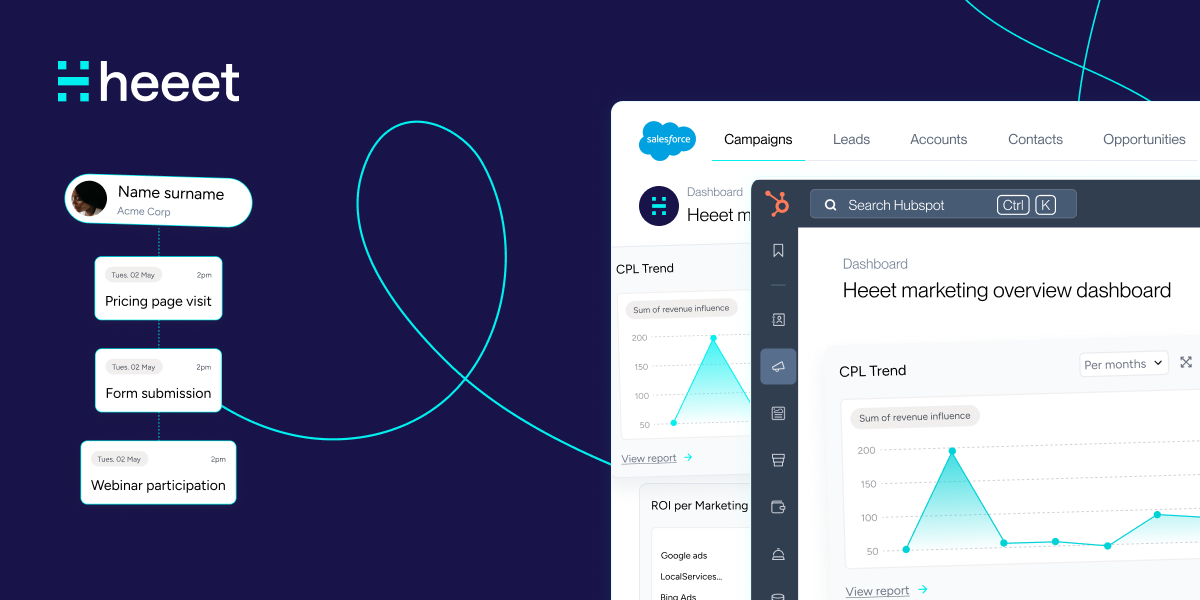

The biggest roadblock between matching revenue outcomes to attribution is the divide between marketing attribution platforms and the closed-deal data in your CRM: if your marketing performance data doesn’t live where your revenue team works, it won’t get used.
Third-party attribution tools extract data from your CRM and load it into external dashboards. This provides beautiful visualizations, high-level models, and in-depth analytics, but all in a separate platform that marketing logs into while sales mostly ignore.
That creates several problems:
Problem 1: Sales doesn’t trust the data
When sales reps look at an opportunity in Salesforce or HubSpot and see one set of campaign touchpoints, then marketing shows them an attribution dashboard with different touchpoints, it creates doubt. Whose data is right? The CRM they use every day or the marketing analytics tool they’ve never seen before?
Problem 2: This disconnect means attribution becomes a marketing report rather than sales intelligence
If attribution insights live in a dashboard accessible only to marketing, those insights never influence how sales prioritizes accounts, tailors conversations, or understands which marketing activities moved their deals forward.
Problem 3: Data freshness lags
Another challenge emerges with data freshness. External attribution platforms sync with your CRM on a given schedule, whether hourly, daily, or weekly. This means the insights remain a step behind reality. An opportunity closes at 3pm, but the attribution platform may not reflect that reality until tomorrow’s sync.
Problem 4: Two sources of truth
Marketing reports pipeline numbers from the attribution platform. Sales reports pipeline numbers from the CRM. Finance reports revenue numbers from the ERP. Nobody’s numbers match. Every meeting starts with “well, according to my data…”
What’s the Advantage of CRM-native Attribution:
Attribution data lives alongside opportunities in Salesforce/HubSpot
When a sales rep opens an opportunity record, they see the full attribution history right there. Which campaigns touched this account? Which content pieces did buying committee members interact with? What was the sequence of touchpoints leading to this opportunity?
Sales and marketing use the same real-time data
Now, both teams use the same attribution data in the CRM in real-time. Sales can immediately validate marketing's reported pipeline using the same records. And when an Opportunity closes, attribution credits update immediately. The data stays current with no waiting.
Changes in attribution logic are reflected everywhere
Switching or updating attribution logic in a single place guarantees that all reports in a single system are in sync, making it the single source of truth.
Now, this doesn’t mean CRM-native attribution is automatically better. It just means the architectural advantages correspond to how B2B revenue teams actually work.
You still need clean data. You still need aligned definitions. You still need offline touchpoint tracking. All seven readiness questions we covered in a separate article still apply. For a quick recap, you should take a look these seven foundations right first:
- Clean CRM data: If you can’t trust your lead source field today, you won’t trust attribution tomorrow
- Sales/marketing alignment: Shared definitions prevent attribution from revealing conflict that it can’t resolve
- Consistent offline tracking: B2B buying happens beyond pixels and cookies
- Budget runway: Sophisticated models need time and data to prove themselves
- Analytical capability: Your team needs to analyze and act on attribution insights
- Account-level visibility: Individual leads don’t buy; buying committees do
- Reconciliation discipline: Attribution credits must equal actual revenue, or the math is meaningless
Once you’ve built those foundations, CRM-native attribution leverages them in a way that external platforms struggle to match.
Think about the pragmatic consequences:
A sales rep is preparing for a call with a late-stage opportunity. They open the opportunity record in Salesforce. Right there, they see that three people from the account attended your recent webinar on solving the exact pain point this deal is focused on.
That’s not just attribution data. That’s sales intelligence. The rep can reference the webinar in their call. They can tackle specific topics that attendees care about. They can use marketing touchpoints to build rapport and demonstrate understanding.
That only works when attribution data lives where sales already work.
Or consider budget planning. The CMO presents to the board showing that content marketing generated $4.2M in attributed pipeline last quarter. A board member asks, “Can you show me which specific opportunities include?”
In a CRM-native system: Pull up the filtered opportunity list in Salesforce, sorted by attribution. Every board member can see the exact deals. They can drill into individual opportunities. They can validate the math themselves.
In an external attribution platform: “I will send you a screenshot after the meeting.” The moment passes. Trust wavers.
This isn’t theoretical. This is how attribution either becomes organizational infrastructure or becomes another unused marketing tool.
The key insight: attribution is too important to live in a silo.
It needs to be embedded in the systems where revenue decisions happen. Where sales work. Where finance audits. Where executives review the pipeline.
That’s the CRM-native advantage: data lives where work happens, not in isolated dashboards.
The 30-Day Readiness Sprint
You can put a CRM Native Attribution system in place and drive real results in 30 days. It starts now: commit to launching your readiness sprint and set your team's plan into motion today.
You can also find the sprint in our Notion Multi-touch Attribution Assessment doc below, so you can duplicate it and document the process in Notion.
Use this sprint framework to build attribution readiness; take action this month to improve your attribution approach whilst keeping business moving.
Week 1: Audit Current State
Day 1-2: CRM Data Quality Assessment
Pull reports for the last 90 days:
- Opportunities with a missing lead source
- Opportunities with zero campaign associations
- Duplicate contact/account records
- Incomplete required fields
Calculate accuracy percentages:
- Lead source completion rate: ___% (target: 95%+)
- Campaign association rate: ___% (target: 80%+)
- Duplicate record rate: ___% (target: <5%)
Identify the top 3 data quality issues to fix.
Day 3: Touchpoint Tracking Inventory
List every channel where prospects engage:
- Website (organic, paid, direct)
- Paid advertising (LinkedIn, Google, etc.)
- Content (blog, ebooks, whitepapers)
- Events (conferences, trade shows, webinars)
- Email (newsletters, nurture sequences)
- Sales outreach (calls, demos, meetings)
- Other (direct mail, partnerships, referrals)
For each channel, assess tracking quality:
- Green: Consistently tracked with proper attribution
- Yellow: Sometimes tracked, gaps in data
- Red: Rarely or never tracked
Count your reds and yellows. Those are your gaps. Start filling them
Day 4: Sales/Marketing Alignment Check
Survey both teams with these questions:
- How do you define “pipeline generated by marketing”?
- What makes a lead sales-qualified?
- Should marketing get credit for opportunities that sales sourced?
- How should we measure marketing’s revenue contribution?
Compare answers. Where do definitions diverge? Document the gaps.
Day 5: Reconciliation Test
Pull last quarter’s revenue data:
- Total closed-won revenue: $
- Revenue attributed to marketing (however you currently measure it): $
- Difference: $
If the difference exceeds 10%, you have a reconciliation issue.
Test one closed deal:
- Deal value: $
- Sum of all attribution credits: $
- Do they match?
Week 2: Fix Major Gaps
Day 6-7: Campaign Taxonomy Standardization
Create a simple, consistent naming convention:
- Format: [Channel][Campaign Type][Audience]_[Date]
- Example: LinkedIn_Webinar_CMOs_2025Q1
Document it in a shared location (e.g., a wiki, Google Doc, or Notion).
Retroactively fix the last 30 days of campaigns to match the new taxonomy.
Day 8-9: Lead Source Cleanup
Pick your top 5 lead sources by volume. For each one:
- Standardize the naming
- Document what qualifies for that source.
- Create validation rules in your CRM to enforce it going forward.
Set up a weekly report showing “unknown” or “other” lead sources. Assign someone to clean them up within 48 hours.
Day 10: Offline Tracking Process
Pick your single most important offline channel (probably events/trade shows).
Build a simple, repeatable process:
- Badge scan or manual entry?
- Who’s responsible?
- What’s the SLA for getting leads into CRM?
- How do you tag them for proper attribution?
Document the process. Train the team. Test it at your next event.
Week 3: Align Stakeholders
Day 11-12: Define Shared Metrics
Run that 90-minute working session with sales and marketing leaders.
Come out of it with documented agreements on:
- MQL definition and criteria
- SQL handoff process
- Pipeline generation vs. pipeline influence
- How to handle sales-sourced opps that marketing touches
- What does “marketing contributed revenue” mean?.
Get everyone to literally sign the document. Make it official.
Day 13-14: Set Attribution Governance
Create an “attribution council” with representatives from:
- Marketing operations
- Sales operations
- Revenue operations
- Finance
Meet monthly to:
- Review the attribution model effectiveness.
- Validate reconciliation
- Approve changes to methodology.
- Resolve conflicts between teams.
Document the charter. Schedule the first meeting.
Day 15: Establish Reconciliation Process
Build a monthly reconciliation dashboard that shows:
- Total closed revenue
- Total attributed revenue
- Difference (should be zero or very close)
- Attribution by channel
- Validation that the sum of channels = total revenue
Assign someone to own this. Make it part of the month-end close process.
Week 4: Pilot Simple Model
Day 16-17: Choose Your Starting Model
Based on your sales cycle:
- Short cycle (1-2 months): Linear attribution works fine
- Medium cycle (3-6 months): Try time-decay attribution
- Long cycle (6+ months): Consider position-based (U-shaped)
Pick one. Document why you chose it.
Day 18-20: Configure in CRM
Set up the model using native CRM functionality:
- Salesforce: Campaign Influence or custom fields
- HubSpot: Attribution reports or custom properties
Keep it simple. Use standard features. Don’t build complex custom code yet.
Day 21-22: Pick One Channel to Test
Choose your most measurable channel (usually paid advertising).
Run your new attribution model just for that channel.
Compare results to your old first/last-touch approach.
Document what you learn.
Day 23-24: Validate the Math
Pick 10 recent closed deals from your test channel.
For each deal:
- List all touchpoints
- Show how attribution was calculated.
- Add up the credits
- Verify it equals the deal value.
If math doesn’t work, debug and fix.
Day 25-30: Share Learnings
Present findings to the attribution council:
- Here’s what we tested
- Here’s what we learned
- Here’s what we’d change going forward
- Here’s our recommendation for next steps
Get buy-in for expanding the pilot next month.
At the end of 30 days, you should have:
✅ Clean data in your most important fields
✅ Aligned definitions across sales and marketing
✅ Standardized offline touchpoint tracking for your top channel
✅ A working attribution model (even if simple)
✅ Validated math that reconciles
✅ A governance process to maintain it
✅ Team literacy on what attribution means
That’s readiness.
Not perfect. Not comprehensive. But ready to actually use multi-touch attribution to make better decisions. Then, and only then, does the conversation about the attribution model actually matter.
Because here’s what we’ve learned after working with hundreds of B2B marketing teams: the best attribution platform in the world can’t fix bad data, misaligned teams, or missing touchpoints.
But the right organizational readiness can make even a simple attribution model incredibly powerful.
When you can do that, multi-touch attribution becomes what it’s supposed to be: an organizational infrastructure that helps you understand what’s actually driving revenue so you can do more of it.
Not a vendor checkbox. Not a marketing project. Not a dashboard that gets presented once and then ignored. Real Infrastructure everyone has access to. The kind that changes how your entire revenue team makes decisions.
And if you’re going to build that infrastructure, build it where your revenue team already works. In your CRM. Where opportunities live. Where sales and marketing collaborate. Where finance validates the numbers.
Because attribution data that lives in a silo? That’s just expensive reporting.
Attribution data that lives in your CRM? That's revenue intelligence.
Now that you know what readiness actually looks like, you can build on foundations that turn attribution from theory into revenue impact.
Ready to see CRM-native attribution in action? Heeet embeds multi-touch tracking and attribution directly inside Salesforce and HubSpot so your revenue team gets the insights exactly where they already work. No external dashboards. No data lag. No second source of truth.
Book a demo and see how your pipeline data looks when attribution finally lives where deals happen.
Other articles

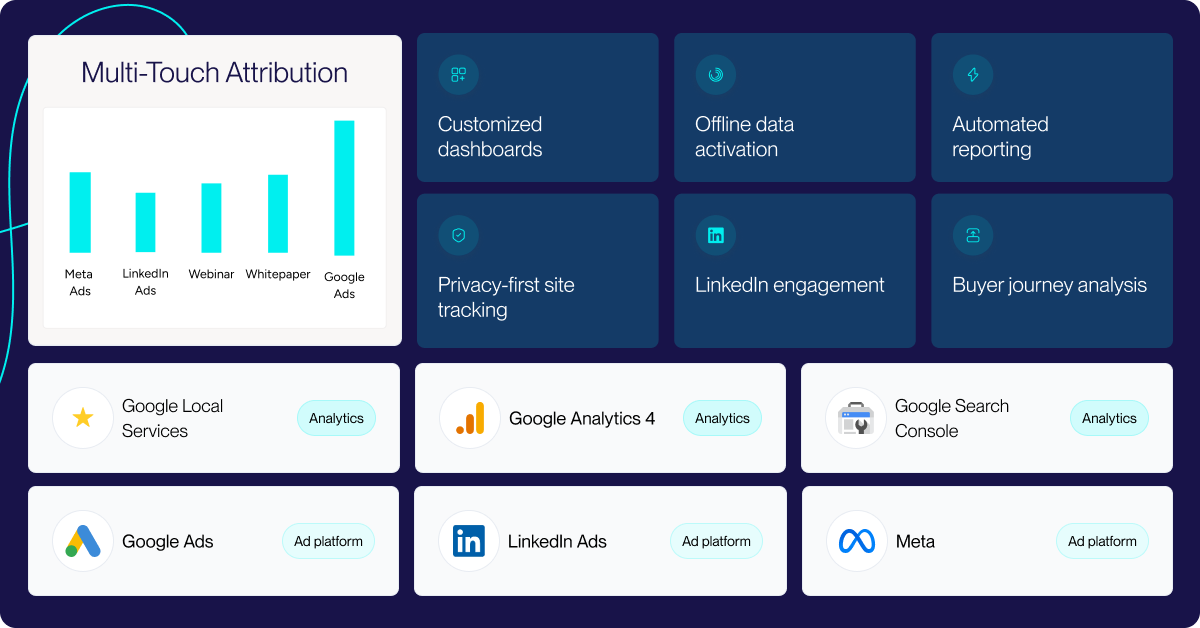
15 Best Multi-Touch Attribution Platforms (2026) — Pricing, CRM Fit & In-Depth Comparison
We compared 15 multi-touch attribution platforms on pricing transparency, Salesforce & HubSpot integration depth, attribution models, and cookieless readiness. Honest scoring, real pricing, and a decision framework for B2B marketing, RevOps, and GTM teams.
.svg)
Êtes-vous prêt à suivre les prospects du lead à la clôture avec Heeet ?
Heet permet aux spécialistes du marketing et des ventes des entreprises informatiques et de sécurité de transformer leurs conjections en décisions éclairées qui génèrent des revenus tout en respectant les mêmes normes techniques de sécurité que celles que vous offrez à vos clients.