
Read time :
The 15 Best Multi-touch Marketing Attribution Platforms in 2026: Compared In-Depth
An honest, in-depth comparison of 15 platforms scored on pricing transparency, CRM integration depth, attribution model flexibility, privacy readiness, and real B2B fit — so you can make a confident decision.


Summary
- The problem: G2 and Gartner reviews all say the same analysis, touting "powerful attribution with solid integrations", which doesn't help you justify a $50K+ investment to your CFO or pick the right tool for your CRM, sales cycle, and budget.
- What's at stake: Choosing the wrong attribution platform wastes budget, creates months of implementation delays, and leaves your team stuck with data in yet another dashboard instead of your CRM.
- What this article delivers: An honest, in-depth comparison of 15 platforms scored on pricing transparency, CRM integration depth, attribution model flexibility, privacy readiness, and real B2B fit — so you can make a confident decision.
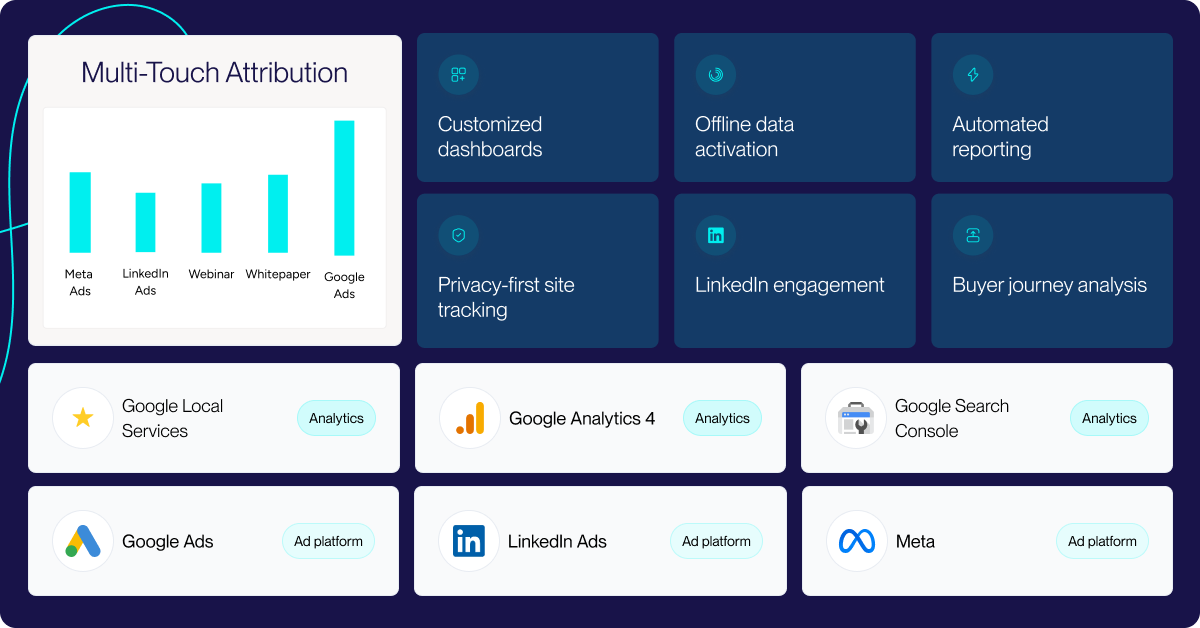
- What Heeet offers: CRM-native attribution that lives inside Salesforce and HubSpot, cookieless tracking that won't degrade as browsers evolve, full cross-channel revenue attribution, and implementation in hours — at a mid-market price point.
You've probably spent hours on G2 and Gartner reading summaries that all say the same thing: “Powerful attribution with solid integrations.” This doesn’t help when you need to justify a $50K+ annual investment to your CFO
This comparison goes deeper. We evaluated 15 platforms across pricing transparency, CRM integration depth, attribution model flexibility, privacy readiness, and B2B fit. Picking the wrong tool wastes budget and sets your team back months.
Quick-Glance Comparison Matrix
Before exploring individual platforms, here’s what the landscape looks like at a glance. We scored each tool on a 1-5 scale across six dimensions that matter most for B2B teams.
Detailed Platform Profiles
Heeet
Why it exists: Most attribution tools force you to export data out of your CRM into yet another dashboard. Heeet takes the opposite approach. It lives in Salesforce and HubSpot, connecting every marketing touchpoint to pipeline and closed revenue without leaving your system of record.
What makes it different:
- True CRM-native architecture. Heeet doesn’t sync data to your CRM (Customer Relationship Management system) through an API (application programming interface). It creates objects and populates fields natively, so your attribution data sits alongside deals, contacts and campaigns. No more toggling between platforms.
- Cookieless tracking from day one. While competitors scramble to adapt to privacy changes, Heeet’s tracking works regardless of browser settings, ad blockers, or cookie policies (rules governing the storage of user information). Your attribution data doesn’t degrade when Chrome users opt out. Cookie refusal is increasing globally. EU citizen’s lead the pack with an average refusal rate of 36% and a range of 30% to 60%%20and%20Latvia%20(13%25)) depending on the country. Data shows that cookie refusal will only grow as the average increases among young people between 25-34, with nearly half (45%) preventing or rejecting cookies.
- Revenue attribution across every channel. Paid search, LinkedIn Ads, Meta, organic content, webinars, and offline events. Heeet traces the complete journey from an anonymous first visit to a signed contract.
- Implementation in hours, not months. Install the package, add JavaScript, and attend onboarding. You’re live. Compare that to the 2-3 month enterprise deployment timeline for tools like Marketo Measure.
Pricing: $1490 per month price point designed for mid-market B2B. It’s more accessible than enterprise options such as Marketo Measure (~$40-60K+/year) or HockeyStack. Provides 100% of the features without limits on page visits or the number of connectors. Ensures teams have a simple forecastable cost they can figure into long-term planning.
Best for: B2B marketing and RevOps teams running Salesforce or HubSpot who need to prove revenue impact inside their CRM without another tool or a data engineering team.
Real-world proof: “An indispensable solution for tracking paid acquisition and optimizing ROI, fully integrated into Salesforce” — Vincent Coulondres, Head of Growth at Ringover
HubSpot Marketing Hub
Why teams choose it: Attribution is bundled into a platform you might already use for email, landing pages and lead management. That convenience is hard to beat if you’re a HubSpot-native team.
What you should know:
- Built-in multi-touch attribution reporting with first-touch, last-touch, linear and U-shaped models
- Custom attribution model builder available on Marketing Hub Enterprise ($3,600/month)
- G2 data shows 74% of users praise custom attribution models in reviews.
- Strongest when your entire marketing and sales operation runs on HubSpot
Where it falls short: Attribution is a feature within a more extensive platform, not a dedicated solution. If you run Salesforce as your CRM, HubSpot’s attribution relies on a sync connector that introduces data lag and mapping complexity. For B2B teams with sales cycles exceeding 90 days, the reporting depth is often insufficient. Their tracking relies on the HubSpot cookie, a fairly standard first-party solution, but it’s not ideal for deep multi-touch attribution across devices, channels, and offline interactions. Its accuracy depends on cookie persistence, consistent code deployment, good UTM practices, and user consent. If you need highly accurate multi-touch insights for decision-making, you’ll likely need to supplement HubSpot with more robust tracking or attribution tools that are less vulnerable to cookie loss and privacy changes.
Pricing: at $3,600/mo Hubspot offer multi-touch attribution and requires an Enterprise subscription with a one-time onboarding fee of $7000.
Best for: Mid-market to Enterprise teams teams whose CRM, marketing automation and attribution all live in HubSpot.
Dreamdata
Why teams choose it: Purpose-built for B2B revenue attribution, with a strong focus on account-based journeys. When your deals involve five stakeholders over six months, Dreamdata maps that complexity well.
What you should know:
- Account-level attribution that aggregates individual contact touches into buying journey timelines.
- Data-driven modelling that uses your own deal data to weight touchpoints
- Strong content attribution showing which blog posts and resources influence the pipeline.
- Warehouse-native approach that connects to databases like Snowflake and BigQuery (cloud data storage platforms) for custom analyses.
Where it falls short: Its last listed price of $999/month for the Growth plan is a significant investment for mid-market teams. It no longer appears on the pricing page, which now references potential limits on syncs and volumes that are customized to your needs and likely come with additional costs. The platform performs best when paired with product-led growth motions and digital-first acquisition strategies. However, offline event tracking and phone call attribution remain limited compared with dedicated tools. CRM integration is handled via APIs rather than through native architecture.
Pricing: Team plan available; Growth at $999/mo; Enterprise is custom. Implementation generally requires weeks of data pipeline configuration.
Best for: B2B SaaS companies with complex, multi-stakeholder deals who need account-level attribution insights.
HockeyStack
Why teams choose it: The fastest-growing B2B attribution challenger. HockeyStack combines multi-touch attribution, lift modelling, account intelligence GTM agents, and AI-driven insights on one platform. Their warehouse-native architecture appeals to data-forward teams.
What you should know:
- Raised $20M in January 2025 (YC-backed), signalling strong product investment
- Proprietary AI agent (Odin) that surfaces optimization recommendations
- Connects product-led growth (PLG, where customer acquisition is powered by users adopting the product itself) and sales-led motions in a unified attribution view.
- Account-level and contact-level attribution with buying committee mapping
Where it falls short: Pricing has increased significantly from earlier sub-$1,000/month tiers to around $2,400/month and is now not mentioned on their pricing page. CRM integration still occurs via APIs and not an official Salesforce connector via the AppExchange, so attribution data is still separate from your Salesforce or HubSpot workflows.
Pricing: Starting around $2,400/month. Annual contracts are typical for mid-market and enterprise.
Best for: Well-funded B2B SaaS companies (mid-market to enterprise) that want unified attribution, ABM intelligence and predictive analytics.
Adobe Marketo Measure (formerly Bizible)
Why teams choose it: The enterprise incumbent for Salesforce-native attribution, Marketo Measure writes attribution data directly into Salesforce and Dynamics. Six pre-built models run simultaneously: First Touch, Lead Creation, U-Shaped, W-Shaped, Full Path and Custom.
What you should know:
- One of the deepest CRM write-back implementations available for attribution tools
- W-Shaped and Full Path models that few competitors offer
- Mature enterprise feature set with custom model building
- Included in Marketo Engage Ultimate packages
Where it falls short: Cost is the elephant in the room. Estimates put Marketo Measure at $40,000–$60,000+ per year for the add-on; six-figure totals when bundled with Marketo Engage Ultimate (with some reported contracts around $133,000 annually). Implementation takes 2–3 months. The platform still relies heavily on cookie-based tracking, creating growing blind spots as browsers restrict third-party cookies.
Pricing: Estimated $40,000-$60,000+/year for Marketo Measure add-on; six-figure totals when bundled with Marketo Engage Ultimate.
Best for: Large enterprise teams already invested in the Adobe/Marketo ecosystem with budget and resources for extended implementation.
Ruler Analytics
Why teams choose it: Strong cross-channel attribution with exceptional call tracking abilities. Ruler connects offline conversions, such as phone calls and store visits, to the digital campaigns that generated them.
What you should know:
- Call tracking that ties phone conversations back to specific ads, keywords and landing pages (webpages visitors land on when clicking a search result or ad).
- Revenue attribution that pushes closed-deal data back into Google Ads and Meta for bid optimization
- Popular with agencies managing multiple clients through white-label dashboards
- Captures form submissions, live chat leads and phone calls in one view
Where it falls short: CRM integrations are usable but not deeply native. B2B teams with complex journeys may find account-level attribution less effective than specialized B2B tools. It is best suited for lead-gen models where individual conversion events matter most.
Pricing: Mid-market pricing tiers based on volume. Pricing is available on their website.
Best for: Agencies and lead-generation businesses where phone calls and forms are primary conversion actions.
Cometly
Why teams choose it: Real-time digital attribution with a unique twist. Cometly’s server-side tracking feeds enrich first-party conversion data and send it back to ad platforms such as Meta, Google, and TikTok. This “attribution improves ad performance” feedback loop helps ad algorithms learn from better data.
What you should know:
- Server-side tracking that captures conversions even when browser cookies fail
- Conversion sync loop that improves ad platform algorithms with first-party data
- CRM integrations with Salesforce and HubSpot
- Accessible pricing starting around $99/month
Where it falls short: Cometly is built for performance marketing teams focused on digital ad attribution. It handles paid channels well, but is limited for content attribution, webinar tracking, and offline events. B2B teams with complex, multi-quarter sales cycles may need something more comprehensive. For teams working with Salesforce, the biggest issue is the need for Zapier, which could become costly to send events at scale to Cometly and presents an added cost.
Pricing: Pricing is not mentioned on their website.
Best for: SMB to mid-market teams running heavy ad spend on Meta, Google and TikTok who want better data flowing back to ad platforms.
6sense
Why teams choose it: Enterprise ABM and intent-driven attribution. 6sense surfaces buying intent signals from the “dark funnel” (anonymous research behavior that traditional analytics miss) and connects them to account-level attribution.
What you should know:
- Dark funnel identification that surfaces accounts consuming competitor content, visiting review sites and researching solutions
- Five-time Gartner Magic Quadrant Leader for ABM Platforms (2025)
- Predictive analytics that scores accounts by purchase readiness
- Deep Salesforce integration for account-level insights
Where it falls short: Starting at $60,000/year and climbing well past $300,000 for enterprise deployments, 6sense is a significant investment. Attribution here is a feature within a wider ABM platform, not a dedicated tool. Teams looking for granular campaign-level multi-touch attribution may find the reporting lacks the specificity of purpose-built attribution tools.
Pricing: $60,000-$300,000+ per year. Enterprise contracts with annual commitments.
Best for: Large enterprise B2B teams running sophisticated ABM programs where determining anonymous buying intent justifies the investment.
Invoca
Why teams choose it: When phone calls produce a significant percentage of your conversions, most attribution tools leave a blind spot. Invoca fills it. Their AI-powered Signal AI analyzes call intent, sentiment and outcomes, then attributes calls to the campaigns that triggered them.
What you should know:
- Named a Leader in multiple Forrester Wave reports on revenue execution and conversation intelligence
- Customers include Verizon, Mayo Clinic and U.S. Bank.
- $184M in total funding, signalling enterprise maturity
- Feeds conversion signals back into Google and Meta for campaign optimization.
Where it falls short: If phone calls aren’t a significant conversion action for your business, Invoca solves a problem you don’t have. Digital-only attribution is limited. The platform complements a wider attribution tool rather than replacing one.
Pricing: Custom enterprise pricing with annual contracts.
Best for: Enterprise teams in industries where phone conversations drive revenue: healthcare, financial services, insurance, home services.
Triple Whale
Why teams choose it: Built exclusively for DTC and ecommerce brands. Triple Whale’s deep Shopify integration plus real-time ad spend tracking make it the go-to for online retailers trying to understand true ROAS across channels.
What you should know:
- Real-time dashboard showing ad spend, revenue and profitability across channels.
- First-party pixel (Triple Pixel) that captures conversions when third-party cookies fail
- Blended metrics similar to MER (Marketing Efficiency Ratio) alongside attribution data
- AI-driven creative analysis that identifies which ad variations drive revenue
Where it falls short: Effectively no Salesforce or HubSpot integrations and no account-based features, so limited B2B relevance. No support for long sales cycles. If you’re reading this article, Triple Whale probably isn’t your tool. We include it here because it appears in nearly every comparison list, and we want to save you the time of evaluating it yourself.
Pricing: Pricing is GMV-based and tiered. Entry-level plans for smaller Shopify stores typically start around $130–$220 per month, with higher-revenue stores paying several hundred dollars or more per month.
Best for: DTC/ecommerce brands with Shopify stores running significant ad spend across Meta, Google and TikTok.
Demandbase One
Why teams choose it: A pioneer in account-based marketing, Demandbase built its Measurement Studio module to bring attribution capabilities into its broader ABM platform. For teams running targeted account campaigns, the combination of ad targeting, web personalization, and attribution in a single tool is appealing.
What you should know:
- Native multi-channel ABM engagement: display ads, conversational marketing, email signatures, web personalization
- Frequently recognized as a G2 leader across ABM-related categories (e.g., 40+ Leader badges in recent quarterly reports)
- Measurement Studio tracks account-level marketing influence across channels.
- Recognized as a Leader in Forrester’s B2B Revenue Marketing Platforms Wave (Q3 2024)
Where it falls short: Attribution here is a module within a larger ABM suite, not a dedicated attribution platform. Contact-level attribution depth is limited compared to dedicated tools.
Pricing: Third-party benchmarks suggest smaller contracts can start in the high five-figure range, while median contracts are often in the $60,000+/year band for Demandbase One. Pricing varies significantly based on deployment scale; many mid-market and enterprise deployments range from $70K–$300K+ annually. This is a premium ABM platform with corresponding enterprise pricing.
Best for: Mid-market to enterprise B2B teams running account-based marketing programs who want engagement and attribution in one platform.
Funnel.io
Why teams choose it: Primarily a marketing data hub with 600+ connectors, Funnel.io acquired Adtriba in June 2024 to add attribution capabilities. If your biggest headache is getting all your marketing data into one place before you can even think about attribution, Funnel solves the plumbing problem first.
What you should know:
- 600+ pre-built data connectors pulling from virtually every marketing platform
- Triangulated measurement combining MTA, MMM and incrementality testing
- Customers include Home Depot, Samsung and major agency networks.
- Study published by Funnel reports 26% average ROAS improvement for customers over two years.
Where it falls short: Attribution is an add-on capability, not the core product. Teams looking for dedicated attribution with deep CRM write-back won’t find it here. The platform shines at data aggregation and normalization, but relies on other tools for downstream CRM workflows.
Pricing: Free tier available (limited); Starter at approximately $400/month; measurement features are add-ons on Business and Enterprise plans.
Best for: Marketing teams whose main challenge is scattered data across dozens of platforms. Solve the data problem first, then layer attribution on top.
CallRail
Why teams choose it: Affordable call tracking and form attribution for small businesses and agencies. CallRail ties phone calls and form submissions back to marketing campaigns, giving teams visibility into offline conversions.
What you should know:
- Dynamic number insertion tracks which campaigns, keywords and pages drive calls
- Form tracking captures lead source data from website submissions.
- Multi-touch attribution across calls, forms and text conversations
- User-friendly interface that doesn’t require a data analyst to operate
Where it falls short: Designed for simpler conversion models: someone sees an ad, visits a page, and calls your business. Complex B2B buying journeys with multiple stakeholders, long timelines and mixed online/offline touchpoints exceed what CallRail is built for.
Pricing: Starting around $45-$50/month. Plans scale with call volume and features.
Best for: SMBs, local businesses and agencies tracking phone and form conversions from digital campaigns.
Segment (Twilio)
Why teams choose it: Segment isn’t an attribution tool. It’s the data foundation you build attribution on. As a customer data platform, it collects, unifies and routes behavioural data to whatever tools you use for analysis, including attribution platforms.
What you should know:
- Server-side data collection removes dependence on client-side cookies.
- Identity resolution stitches together anonymous and known user profiles
- Hundreds of pre-built integrations (450-700+ depending on source) route data to analytics, attribution and marketing tools
- Acts as a single source of truth for customer event data
Where it falls short: No built-in attribution models. No dashboards. No campaign-level reporting. You need a data team to set it up and maintain it. Segment is for organizations that want to own their data infrastructure and build custom solutions on top of it.
Pricing: Free developer tier; Team plan available; Business pricing is custom-based on tracked users.
Best for: Technical teams building custom data infrastructure who need a unified event stream feeding multiple downstream tools.
Side-by-Side: CRM-Native Attribution Platforms for Salesforce Teams
If you’re running Salesforce, the attribution landscape narrows quickly. Only a handful of tools write data natively into your CRM rather than asking you to check yet another dashboard. Here’s how the Salesforce-native (or near-native) options compare.
The takeaway: Native Salesforce attribution is free but extremely limited. HubSpot’s attribution works best within its own ecosystem and degrades through the Salesforce connector. Marketo Measure offers one of the deepest feature sets available, but at a price point and implementation difficulty that puts it out of reach for most teams. Heeet fills the gap: CRM-native depth, mid-market accessibility, and modern cookieless tracking.
Choosing the Right Tool: Decision Framework by Use Case
The “best” attribution platform depends entirely on your tech stack, sales cycle, team size and budget. Here’s a pragmatic framework.
What the Comparison Data Tells Us
After evaluating all 15 platforms, a few patterns emerge that are worth calling out.
Most comparison articles lack depth. Review sites like G2 list dozens of tools with one-paragraph descriptions. Vendor-published comparisons (surprise) rank themselves first. And generic “best of” lists rarely address the question you’re trying to answer: which tool works for my specific CRM, sales cycle and budget?
CRM integration depth varies wildly. There’s a considerable difference between “integrates with Salesforce” and “writes attribution data directly into Salesforce objects.” Many platforms adopt the word “integration” to describe what is essentially a CSV export or a basic API push. If your team lives in Salesforce, you want native architecture, not another dashboard to check.
Pricing transparency is a competitive advantage. Only a handful of tools publish pricing openly. When 64% of B2B marketing leaders already don’t trust their measurement (Forrester, 2024), hiding pricing behind “contact sales” does nothing to build confidence. We’ve included estimated pricing where publicly available to help you budget realistically.
Privacy-first tracking isn’t optional anymore. Safari and Firefox already block third-party cookies. Chrome’s consent-based approach means a growing percentage of your traffic becomes invisible to cookie-dependent tools. Platforms that built cookieless tracking from the ground up don’t just work today. They’ll still work in 2027.
Other articles

Introducing Buyer Journey Analytics: How to See Which Channels, and Campaigns Lead to Revenue
The new Heeet feature tracks and analyzes every engagement a buyer has with your brand, from the first ad click to the signed contract. Instead of isolating individual touchpoints, it connects them into a sequence that reveals how deals progress through your funnel.

.svg)
Êtes-vous prêt à suivre les prospects du lead à la clôture avec Heeet ?
Heet permet aux spécialistes du marketing et des ventes des entreprises informatiques et de sécurité de transformer leurs conjections en décisions éclairées qui génèrent des revenus tout en respectant les mêmes normes techniques de sécurité que celles que vous offrez à vos clients.