

Read time :
Creating the Revenue-Driven Content Flywheel: A Complete Framework to Put Yours in Place
If leadership asked your team, “Can you name one piece of content that directly added a dollar to pipeline last quarter?”, could you answer confidently? If the answer is no, let's change that.

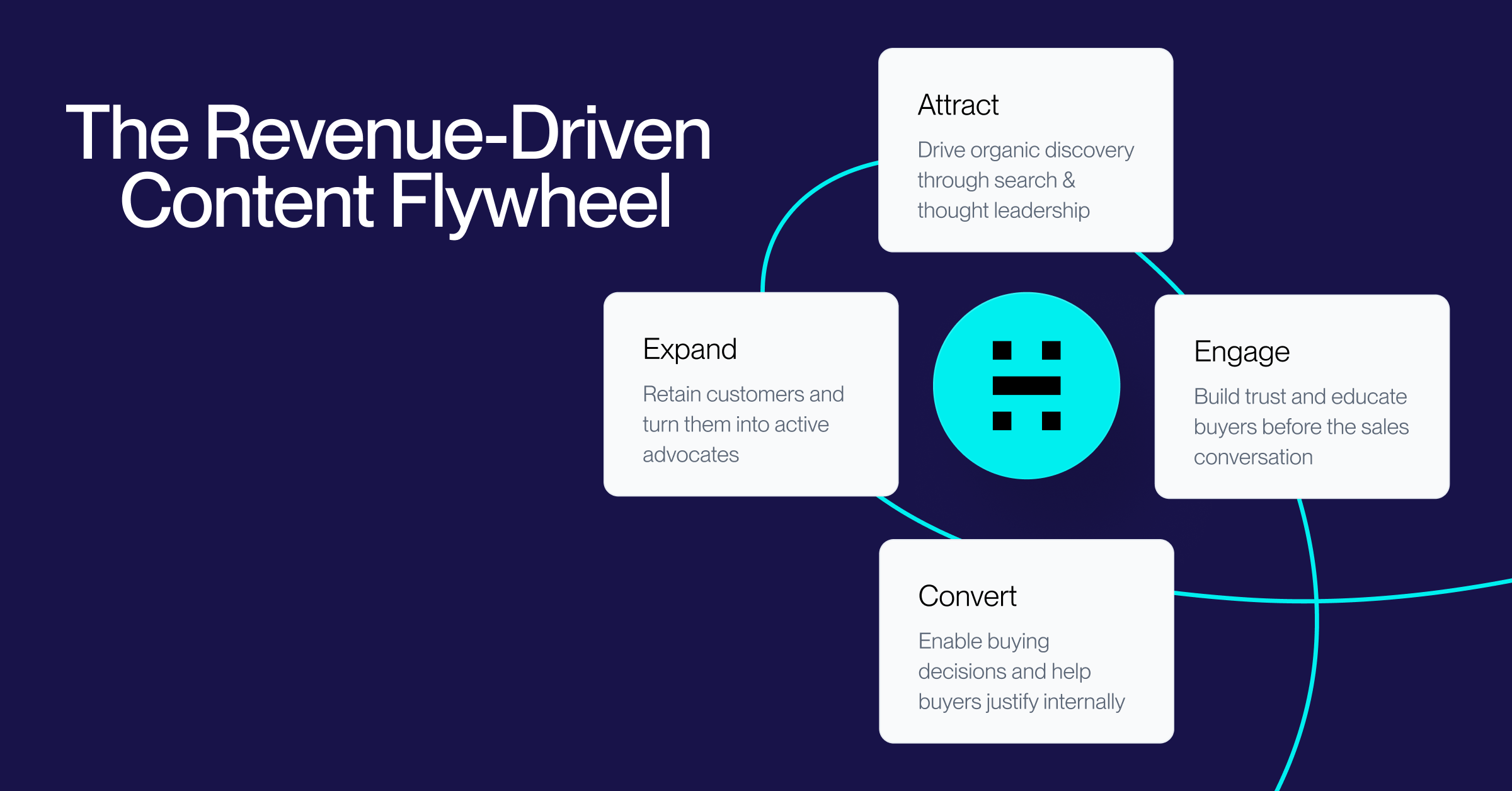

This single question spotlights the real problem: the disconnect between revenue data and the allocation of your content creation resources. A revenue-driven content flywheel aligns all assets with pipeline results, letting each piece fuel the next, while making room to let your strategic juices flow so you can repurpose content that will be cited in the LLMs your prospects use to get closer to a buying decision.
This guide breaks down how the flywheel model works, explains why traditional funnels are failing B2B marketers in the AI reality we all live in, and offers clear, concrete steps to build a system that compounds content into measurable revenue.
What is a revenue-driven content flywheel?
A revenue-driven content flywheel is a self-sustaining system in which decisions about what to publish next are guided by content that has already driven revenue. That content is then refined with insights from your subject matter experts and customer feedback. Once refined, it’s time to recycle and redistribute the content through the channels that matter to your audience, and get cited by LLMs.
Unlike a linear sales funnel that treats content as a one-time or one-sided input, the flywheel uses each company win or piece of successful content to fuel the next:
- Customer wins become case studies and G2 reviews
- How-to content or pages that drive qualified traffic become part of a video series
- Webinars that attract new prospects become podcast episodes with industry influencers your audience trusts.
Prospects engage with the content they see in several places, convert, and eventually become advocates themselves.
The idea is to pick the winners, double down, and recycle the content that is generating results. That’s the flywheel.
A flywheel gains speed as you apply force; the faster it spins, the more momentum it gains, making maintaining motion take less effort. Content behaves similarly when tied to revenue outcomes.
Traditional content marketing measures success in pageviews, downloads, and social shares. A revenue-driven flywheel built for today’s B2B audiences measures pipeline influenced, deals accelerated, and revenue attributed, and redistributes content to the channels your audience lives in and where AI consumes it, to multiply impact.
That distinction changes everything about how you plan, create, and optimize your content.
Why the content funnel model isn’t helping B2B marketers anymore
The funnel metaphor served marketers well for decades. Awareness at the top, consideration in the middle, decision at the bottom. Simple. Intuitive. And increasingly disconnected from how B2B buyers behave.
The simple truth is that AI is changing b2b buying behaviour. Your potential buyers are parsing the results of their ChatGPT research and rarely clicking through to browse your website.
That’s because the journey takes place more than ever in the places you don’t control, which means third-party review websites, podcasts, Reddit and more. AI is mopping up all this context and forming answers that influence your buyer’s decision. Thus, the top of the funnel is flowing through more dark social channels you can’t trace, and AI is eating up the middle of the funnel content. More and more B2B buyers have already made up their minds before raising their hands.
The funnel can’t capture this reality. It assumes a single buyer moves along sequential stages. The flywheel acknowledges that multiple stakeholders engage with content across various channels and recycles worthwhile content to be everywhere you need to be.
Content gets credit for traffic, but not pipeline
What’s funny is that because of the new buyer journey mentioned above, the traffic your content creates is most likely decreasing. So if you’re still measuring traffic alone, you’re shooting yourself in the foot.
Even if you manage to generate substantial traffic growth and point to 50,000 monthly blog visitors when speaking to leadership, it still doesn’t translate into pipeline or revenue they’re intent on hearing about.
The disconnect occurs because engagement data is in one system and revenue data is in another. Google Analytics tracks sessions; your CRM tracks opportunities. Without a bridge, content teams defend budgets with metrics that don’t resonate in meetings with leadership.
How the flywheel model creates compounding returns
The flywheel concept comes from physics, but it translates beautifully to content strategy. Energy stored in the system builds momentum over time.
Energy stored versus energy lost
In a funnel, you pour resources in at the top and lose potential at each stage. Visitors become leads. Leads become opportunities. Opportunities become customers. Each transition loses volume.
A flywheel works differently. Every asset that ranks, gets shared, or influences a deal adds energy as it is recycled and redistributed. That energy endures for continued results. A great example is a blog post from years ago that still drives leads. Here at Heeet, it’s the Salesforce-specific attribution content that has been moving the needle, and that’s the type of content we keep refreshing.
Momentum builds with every touchpoint
Content touchpoints create compounding value when connected properly. A blog post influences a webinar signup. The webinar influences a demo request. The demo influences a closed deal. Every engagement stores energy in the system rather than depleting it.
The keyword is “connected.” Without attribution linking touchpoints, momentum remains hidden; you only see isolated metrics that lack a coherent story.
Customers become content amplifiers
Satisfied customers share, review, and refer, organically boosting the flywheel. A single success story can influence dozens of future deals.
Here’s where the flywheel truly separates from the funnel. Funnels end at the sale. Flywheels treat the sale as another input that generates future outputs.
The four stages of a marketing flywheel
Let’s break the flywheel into stages you can implement. For each stage, set clear content goals, assign asset types, and define specific outputs you can track for effectiveness.
Attract with search and LLM-optimized content
Top-of-flywheel content is built to capture demand through search and LLM answers. This is where you can focus on the problems your buyers are searching for, not product features. For example, “How to prove marketing ROI to your CFO” attracts more qualified visitors and gets cited more than “Marketing attribution software features.”
The difference is quantifiable: problem-focused keywords not only drive better engagement, but often result in higher-value actions. For instance, writing content around “How to prove marketing ROI to your CFO” led to 50+ demo requests in a single quarter, while feature-based pages lagged behind. When your keyword strategy maps directly to results such as pipeline and demo requests, the reason for the strategic change becomes clear.
Engage through educational resources
Mid-flywheel content builds authority and trust. Webinars, comprehensive guides, and deep-dive content keep prospects returning. This stage nurtures relationships before sales conversations begin. Another resource you can pull from during this mid-stage is your sales and demo calls. What are the recurring questions you’re hearing? Are there any misconceptions you can dispel before the call that might lead to objections? For example, a recurring objection we hear in sales calls is, “We can’t prove ROI to finance.”
When you identify these real buyer concerns, you can create content specifically designed to pre-empt and address them, such as a detailed ROI calculation guide or a testimonial from a customer who overcame the same challenge. This is where you can find the type of content gold that not only educates your leads but also qualifies them and brings them closer to a decision.
Convert with bottom-funnel assets
Content that enables purchase decisions often gets overlooked. Comparison pages, pricing guides, and implementation resources help buyers justify decisions internally. Sales teams can use these assets throughout the deal cycle. This is also where you can start sharing the impressive G2 rating and comparative articles from authoritative blogs. That content can come from your blog, but the best type of comparison comes from a third-party.
Expand using customer success content
Post-sale content turns customers into advocates. Training materials, advanced use cases, and community content keep customers engaged. Happy customers generate referrals, reviews, and case studies that feed the attract stage.
What channels should you be focused on?
You need to keep in mind what LLMs are crawling to create their answers and see where your clients are at the same time. In most cases, LLMs know where your customers are and are actively seeking context from these channels to give your clients the best answer. It all starts with asking LLMs the questions your prospects are asking and seeing what’s being cited. In the B2B world, you're most likely seeing :
- G2
- YouTube
- High authority industry blogs
We think YouTube will become increasingly critical, as it’s one of the few places where AI slop won’t cut it. AI avatars aren’t the ones educating your clients. Real people with genuine emotion sharing their expertise on YouTube with long-form content that keeps prospects with you for 10 plus minutes. This is where you should make it count and recycle the content that your audience is engaging with all the way to revenue.
The next step is to ask your clients who they listen to, what videos they watch, what they read, and where. Find out who the influencers are shaping your clients' decisions, then start recycling the winning content with the right subject matter experts in the right channels. This is how you’ll find the right YouTube channels and podcasts to work with.
A practical example of content in the flywheel
Here’s an ideal source: your comprehensive blog post, written by subject-matter experts on SEO topics, which is regularly the first touchpoint in the buyer journey.
From there, you can adapt for the channels and formats you need to cover:
- video that explains the concept in full, along with some tactics the audience can use
- LinkedIn post with the YouTube video on the executive’s LinkedIn profile
- Newsletter that promotes the blog, YouTube video, and LinkedIn posts through email
- Carousel post from the blog content
Now that you have the strategy in place, it’s time to measure what drives revenue to continue feeding winning content to the flywheel shown above.
Measuring content flywheel performance with revenue metrics
Connect each content initiative to a measurable revenue outcome. Replace general web traffic metrics with KPIs like deals influenced or sales accelerated. Consistently assess and modify content efforts based on these results.
Pipeline influenced by content
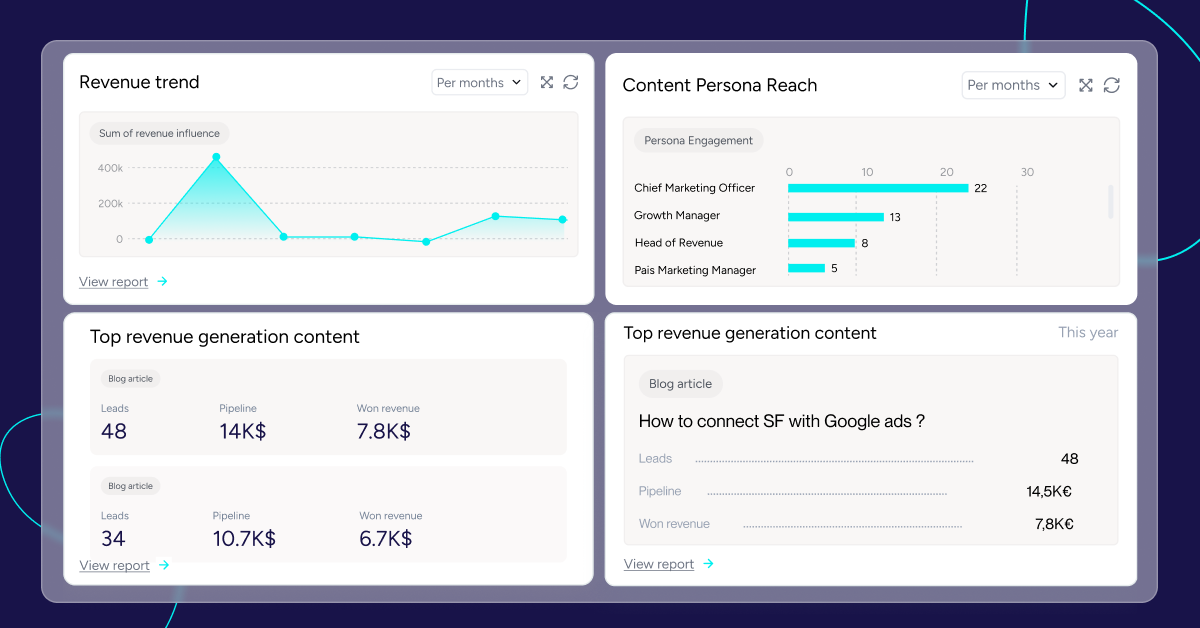
Track which content assets touched opportunities before they were created. This metric reveals content’s role in generating pipeline, not just leads.
For example: “Our comparison guide influenced $1.2 million in pipeline last quarter.” That statement holds weight in budget conversations.
Content-attributed revenue
Calculate revenue generated by content using multi-touch attribution models. W-shaped attribution works well for B2B because it credits first touch, lead creation, and opportunity creation equally.
This requires connecting content analytics to closed-won opportunities in your CRM. Without that connection, you’re guessing.
Content velocity and sales cycle impact
Measure whether content consumption accelerates deals. Do prospects who engage with more content close faster? This reveals flywheel momentum in action.
If content-engaged deals close 20% faster than non-engaged deals, you have quantifiable proof that content accelerates revenue.
Cost per opportunity by content type
Compare investment in different content types against the pipeline it generated. Blog posts might cost less to produce than webinars but generate comparable pipeline influence. This data informs resource allocation.
Identifying and removing friction in your content flywheel
Identify common friction points: heavy gating, disconnected data systems, missing attribution, or lack of coordination between teams. Remove or minimize these to accelerate the flywheel. Review processes quarterly for new bottlenecks.
Gated content that blocks momentum
Heavy gating creates friction. When every asset requires a form, you lose anonymous engagement data and frustrate buyers who aren’t ready to identify themselves.
Consider ungating more content and tracking influence differently. A prospect who reads five ungated blog posts signals intent even without filling out a form.
Disconnected content and CRM data
When content engagement data lives in one system and revenue data lives in another, you can’t measure flywheel performance. This disconnect kills momentum because you can’t optimize what you can’t measure.
CRM-native attribution platforms solve this by storing content impact data directly in Salesforce or HubSpot, where revenue data already lives.
Missing attribution across touchpoints
Without multi-touch attribution, you can’t see which content contributes to deals. First-touch and last-touch models hide the flywheel’s true contribution by crediting only one touchpoint.
Multi-touch models distribute credit across the full journey, revealing how content at each stage influences outcomes.
The technology stack for a revenue-driven content flywheel
Implement tools that link content touchpoints to pipeline outcomes. Ensure your tech stack integrates CRM data, attribution tools, and analytics to monitor, analyze, and optimize for revenue.
CRM-native attribution platforms
Attribution data belongs where revenue data lives. Platforms that integrate natively with Salesforce or HubSpot eliminate data silos and enable real flywheel measurement without complicated data pipelines.
When attribution lives inside your CRM, sales and marketing see the same numbers. That alignment accelerates decision-making.
Content analytics and engagement tools
Track consumption patterns, scroll depth, and content journeys. These tools show which content connects before conversion happens. Understanding involvement patterns helps you create more of what works.
Journey mapping and path analysis
Visualize how buyers move through content. Identify the most successful paths to conversion and double down on content that appears in winning journeys.
Sankey diagrams can show exactly which channels and content pieces your converted leads engaged with from first touch to closed deal.
Retargeting engaged leads with winning content
Loop high-performing content into your ad strategy. When you know which content influences pipeline, you can retarget engaged leads with that content across platforms and at the right funnel stage.
How to apply flywheel thinking to your content budget
Flywheel strategy changes how you allot resources.
Reallocate based on revenue impact data
Use attribution data to identify underperforming content investments. If webinars drive twice the pipeline per dollar spent as ebooks, shift resources accordingly.
Measure budget efficiency by flywheel stage
Track cost per engaged visitor at the attract stage. Cost per lead at the engage stage. Cost per opportunity at the convert stage. Optimize spend across the full flywheel rather than focusing only on top-of-funnel volume.
Aligning sales and marketing around content-driven revenue
The flywheel business model requires alignment. Sales uses content in deal cycles. Marketing needs feedback on what works.
- Shared attribution logic: Both teams agree on how content gets credit for pipeline and revenue
- Content feedback loop: Sales reports, which content helps close deals, steering future content priorities
- Joint revenue goals: Marketing measured on pipeline influence, not just lead volume
When sales and marketing share the same attribution data inside the CRM, finger-pointing decreases and collaboration increases.
Using AI to automate the content feedback loop
This is where AI will really shine. Effective content flywheels capture company knowledge and inject it into content creation. AI can automate this feedback loop when fed the right inputs.
Supplementing AI content with company knowledge sources
AI-created content lacks the experience, expertise, authority, and trustworthiness that search engines and buyers demand. The solution isn’t avoiding AI. It’s supplementing AI with the company’s proprietary knowledge.
Pull from case studies, sales call recordings, win-loss analysis, battle cards, and customer success stories stored in Notion, Confluence, or your CRM. This transforms generic AI output into content reflecting your market experience.
The 30-30-40 content creation framework
An effective balance for flywheel content creation:
- 30% AI: Ideation, structural scaffolding, and successive refinement
- 30% Company knowledge: Real customer conversations, sales objections, competitive insights
- 40% Human expertise: Strategic perspective, editorial judgment, brand voice
Building the knowledge pipeline from sales to content
Create organized processes to capture sales intelligence and route it to content creators. After deal closures, extract key objections handled and winning messages used. After lost deals, document why prospects chose competitors.
Store this in a centralized knowledge base that AI can reference during content creation. Sales insights immediately improve content, which then influences future pipeline.
From content calendar to content flywheel
The transformation from tactical content production toward strategic flywheel marketing requires a mindset shift.
Stop measuring content by output volume. Start measuring by pipeline and revenue influence. Build systems that connect content engagement to CRM opportunities. Focus on removing friction and accelerating momentum. The focus on quality, which drives real outcomes rather than quantity, will be felt in the B2B world, where content becomes the cheapest commodity thanks to AI. Your thousands of articles made for SEO don’t matter if the traffic doesn’t result in qualified sales.
What will your pipeline look like once every asset you publish spins the flywheel? Choose to build for impact, not just output, and imagine the growth your team can unlock when every content piece plays a part in driving real revenue.
When content connects to revenue inside your CRM, budget conversations change. You’re no longer defending content investment. You’re discussing how to scale what’s working.
Book a demo to see how Heeet connects content touchpoints to pipeline and revenue inside Salesforce or HubSpot.
Other articles

Multi-Touch SEO Attribution: The Best Solution?
Tracking SEO ROI is difficult. Multi-touch attribution can help measure it. Here’s how to do it.
10 Best Content ROI Tools to Prove Content Drives Revenue
Compare 10 tools that connect blog posts and assets to pipeline. Features, pricing and how each handles multi-touch attribution for content teams.

Multi-Touch Attribution Models: Calculate B2B Channel ROI (2026)
Compare multi-touch attribution models and learn the exact formulas to calculate channel ROI across your B2B funnel in Salesforce or HubSpot
.svg)
Ready to track prospects from lead to close with Heeet?
Heeet gives marketers and sales professionals at IT & Security firms turn geuss work intro informed decisions that drive revenue while meeting the same secruity technical standards you provide your clients.