

Read time :
The Real Reason Sales and Marketing Fight Over Attribution: How RevOps Can Fix It
Your sales and marketing teams have the same argument to varying degrees. The form gets filled. A demo gets scheduled. And the struggle for credit begins.



"That lead came from my outreach sequence," says the SDR. "They responded to my third email."
"Check the source field," counters marketing. "They clicked through from our paid search campaign."
Both teams pull up their dashboards. Both have data to prove their case. And RevOps is left in the middle, looking at data from both sides while the real problem goes unaddressed.
The attribution dilemma isn't a people problem. It's a tracking infrastructure problem.
IDC Research estimates that B2B companies lose 10% or more of their annual revenue due to misalignment between sales and marketing. That's not a rounding error. For a company doing $50 million in revenue, we're talking about $5 million lost.
The problem is that your attribution framework likely wasn't built for how modern GTM teams operate. And until you address it, the issue remains.
Why Marketing Struggles to Generate Net-New Leads Today
Here's something that doesn't get said enough: generating actual net-new leads has become nearly impossible for most marketing teams.
Two strategies bring this issue to light. First, account-based marketing is most likely your dominant strategy as a B2B company. Teams stopped casting wide nets and started targeting specific companies with coordinated campaigns. Second, data enrichment tools like Apollo, Cognism, and ZoomInfo became standard issue in every revenue tech stack.
The result? A predictable workflow that breaks traditional attribution.
RevOps enriches target accounts with contact data from these platforms. Sales adds those contacts to automated outreach sequences. Emails go out. LinkedIn touches happen. Calls get logged. And then, weeks or months later, someone from that account visits your website and fills out a form.
Marketing sees the form submission as an inbound lead. Sales looks at their activity history and considers the culmination of a coordinated outreach campaign. Both are looking at the same person. Both are correct about what they did. And both are wrong about what it means.
Gartner's research shows that B2B buying groups consist of five to ten people making decisions asynchronously. Multiple stakeholders interact with various channels before anyone raises their hand. Attribution can't live at the individual contact level anymore. Yet most tracking frameworks still operate like it's 2015.
Where the Attribution War Begins
Let's walk through the moment when everything breaks down.
A contact at one of your target accounts visits your site. They navigate to the pricing page. They fill out the demo request form. Salesforce creates a new lead. And now the questions start.
Sales pulls up their sequence data. This contact received three emails, one LinkedIn connection request, and a voicemail over the past six weeks. The form fill happened two days after the last email touch. From their perspective, outbound drove this conversion.
Marketing pulls up their channel data. The session source shows Google Paid Search. The UTM parameters trace back to a campaign targeting that specific industry. From their perspective, paid media drove this conversion.
Here's the thing: neither team is lying. Sales and marketing are both looking at accurate data. The disconnect is that your tracking framework forces a binary answer to a non-binary question.
Who gets credit? That's the wrong question entirely.
Why Neither Team Is Wrong: Your Tracking Framework Is
Attribution isn't a zero-sum game. Treating it like one guarantees conflict.
Think about what happened in that lead's journey. Sales activities created initial awareness. Those emails landed in an inbox, surfaced pain points, and planted a seed. Maybe the prospect didn't respond. That doesn't mean the messages had no effect.
Marketing activities reinforced that awareness. The paid search ad appeared at precisely the moment that the prospect was researching solutions. Brand recognition from the outreach made them more likely to click. The landing page addressed the same challenges mentioned in those emails.
Both functions influenced the outcome. The sale wouldn't have happened without either contribution. So why does your attribution model only acknowledge one?
The fundamental issue is that most organizations default to last-touch attribution because it's easy to implement. Last-touch tells you what happened immediately before conversion. It doesn't tell you anything about the journey that made that conversion possible.
Consider the alternatives:
First-touch attribution assigns credit to the interaction that started the relationship. Helpful in understanding awareness channels. Useless for understanding what closes deals.
Last-touch attribution gives credit to the final interaction before conversion. Simple to track. Completely ignores everything that warmed up the prospect beforehand.
Multi-touch attribution distributes credit across the entire journey. More accurate. More complex. And the only model that reflects the reality of B2B sales cycles.
For B2B companies with distinct pipeline stages, the W-shaped model offers a balanced approach that acknowledges both early awareness and late-stage conversion moments.
Alternatively, the U-shaped model works well for teams prioritizing first touch and lead creation over opportunity creation.
If your team is new to multi-touch attribution, linear attribution provides the simplest starting point by distributing credit equally across all touchpoints.
Gartner found that 64% of B2B sales reps are more likely to follow up on marketing leads when the qualification criteria are jointly agreed upon. That statistic points to something more profound: alignment starts with shared definitions. Not just about what counts as a qualified lead. About how credit gets assigned in the first place.
The RevOps Role: From Data Janitor to Strategic Arbiter
RevOps teams get stuck fixing data problems. Deduplicating contacts. Cleaning up source fields. Running reports that nobody trusts.
That's a waste of strategic potential.
RevOps owns the data infrastructure that enables attribution. They sit at the intersection of sales and marketing systems. They have visibility into both worlds. And unlike sales or marketing leadership, they don't have a dog in the fight.
That makes RevOps uniquely positioned to serve as the neutral arbiter of attribution disputes.
Three responsibilities should fall squarely on RevOps' shoulders:
Define shared qualification criteria. What makes a lead marketing-qualified? What makes it sales-accepted? Get both teams in a room and hammer out specific, measurable criteria that everyone agrees to before the arguments start.
Maintain clean, trustworthy data. Attribution disputes often stem from dirty CRM data. Duplicate records. Missing source information. Conflicting timestamps. RevOps must own data hygiene as a continuous practice, not a quarterly cleanup project.
Build attribution models that serve both teams. Stop implementing whatever Salesforce ships out of the box. You need to understand the pros and cons of the tools like Salesforce's Campaign Influence your CRM provides. Design models that give sales visibility into marketing's influence and give marketing visibility into sales' touchpoints.
Research shows that 32% of companies say creating a liaison role spanning both functions is their most effective alignment tactic. RevOps is that role. When they step into it fully, attribution stops being a battleground and starts being a shared dashboard.
The solution starts with a proper attribution setup in Salesforce and HubSpot that automates data collection and maintains consistency across teams.
What a Good Attribution Setup Looks Like
Theory is nice. Let's get tactical.
Track the Form-Fill Moment Within Outreach Sequences
Most CRMs can tell you when a contact filled out a form. Very few can tell you where that action falls relative to sales touchpoints.
Did the conversion happen after step two of the outbound sequence? After the bump email? After the LinkedIn touch? That context matters enormously.
When you can pinpoint precisely when a form fill occurred relative to sales activity, you unlock new insights. You can identify which sequences perform best. You can segment that performance by territory, persona, or industry. And you can have honest conversations about shared credit that are grounded in real data.
The outcome isn't declaring one team the winner. The outcome is understanding how coordinated efforts produce results.
Notify Sales Properly When Existing Contacts Convert
This sounds basic. Many organizations still get it wrong.
A contact already exists in your CRM. They're assigned to an account owner. Marketing runs a campaign. The contact converts. And then? A duplicate lead gets created. The original record doesn't update. The account owner never gets notified. And attribution goes to a phantom record that nobody follows up on.
Clean RevOps workflows should update the existing contact record, maintain the complete touchpoint history, and trigger alerts to the right rep immediately. Broken workflows create attribution chaos and tank your speed-to-lead metrics.
Feed Real Conversion Data Into Analytics and Ad Platforms
Here's where most marketing teams leave money on the table.
You run paid campaigns. Someone books a demo. You fire off a "Demo Booked" event to GA4, Google Ads, and LinkedIn. The algorithms optimize toward that conversion. And then you wonder why your cost per qualified opportunity keeps climbing.
Demo booked isn't a business outcome. It's a hand-raise. Plenty of demos get booked by people who will never buy. Training your ad platforms to find more of those people doesn't help anyone.
Instead, delay your actual conversion activation until you hit a downstream milestone. Wait for the demo to get completed. Wait for the opportunity to get created. Wait for the deal to close. Then push that revenue event back to your ad platforms.
The algorithms get smarter. Your bidding optimizes for people who look like your closed-won customers, not tire-kickers. Marketing can prove real ROI. And sales stops complaining that the leads are garbage.
Building Shared Goals That Work
Technology fixes only go so far. At some point, you have to address the incentive structures.
Marketing teams get measured on MQLs. Sales teams get measured on closed revenue. Those metrics create fundamentally different priorities. Marketing optimizes for volume. Sales demand quality. And the conflict becomes structural.
The fix requires laddering both teams' KPIs up to a single revenue metric.
Some examples that work:
Marketing-influenced pipeline measures the percentage of open pipeline that had at least one marketing touchpoint in its history. It gives marketing credit for influence without requiring them to source every deal.
Sales-accepted lead rate tracks the percentage of marketing-generated leads that sales agrees to work with. It creates accountability on both sides. Marketing has to send quality. Sales has to give genuine feedback on what isn't working.
Average deal cycle time measures how quickly leads convert from first touch to closed-won. Both teams can influence this metric. Both benefit when it improves.
LinkedIn's Global Product Marketing Leader put it well: "The places I've seen sales and marketing alignment work most effectively are when goals are tied together, and teams look at revenue metrics across both functions."
Separated KPIs create separated teams. Unified revenue accountability creates shared success.
Shared Attribution Means Shared Success
Sales and marketing don't need to compete for credit. They need to align on the same data, touchpoints, and conversion signals.
Teams realize they need attribution software to automate this complexity rather than manage it manually in spreadsheets.
With the proper RevOps infrastructure, attribution becomes a strategic tool rather than a political battleground. Instead of arguing about who sourced a lead, teams can analyze which combinations of activities produce the best outcomes. Instead of hoarding credit, they can coordinate efforts based on the data.
Modern GTM success is rarely the result of a single touch. It's the combined influence of coordinated efforts across multiple channels and stakeholders. Your attribution models should reflect that reality.
The goal isn't to prove that sales or marketing "won" the lead. The goal is to understand how both teams drive revenue, and build systems that make their efforts visible, measurable, so future budget is justifiable.
Stop the in-fighting in your attribution reports. Start building frameworks that tell the whole story.
Other articles
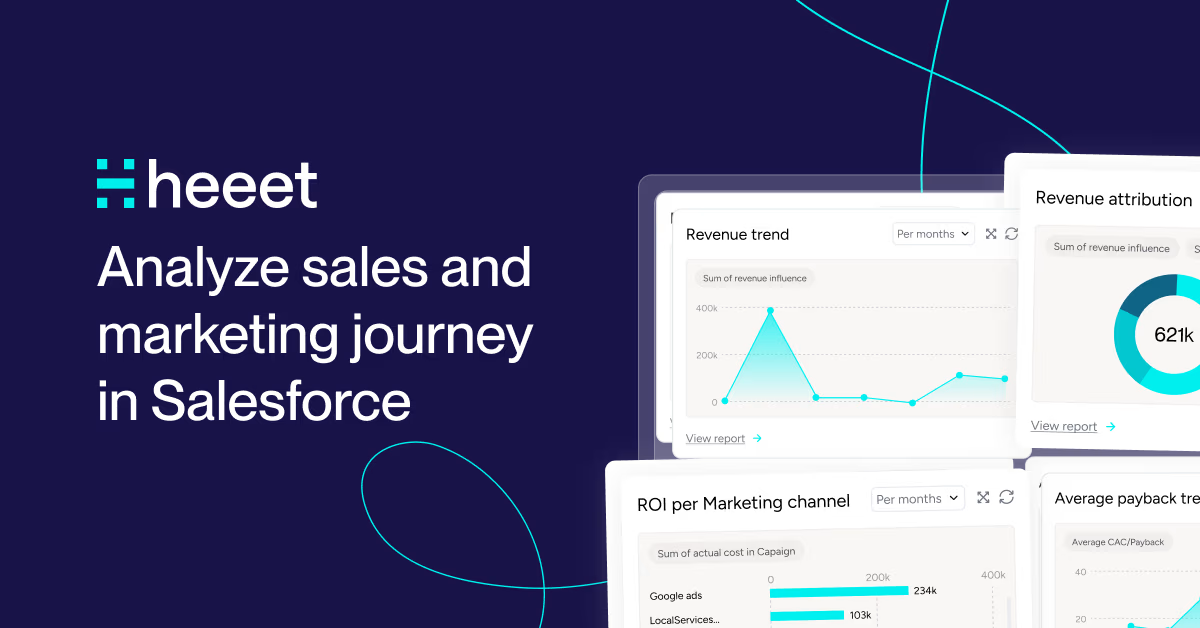
Analyze sales and marketing journey in Salesforce
Due to lack of data, understanding what is the typical funnel to close an opportunity is usually quite hard in Salesforce.
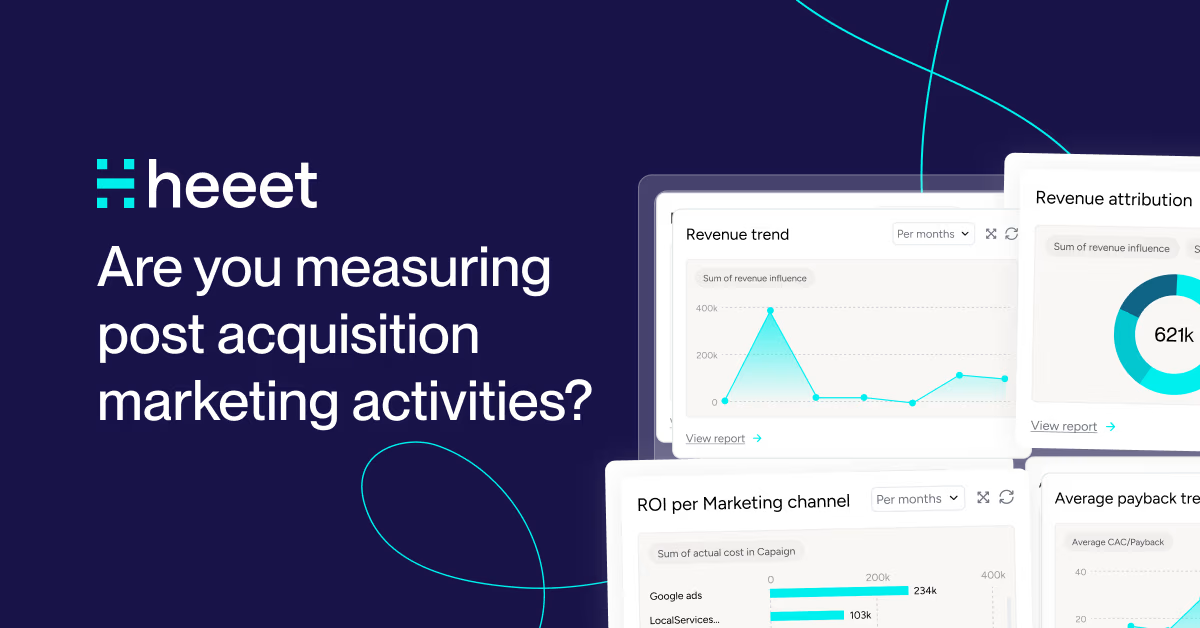
Are you measuring “post acquisition” marketing activities?
Pre Acquisition activities are all the activities happening before the record is created in Salesforce. Post Acquisition activities are all the activities happening after the record is created in Salesforce.
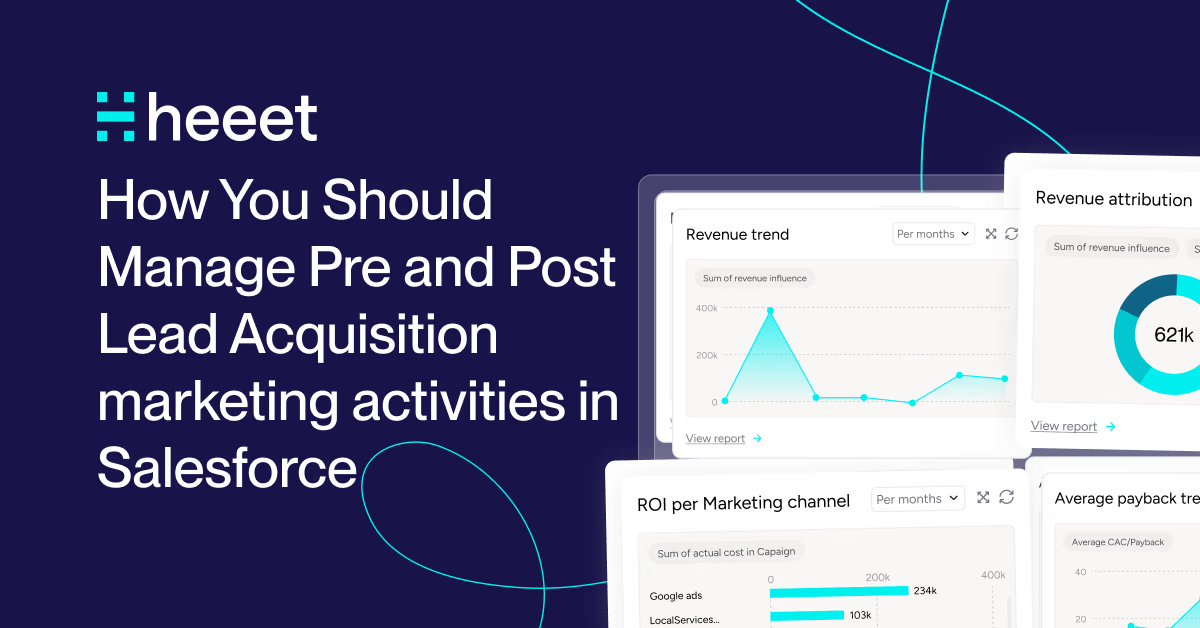
Managing Pre and Post Lead Acquisition marketing activities in Salesforce
Track both pre and post lead acquisition activities in Salesforce. Measure true campaign ROI and full customer journey attribution
.svg)
Ready to track prospects from lead to close with Heeet?
Heeet gives marketers and sales professionals at IT & Security firms turn geuss work intro informed decisions that drive revenue while meeting the same secruity technical standards you provide your clients.