
Read time :
Blended B2B Attribution Setup: Why Self-Reported attribution is in Your Star-Studded Cast
Discover how blending self-reported attribution, sales interviews, and multi-touch tracking reveals more of the B2B buyer journey than any one tool on it's own, and start including the 70% hidden in the dark funnel in your journey analysis. Learn a practical framework to measure what cookies can't.

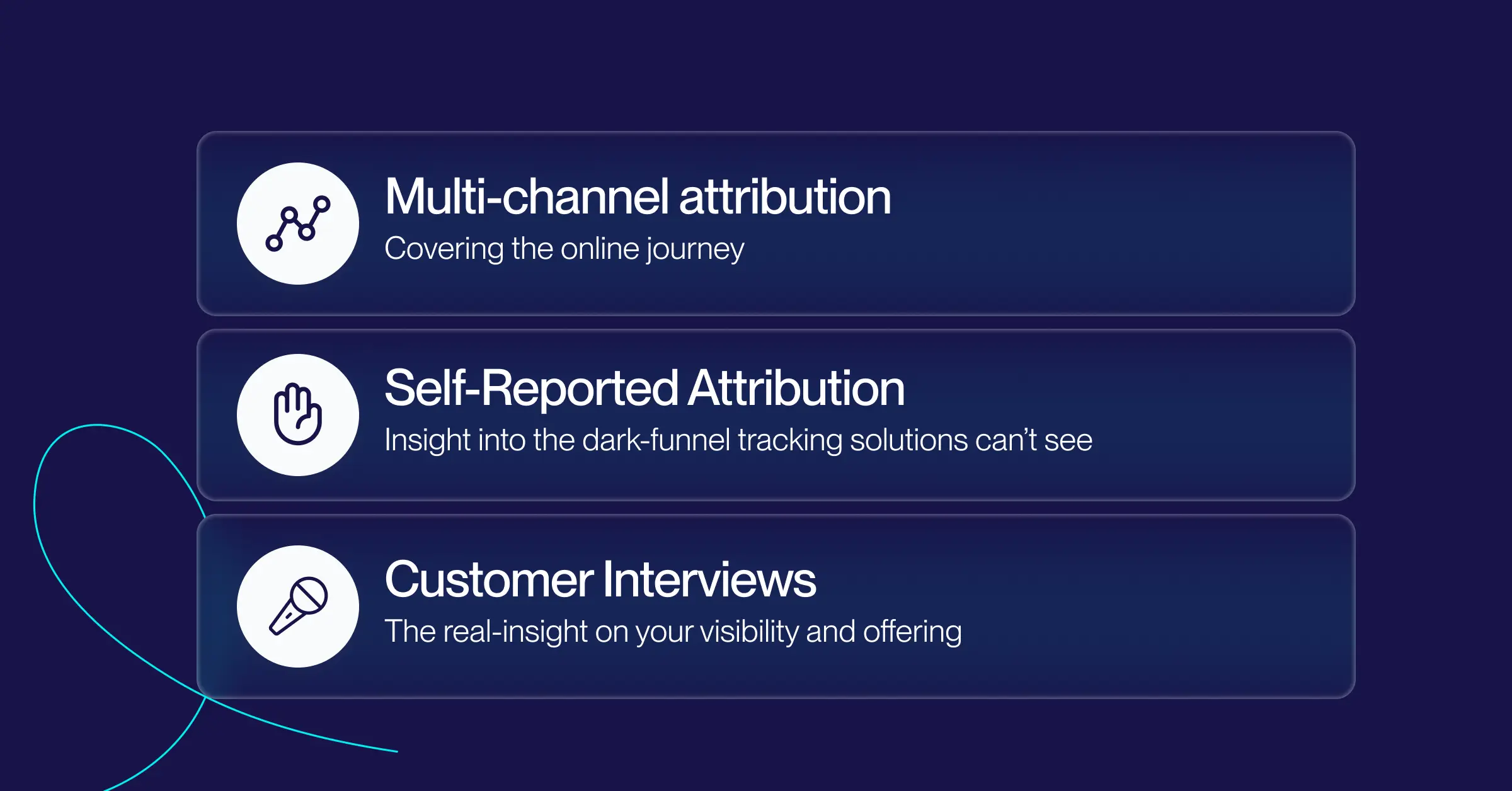

Sometimes you need to go analog to get to the bottom of your attribution headaches.
You can have tracking set up across every channel, convert a high-value lead, and still discover during the demo that someone they trust mentioned you in a podcast.
Your CRM shows they came from a branded Google search. They later clicked through on a LinkedIn post, read four blog posts over the next month, and viewed documentation before finally making a demo request from direct traffic days later.
That’s a fast journey by B2B standards, but we saw it in our funnel last week. Not coincidentally, we sponsored a podcast that our audience appreciated a few months earlier.
Clearly, your tracking provides detailed insights, but it cannot uncover every true lead source on its own. Recognizing the limitations of digital tracking is key to understanding where additional input is needed for accurate attribution.
Up to 70% of the B2B buyer journey now happens in the “dark funnel,” often before your brand is contacted: private Slack messages, podcast mentions, WhatsApp forwards, LinkedIn DMs, and real-life conversations. Also, 84% of B2B content sharing occurs through private channels inaccessible to traditional analytics tools.
Your attribution model isn’t lying to you. It’s just telling you part of the story.
As Romain Blanc, Co-founder of Heeet and a Salesforce ecosystem specialist with 20+ years in B2B data solutions, puts it: “The only way to accurately calculate cost in B2B is to capture the engagement with content throughout the buyer journey, which conventional attribution models don’t credit.”
So how do you tell the whole story? You assemble a cast.
Why Your Attribution Needs a Cast, Not a Solo Act
The Oscars reminded us that a great film isn’t the work of a single actor. It takes a lead, a supporting cast, a director behind the scenes, and dozens of crew members who go unseen on screen. The same is true for B2B marketing attribution.
No single attribution model, tool, or method captures the entire buyer journey. A multi-touch attribution platform won’t tell you if a buyer’s colleague forwarded your case study in a group chat. A self-reported form won’t show the blog posts they read before booking a demo. Your sales team won’t always hear how a prospect first heard about you at an industry event three months ago.
This isn’t just a theoretical problem. Heeet often hears from B2B marketing teams running demos. Prospects describe a “black box” after the MQL handoff. Teams can track lead generation, but once sales takes over, marketing loses visibility into how campaigns, events, and content influence open opportunities.
You need a blended approach: a full cast playing individual roles, to reveal the real picture. By combining multiple attribution methods, you uncover more actionable insights.
Here’s who’s in the lineup.
Enter Stage Left: Self-reported Attribution
Role: The Character Actor
Self-attribution isn’t flashy, but it reliably captures essential information in every lead interaction.
Self-attribution is the field on the form. It’s the simple question, “Where did you first hear about us?” Answers aren’t always accurate. Sometimes respondents default to “Google” because it’s easy. Still, the responses often reveal valuable insights.
This is the only tool in your stack that can surface dark social and dark-funnel touchpoints: the podcast mention, the Slack recommendation, the conference conversation, and the LinkedIn DM from a peer. None of these leaves a cookie. None of them fires a pixel. But they’re often the actual reason someone is sitting in your pipeline.
As Heeet’s team explains, dark social refers to sharing that happens in private channels: Slack conversations, WhatsApp messages, email forwards, and podcast recommendations. Attribution software sees none of it. Neither software nor self-reported data tells the full story, so combining both gets you closer to accurate, complete answers.
How to get the most from self-attribution
Keep the question open-ended. Drop-down menus with pre-set options defeat the purpose. You want to hear “my VP forwarded your newsletter” or “saw you on [podcast name],” not “social media.”
Make it required but forgiving. Set it as a required field on high-intent forms (e.g., demo requests, contact forms), but optional on lower-intent ones (e.g., content downloads). You want a quality signal, not forced guesses.
Let responses come in raw. Tag and categorize them weekly or monthly. You’ll see patterns—specific communities, podcasts, or people mentioned repeatedly.
When someone says they heard about you on a podcast, but your CRM shows a LinkedIn touchpoint, you haven’t found a contradiction. You’ve discovered a full story: the podcast created awareness, LinkedIn nurtured it, and the demo request converted it.
Enter Stage Right: Sales Calls and Client Interviews
Role: The Director’s Commentary
If self-attribution is the character actor who reveals dark social, sales conversations are the director’s commentary—the behind-the-scenes footage that shows you why the story played out the way it did.
This isn’t just about understanding your lead sources. It’s also a chance to learn where your ICP consumes content and which voices they trust. Working some questions into your initial setup call with new clients gives you attribution intelligence that no tool can replicate.
Questions to build into discovery and onboarding calls
- “Are there any B2B communities, networks, or voices in the industry that mentioned us?” This surfaces the influencers, micro-communities, and word-of-mouth channels that drove awareness you’d otherwise never know about.
- *“What content along the journey gave you the most value? Podcasts, event workshops, webinars, case studies?” This reveals which formats move the needle, not just which get clicks.
- “What steps did you take when looking for a solution like ours?” This reveals the buying process: Did they start with Google, ask peers in Slack, check G2 reviews, or look at competitor comparisons? Understanding this motion helps you invest in the right channels.
- “What was the internal conversation like when you evaluated us?” This uncovers objections, competitor comparisons, and key stakeholders. This insight improves your messaging, content strategy, and attribution.
- “Was there an exact moment or piece of content that tipped the decision?” Sometimes there’s a single trigger: a case study that matched their use case, a podcast where the host vouched for you, a conversation at an event. This is your highest-signal attribution data point.
Why this matters beyond attribution
Every customer interview is a two-for-one. You get attribution data, and you get market intelligence: where your ICP hangs out, which formats they prefer, which competitors they evaluated, and what messaging resonated. This feeds back into your demand gen strategy in ways no dashboard can.
Center Stage: Your Online Multi-Channel Tracking Solution
Role: The Lead Actor
This is the star of your attribution cast: the multi-touch, multi-channel tracking and marketing intelligence platform that collects the online footprints across the entire customer journey.
Whether you use Salesforce or HubSpot attribution, a CRM-native integration like Heeet, or UTM and GA4 tags, this system reveals which channels, campaigns, content, and touchpoints drive pipeline and revenue.
This is where you see the full digital journey: the organic search that started it, the LinkedIn ad that re-engaged them, the four blog posts they consumed, the pricing page they visited three times before finally requesting a demo.
What your tracking gives you that nothing else can
Journey mapping at scale. Self-attribution and sales conversations give qualitative depth but don’t scale. Your tracking platform shows patterns across hundreds or thousands of leads going through the channels that drive pipeline, drop-off points they hit, and the best-converting content they visit on a revenue driving journey.
Attribution modelling flexibility. First-touch, last-touch, linear, time-decay, W-shaped, U-shaped, all these models tell you different things. First-touch reveals what creates awareness. Last-touch reveals what closes deals. Multi-touch shows the full picture. As Romain Blanc notes: “Attribution model selection comes down to one question: what are you trying to optimize?” Use them in combination, not in isolation.
You can’t wait for quarterly customer interviews to decide if a LinkedIn campaign is worth running. Tracking data lets you optimize spend, pause underperforming channels, and double down on what works on a weekly basis not quarterly.
The best attribution tools connect touchpoints directly to closed-won revenue, and not just leads or MQLs. This allows you to say, “This campaign influenced $400K in pipeline,” rather than “This campaign generated 200 leads.”
The tracking blind spots you need to accept
No matter how robust your implementation, digital tracking always has blind spots that limit full visibility into buyer journeys. Awareness of these limitations is necessary for an effective attribution strategy.
- Cookie deprecation and consent rules make a growing share of journeys untrackable at the individual level. Safari and Firefox already block third-party cookies, and Chrome’s changes continue to evolve.
- Dark social sharing, such as someone forwarding your content via Slack, email, or text, shows up as “direct traffic” in your analytics.
- Multi-device journeys break tracking when someone reads your content on mobile and converts on desktop.
- B2B buying committees mean multiple people are researching your product, but only one fills out the form. Your tracking sees one journey; reality had five.
This is precisely why tracking alone isn’t enough. It’s the lead actor, not the entire cast.
The Questions Your Blended Cast Should Answer
After working with hundreds of B2B marketing teams, Heeet has identified the recurring questions that drive most attribution frustrations. When you assemble your blended cast correctly, you should be able to answer each of these:
“How do I prove marketing’s influence on sales-sourced deals?”
This is the #1 pain point. Marketing teams can track lead generation, but once the MQL handoff happens, visibility goes dark. Your blended approach solves this: multi-touch tracking captures post-handoff touchpoints (blog visits, email opens, webinar attendance on existing contacts), while sales conversations confirm which content or channels influenced the deal’s progression.
Romain Blanc explains why this matters: “SEO plays a large role in future conversions.” Prospects continue engaging with your content throughout the sales cycle, and conventional attribution models don’t credit that influence.
“How do I measure the ROI of events, webinars, and offline touchpoints?”
Events are often the biggest cost center yet the hardest channel to attribute revenue to. Leads arrive via Excel imports, not forms, breaking standard tracking. This is where your blended cast earns its keep:
- Self-attribution captures “I met your team at [event]” responses
- Sales calls uncover which event conversations influenced the deal
- Multi-touch tracking connects post-event digital engagement (e.g., follow-up emails clicked, content downloaded) to the pipeline.
Without blending all three, you’re left guessing whether that $50K trade show booth was worth it.
“How do I connect ad spend to actual pipeline and revenue — not only clicks?”
Paid media teams live in platform dashboards showing CPCs and click-through rates, but those numbers don’t match what’s in your CRM. Blended attribution bridges the gap: your tracking platform connects ad clicks to downstream pipeline and revenue, while self-reported attribution captures when prospects say “I kept seeing your LinkedIn ads.” This is a signal that can’t be measured in impressions alone. Companies without a first-party data strategy may spend 10-20% more on marketing to achieve the same returns.
“How does attribution work when 10 people research before one deal closes?”
Enterprise B2B deals involve multiple contacts within an account, each doing independent research. Your tracking sees distinct journeys, but the buying decision is collective. This is where account-level attribution comes in, rolling up touchpoints from all contacts to the opportunity level rather than tracking individuals in isolation. When combined with sales conversations that reveal who else was involved internally, you get the full picture of how the committee moved from awareness to decision.
As Romain notes: “B2B buying isn’t that simple. Some journeys involve hundreds of touchpoints and multiple stakeholders.”
Your Star-Studded Attribution Cast: The Full Picture
The truth of the matter is that you need a cast of tools, each with its own unique role, to help you fully understand what brought in the eyes that filled out the form.
Think of it like the ensemble cast that wins Best Picture. Each player has a role:
Self-attribution gives you the top-of-funnel confirming insights on dark social sources you can optimize. It answers the question your CRM can’t: what actually planted the seed?
Your marketing intelligence tool, which tracks online engagement, gives you the meat and potatoes of the customer journey. It shows you the nurture path from awareness to conversion, at scale, with revenue attached.
Talking to your customers gives you the best insight into how they encountered your solution, how they compared it to competitors, and the feedback or pushback they received internally when trying to get buy-in for it. It’s the richest data source you have. You just can’t automate it.
How to Implement Your Blended Attribution Framework
Assembling the cast is one thing. Directing them is another. Here’s how to put everything together.
1. Start with self-attribution today
Add a “How did you first hear about us?” open-text field to your demo request and contact forms. This takes five minutes and will start generating a signal immediately. Don’t overthink it. Just ship it.
2. Build interview questions into your sales process
Work with your sales team to add 2-3 attribution questions into discovery and onboarding calls. Make it part of the script, not an afterthought. Share the insights in a collaborative doc or a CRM field so marketing can access them.
3. Audit your multi-touch tracking
Ensure your attribution platform captures touchpoints across channels and connects them to the pipeline and revenue, not just leads. If you’re only tracking first-touch or last-touch, you’re leaving the middle of the journey in the dark. As Romain explains: “The foundation has shifted, and many traditional implementation approaches no longer work.” Cookieless, CRM-native attribution ensures you retain visibility regardless of browser settings or privacy changes.
4. Create a monthly attribution review
Pull together self-reported data, interview insights, and platform data into a single view. Look for patterns:
- Are buyers consistently referring to a channel your tracking can’t see?
- Is a specific content format appearing in interviews but not receiving credit on your platform?
- Are there channels that get all the credit digitally but never come up in conversation?
5. Use the blended picture to make investment decisions
This is where it all pays off. When you know that your podcast sponsorship is consistently surfacing in self-reported attribution, your blog content is driving the mid-funnel nurture your platform tracks, and your customers are telling sales they evaluated three competitors before choosing you, you have the full story.
You can justify the investment in channels that can’t be tracked with cookies. You can show leadership that the podcast sponsorship isn’t “unmeasurable.” It’s measurable from a different perspective. And you can allocate the budget with confidence rather than guesswork.
The Standing Ovation
The best B2B marketing teams in 2026 aren’t arguing about whether marketing or sales “sourced” a deal. They’re not defaulting to last-click because it’s easy. And they’re not cutting podcast budgets because they can’t prove ROI in a dashboard.
They’re assembling their cast. They’re blending the quantitative discipline of multi-touch tracking with the qualitative depth of customer conversations and the dark-social illumination of self-reported attribution.
Because in B2B, the buyer journey has never been a solo performance. It’s an ensemble production. And the teams that measure it that way are the ones that take home the award.
Your CRM is telling you part of the story. Self-attribution tells you the part it can’t. And your customers will tell you the rest if you ask.
Other articles
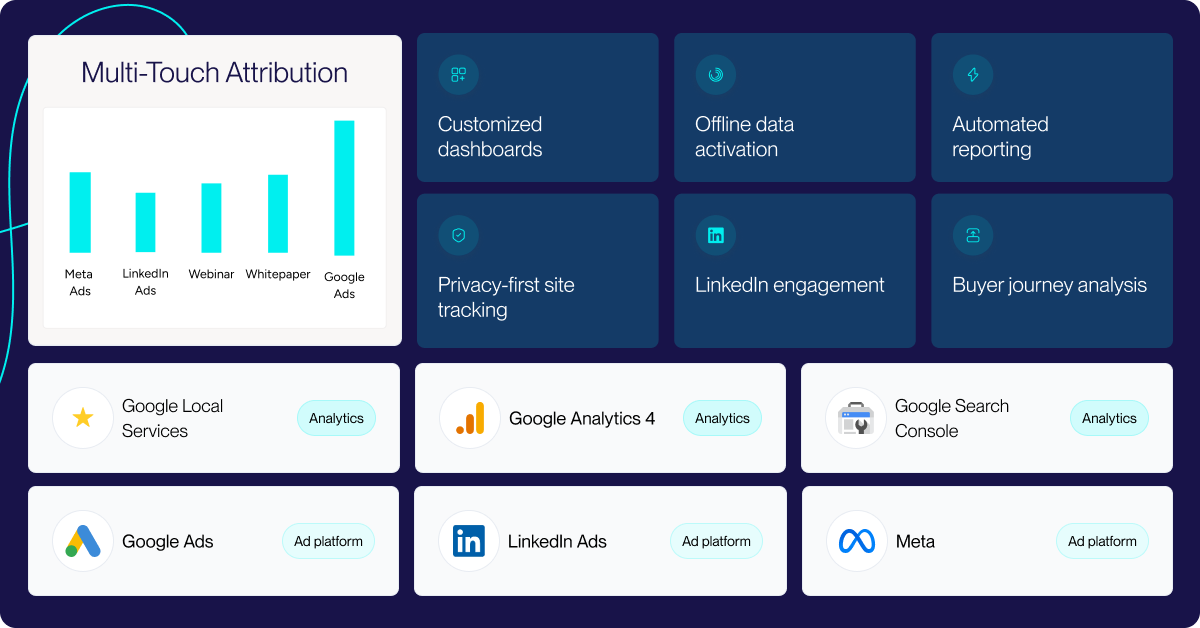
15 Best Marketing Attribution Software in 2026 - Reviewed & Ranked
We compared 15 marketing attribution software on pricing transparency, Salesforce & HubSpot integration depth, attribution models, and cookieless readiness. Honest scoring, real pricing, and a decision framework for B2B marketing, RevOps, and GTM teams.
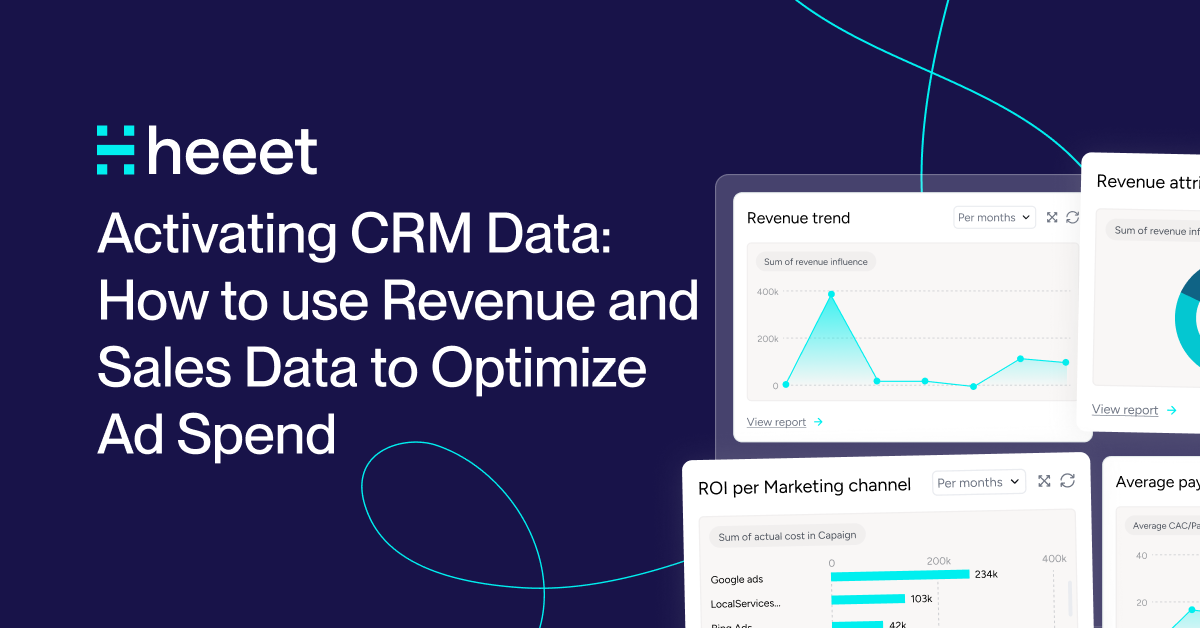
Activating CRM Data: How to Use Salesforce & HubSpot to Optimize Ad Spend
Learn how to activate Salesforce and HubSpot CRM data in Google Ads to optimize ad spend. Send Closed Won revenue data, create MQL lookalike audiences, exclude unqualified leads, and improve ROI with first-party data activation.
AI Search Visibility: How to track the revenue impact of brand mentions
Learn to track and measure AI search ROI with proven GEO strategies. Complete guide to LLM mentions attribution, revenue tracking tools, and conversion optimization for B2B success.
.svg)
Ready to track prospects from lead to close with Heeet?
Heeet gives marketers and sales professionals at IT & Security firms turn geuss work intro informed decisions that drive revenue while meeting the same secruity technical standards you provide your clients.