
Read time :
Branded vs Non-Branded Keywords: How to Measure the ROI of Both Strategies
Branded vs non-branded search behave differently in B2B, and last-click ROAS misjudges both. See what each really does and how to attribute them to revenue.

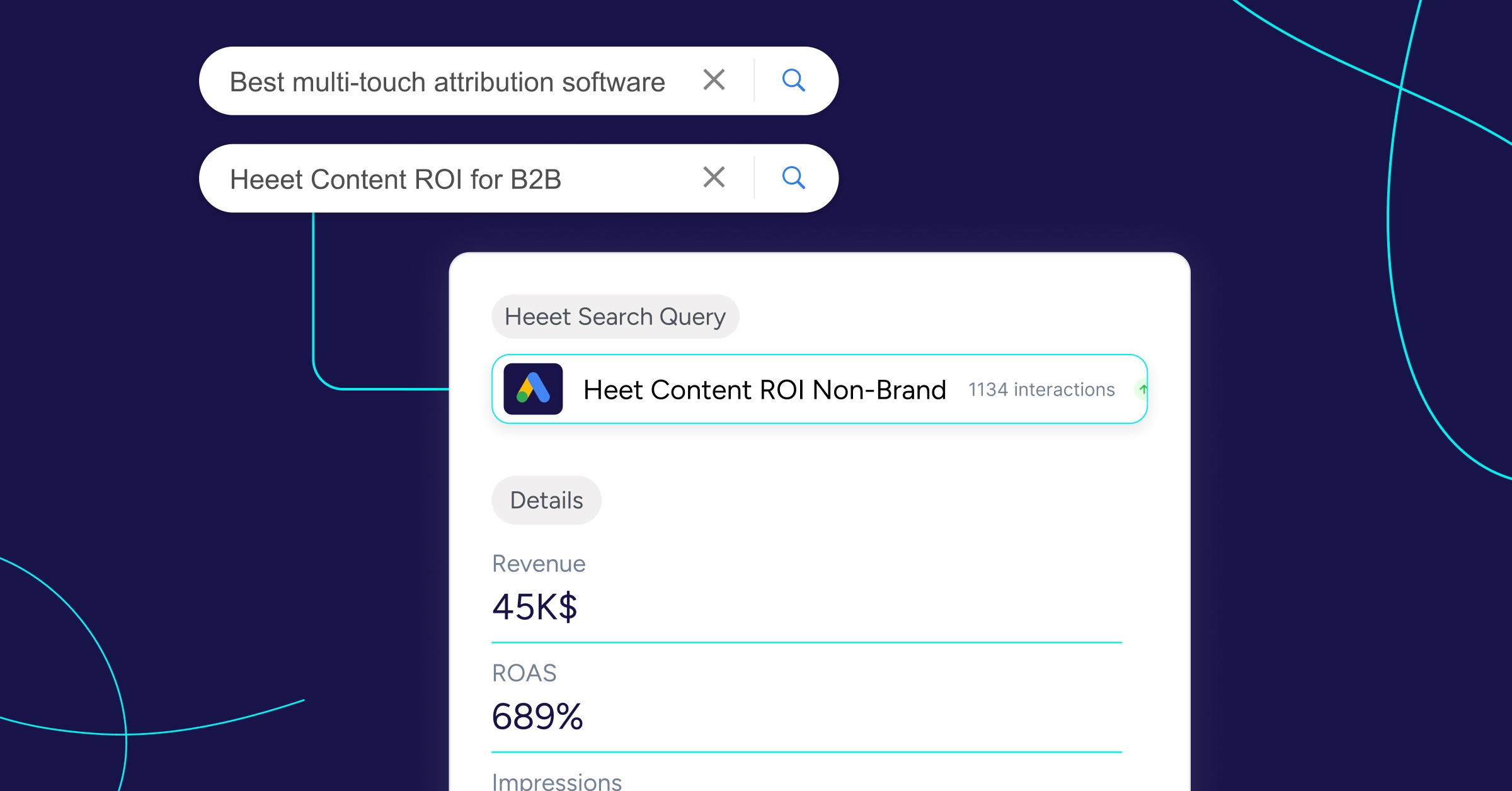

Branded vs non-branded keywords in your Google Ads campaigns strike a revenue divide that comes to a head when the reporting comes in. When you compare the cost and ROAS of both categories, branded keywords always pull ahead and seemingly prove that's where you should shift budget.
That's not the insight you should take from the reporting. It's a framing issue. One category is working on Demand Capture and the other on Demand Generation—two very different strategies with two different costs attached.
In this article, we zoom in on the two strategies, our personal experience driving and capturing demand from search ads, and what reporting you should have in place to understand their impact on revenue separately.
What is the difference between branded and non-branded search?
Branded search is any query that contains your company or product name, like "Heeet pricing" or "Heeet Salesforce attribution." Non-branded search is everything generic: the category and pain problem queries a buyer types before they know who you are, like "B2B attribution software" or "how to connect Google Ads to Salesforce." The first captures demand. The second creates it.
That demand-capture versus demand-creation distinction matters more than the wording suggests, so it's worth sitting with.
When someone searches your brand name, something already happened; it's a result of your other go-to-market motions. They went to an event, read a comparison, saw a LinkedIn post, sat in on a demo, heard about you from a peer. They're not discovering you at that moment. They're trying to find you.
Non-branded searches sit earlier in the funnel
Here’s a quick example: a lead typing "multi-touch attribution vs marketing mix modelling" isn't shopping for a vendor. They're learning about a category, building a list of features they need, deciding what tool is best for their org. The brands that show up in that key discovery moment shape the initial criteria the buyer will use to compare solutions.
Here's how the two compare across the things that drive a buying decision:
Notice none of those rows is "which one drives more revenue." That question doesn't have a clean answer at the keyword level, and pretending it does is where most B2B search reporting goes wrong.
Branded search looks so much more profitable
Branded search reports a return many times higher than non-branded. Ten to one isn't unusual; sometimes the gap is much wider. Stare at that number long enough, and the conclusion writes itself: pour more into branded, starve the rest. It's the wrong read, and the reason is incrementality.
Incrementality frames the question of ROI differently by asking "how much of that revenue would have happened anyway, with no ad at all," instead of "how much revenue is attached to the branded click". For branded search, the honest answer is often most of it.
A decade-old experiment at eBay, conducted by economists Thomas Blake, Chris Nosko, and Steven Tadelis, who switched off paid search on the company's own brand terms, showed that brand-keyword ads produced "no measurable short-term benefits." Traffic that used to arrive via the paid brand ad instead walked through the organic result. The ads had looked wildly profitable in the reports. Their true incremental contribution was close to zero, because eBay already ranked first organically for its own name.
Google's own research points the same way. Its meta-analysis of Search Ads Pause studies found that across advertisers, about 89% of search ad clicks are genuinely incremental. But the same research notes branded queries, where your organic listing already sits at the top, show a much lower incremental share, because without the ad, people click the organic link right below it. Microsoft's brand-bidding studies put rough numbers on the cannibalization: somewhere between 11% and 18% of brand ad clicks would have gone to the organic result anyway.
So a chunk of every branded search "win" is a click you already owned, repriced as paid. That doesn't make brand bidding pointless. Defending your name against competitors who bid on it is a real reason to show up. It's what some call the "Google Tax".
Non-branded search serves the purpose of generating demand. Unfortunately, this means its revenue influence is often hidden behind whatever touch came last, usually a brand search or a direct visit. The generic query that started everything gets nothing.
Branded search is demand capture. Non-branded is demand creation.
Strip away the keyword mechanics, and you're left with two different jobs. Branded search captures existing interest in your brand. Non-branded search, along with content, social, events, and the rest of the top-of-funnel, shapes intent in the first place.
The Ehrenberg-Bass Institute gave this a number that's worth taping to your monitor. At any given moment, only about 5% of B2B buyers are in-market. The other 95% aren't buying anything soon, no matter how good your ad is. Branded search lives almost entirely inside that 5%, because you can't search a brand you've decided to evaluate until you've heard of it and decided to evaluate it. Non-branded search and brand-building are how you reach the 95% who'll enter the market next quarter, or next year, and remember you when they do.
There's a tell that makes this concrete. When your branded search performance climbs, it most likely because something upstream worked. That something could be your unbranded campaigns or even your organic SEO working its magic. In our experience with Google Search Ads at Heeet, non-branded search terms or queries often lead to a branded search campaign click that closes months later. We’ve also seen the branded search campaigns cannibalize some of our organic SEO leads coming from traffic that ordinarily flowed from our Salesforce-focused blog content. Lesson learned. Searching for incrementality could very well lead to cannibalization of organic revenue influence.
We watch this pattern constantly. One of the more useful habits everyone should pick up early on is the On/Off incrementality test:
Try pausing an upper-funnel channel, if your branded search volume doesn't move, that channel probably isn't pulling its weight. If branded searches dip a few weeks later, you just found a demand-creation engine your last-click report was crediting to "brand."

Last-click attribution is burrying your non-branded search
Last-click doesn’t credit early touches like clicks from non-branded search. Last-click attribution gives 100% of the credit to the final trackable interaction before a deal. In a B2B journey, that final touch is almost always a brand search, a direct visit, or contact with sales. So last-click doesn't measure which channel worked. It measures which channel tends to show up last. Branded search shows up last constantly. Non-branded rarely does.
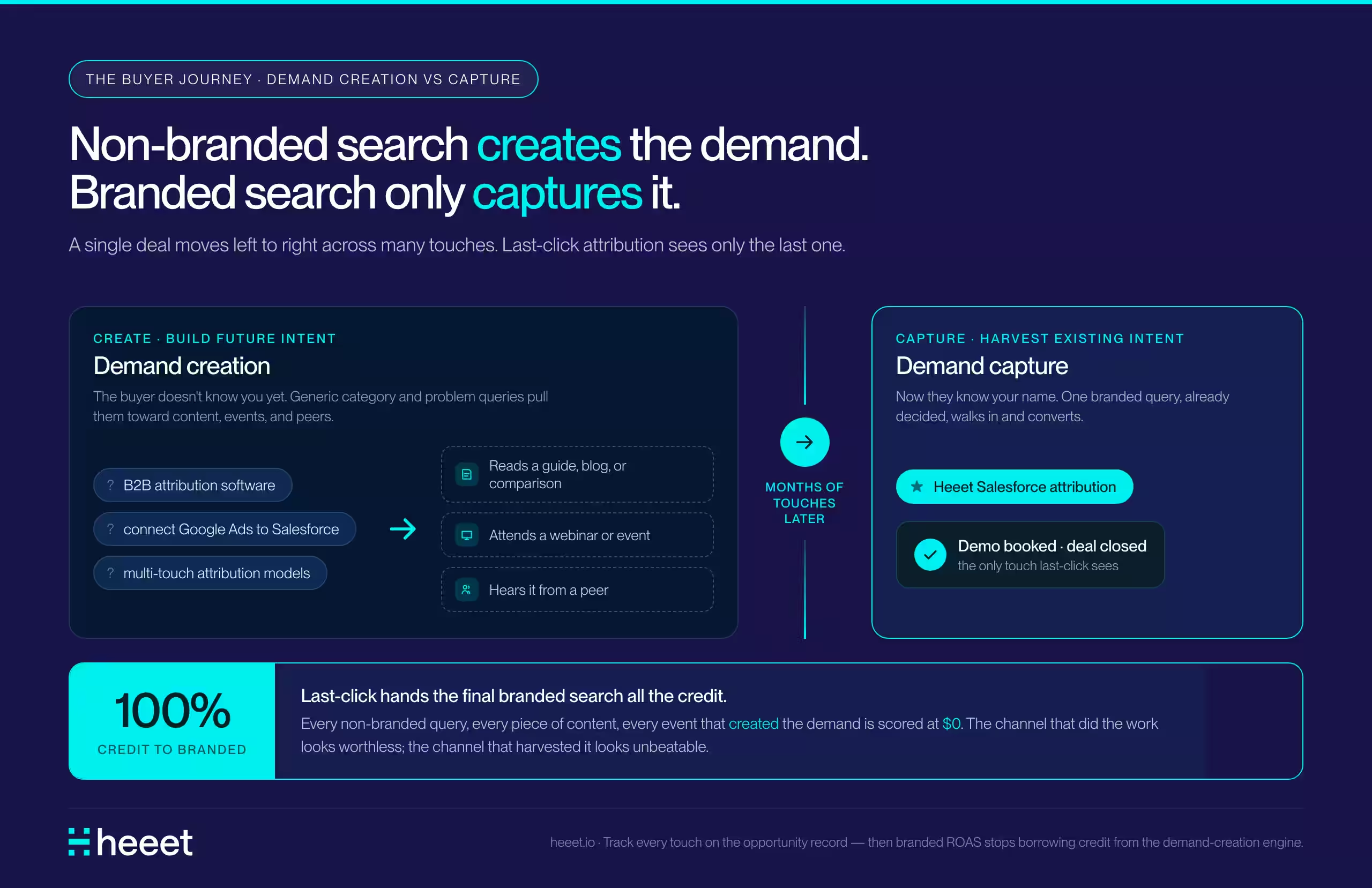
The mismatch gets severe because B2B journeys are long and crowded. A single deal might start with three different stakeholders typing three different non-branded questions over two months, and finish with one of them searching your brand name the day before they fill out the form.
Last-click hands that entire deal to the brand search. The 26 touches that built the case, including every non-branded query that introduced you, get zero.
You don't fix that by arguing about it. You fix it by testing and changing what you measure.
How to attribute the influence of branded and non-branded search
The goal isn't a prettier ROAS column. It's to see, per query and per channel, how much real pipeline and revenue each one influenced across the whole journey, inside the system where revenue is closed. Here's the sequence we walk customers through.
1. Move attribution into a dedicated attribution platform like your CRM, not the ad platform
Google Ads and your analytics tool see clicks and form fills. They can't see the deal that closed 90 days later in Salesforce, or the three other touches that deal involved. Multi-touch attribution that lives in your CRM can. That's the only place where branded and non-branded search can be scored against closed revenue rather than form fills.
2. Track every touch, not the last one
Capture the full sequence: the non-branded query that started it, the middle content, and the brand search at the end. Once every touch is on the opportunity record, you can finally ask which queries appear early in journeys that close, not just which appear last. Those early non-branded terms are the demand-creation engine. They're invisible until you look this way.
3. Connect the exact search query to revenue, not just the keyword
This solved a budget problem for us. The keyword you bid on and the query the buyer actually typed are often different things. So we built Search Query Revenue Attribution into Heeet: it captures the actual query behind each ad click and keeps it attached to the lead, opportunity, and closed deal, all within Salesforce. That's how I found the 20% of dead spend I opened with. It's also how we found the opposite: our highest-value customers weren't searching the polished category terms we were bidding on. They were typing problem-shaped queries like "how to track LinkedIn ad ROI in Salesforce" and "connect Google Ads conversions to Salesforce opportunities." We were under-bidding the queries that paid.
4. Feed real revenue back into Google Ads
Once the CRM knows which queries and campaigns drove revenue, push those conversions back into the ad platform so it optimizes for pipeline, not cheap leads. This is where the branded-versus-non-branded decision finally gets made on evidence: you can see which non-branded queries seed real deals and bid up, and which branded spend is just repricing organic clicks and bid down.
5. Pressure-test branded with a holdout
If you suspect your brand campaign is mostly cannibalizing organic traffic, do what eBay did on a small scale. Pause it in one region or for one set of terms, hold everything else steady, and watch whether total demos fall. If they don't, you just found budget.
This isn't theory for us. Ringover, the cloud communications company, rebuilt exactly this setup with Heeet across paid and organic channels in Salesforce. Their Growth Marketing Manager, Saniya Chainani, put the starting problem the way most teams would recognize it: "We can track tens or even hundreds of marketing KPIs, but without a clear link to pipeline and revenue, they remain surface metrics and can lead to biased decisions." After connecting ad spend to CRM revenue, Ringover reported a 14% improvement in Google Ads ROAS, three times more pipeline attributed to paid media, and an 80% increase in paid's measured contribution to revenue. None of that came from spending more. It came from finally seeing which spend was working.
What this means for your search budget
So which deserves the money, branded or non-branded? Wrong question. What you need to understand is the role of each strategy and how they support each other on the long B2B buyer journey. Branded search is cheap, defensive, and high-intent, and a meaningful slice of its return is demand you'd have captured for free. Non-branded is more expensive, easier to misjudge, and it's doing the work that produces tomorrow's brand searches in the first place.
A few principles hold up across the B2B accounts we see:
- Keep enough branded coverage to defend your name against competitors bidding on it, but don't mistake its ROAS for proof you should pour more in. Test it with a holdout before you scale it.
- Don't defund non-branded on a last-click verdict. You'll feel fine for a quarter, then watch branded volume sag for no reason.
- Judge both on revenue influence inside the CRM, scored across the full journey, not on form fills in the ad platform.
- Drop below the keyword to the actual query. The branded/non-branded label is a blunt instrument. Revenue-by-query is a scalpel.
The teams that get this right stop treating search as two rival line items fighting for the same dollar. They treat it as one system, where non-branded plants and branded harvests coexist, and they fund both according to what the CRM, not the ad platform, says each is really worth.
If you want to see what your own search spend looks like once it's scored against closed revenue instead of clicks, that's the thing Heeet was built to show you. You can book a demo here, and we'll walk through it against your numbers.
Other articles
The Missing Piece: connecting exact Search Queries to revenue in Salesforce with Heeet
Search Query Revenue Attribution links Google Ads queries to Salesforce revenue, lowering CPL and boosting campaign optimization

Multi-Touch SEO Attribution: The Best Solution?
Tracking SEO ROI is difficult. Multi-touch attribution can help measure it. Here’s how to do it.

How to Measure & Maximize Paid Ads ROI in 2027
A practical 2026 guide to measuring paid ads ROI in B2B formulas, attribution methods, common mistakes, and a framework to improve performance
.svg)
Ready to track prospects from lead to close with Heeet?
Heeet gives marketers and sales professionals at IT & Security firms turn geuss work intro informed decisions that drive revenue while meeting the same secruity technical standards you provide your clients.