

Read time :
MTA vs. MMM: The B2B Marketer's Guide to Making the Right Choice
Struggling to choose between multi-touch attribution and marketing mix modeling? Learn when to use each, and why the cookieless era demands a new approach.



Multi-touch attribution (MTA) provides details on every touchpoint along the customer journey. Marketing mix modeling (MMM) looks at the big picture and long-term marketing results. Both have their strengths and weaknesses. In today's privacy-focused world, neither is perfect on its own.
The most sophisticated B2B marketing teams use both MTA and MMM. The question is whether you need both, and if so, which one is best suited to your business. Are you using channels that multi-touch can’t consider, and are you generating leads at enterprise scale to justify either system?
This guide will help you figure that out. First, I'll define each approach, then compare them, and show you how to get the most out of both.
What Is Multi-Touch Attribution (MTA)?
Multi-touch attribution tracks your prospects, leads, and customers' interactions across channels and campaigns, so you can get the most accurate picture of the path they took to conversion and, eventually, revenue.
It documents the influence of marketing campaigns and initiatives throughout the funnel so you can understand what works and where you may be wasting time and resources.
Multi-touch attribution, unlike single-touch first- or last-touch models that are great for tracking awareness and conversion, is designed to document the complex customer journey B2B orgs are accustomed to.
MTA models include:
- Linear attribution: Every touchpoint gets equal credit
- Time-decay: More recent touchpoints get more credit for a conversion
- Position-based (U-shaped or W-shaped): key milestones, such as first touch, lead creation, and sales qualification, are highlighted to help you understand how to move leads along complex sales journeys.
- Data-driven: Uses algorithms to calculate actual influence based on conversion patterns.
MTA is built to answer questions like: Which ad creatives from which campaign are performing best this week? Which keywords generate a qualified pipeline? Which product landing page is converting best?
How multi-touch attribution and marketing mix modeling differ
Marketing mix modeling takes a fundamentally different approach. Instead of tracking individual users, MMM analyzes aggregate historical data to understand how marketing spend correlates with business outcomes over time.
It provides a comprehensive overview of all your marketing investments, spanning both digital platforms and conventional media. Through regression analysis, MMM separates out each channel’s contribution while factoring in outside influences such as seasonal trends, market conditions, and competitor actions. Originally created for consumer packaged goods brands in the pre-digital era, MMM works particularly well for companies running traditional advertising through TV, radio, print, and outdoor media that lack trackable digital elements.
MMM is built to answer high-level strategic questions for large enterprises, like What's the ROI of each channel when you account for everything? How can we reduce next quarter's budget and maintain growth? If I increase LinkedIn spend by 20%, what sales increase am I likely to see? How much did that brand campaign, with print and OOH formats, contribute, given that there are no clicks to measure?
What's the catch? MMM requires 12 to 24 months of historical data and typically delivers insights quarterly rather than in real time. (Marketing Mix Modeling Data: Requirements, 2024)
MTA vs. MMM: Key Differences
Why the debate between MTA and MMM has shifted in recent years
A big part of the shift is due to privacy regulations limiting the accuracy of digital measurement and martech tools. The change explains MMM's renaissance. Because MMM uses aggregate data, it stays viable regardless of browser settings or privacy regulations.
Third-party cookies are slowly disappearing from browsers or being reimagined, after Google decided to backtrack and keep cookies in Chrome. (Google No Longer Plans to Eliminate Third-Party Cookies in Chrome, 2024)
This isn't a future concern. It's happening now.
The change in data regulations is affecting the MTA playbook, which relies on stitching together cross-site user journeys. Without an answer to a growing issue, tracking will become harder.
Server-side tracking via Conversion APIs helps recover some of the lost signal for ad platform optimization. But it doesn't fully solve cross-site attribution because walled gardens like Google, Meta, and Amazon keep their data siloed. (Server-Side Tracking Guide 2026, 2026) The complete customer journey across platforms? Increasingly difficult to reconstruct.
B2B Attribution Has Unique Challenges
The B2B world operates under unique constraints that make both approaches more complex.
Your sales cycle rarely starts and ends within a 6-month period, with multiple stakeholders and important offline touchpoints such as trade shows, SDR calls, and in-person meetings. (Sales 2026 guide: Future trends, sales tech innovations, 2025) None of this fits neatly into MTA or MMM systems built for short sales cycles without extensive sales contact.
BCG's analysis put it bluntly: "Attribution systems tied to cookies will naturally be threatened, and using marketing-mix models may cause difficulties for B2B marketers given purchasing cycles often exceed six months."
MTA and MMM alone can't solve all the challenges in B2B. This is why a different approach is needed to cover as many blind spots and answer budget-critical questions.
When to Use MTA: Tactical Optimization
If you’re focusing ona digital marketing strategy and need to track the sales journey from click to close, MTA will allow you to:
- Test Digital Ad Creatives at Scale: Understand which ad creatives drive qualified leads.
- Measure Keyword performance: Whether it's for your SEA or SEO strategy, you can see what’s driving qualified traffic to your site.
- Funnel analysis: Track interactions pre- and post-conversion to see what channels, content, and interactions pushed leads to a sale.
- Landing page optimization: Pinpoint what copy speaks to your audience
- Channel efficiency: Identify which platforms deliver the lowest cost per qualified lead and allocate your budget there.
MTA gives B2B marketers a granular view of their digital efforts, enabling them to optimize their overall marketing strategy, increase efficiency, and scale faster.
Where does MTA fall short? MTA struggles with touchpoints it can't track directly. It’s not meant to measure increases in brand awareness or account for cross-device journeys. Without manual logging and alignment between sales and marketing, it also struggles to determine the impact of offline interactions.
For B2B teams using Salesforce, native Campaign Influence provides basic insights, though it requires significant configuration and manual logging of contact roles to give you the insights you need to start making better marketing decisions.
When to Use MMM: Strategic Budget Allocation at The Highest Level
MMM starts to make sense for large B2B enterprises when you need to consider:
- Budget allocation: How should you distribute spending across digital and traditional channels next year?
- True ROI calculation of digital and traditional channels: What's each channel's real contribution
- Brand impact measurement: Understanding what impact non-digital awareness campaigns had on pipeline.
- Scenario planning: forecasting lift in conversions or revenue by readjusting the budget.
- External factor analysis: including the affect of seasonlity and other external factors on your performance.
MMM is truly built to measure top-of-funnel awareness that MTA can’t without self-reported attribution.
Without MMM, you risk not truly seeing the results of top-funnel channels that create demand, and possibly cutting a lead-generating engine.
MTA may undervalue the awareness-generating channels that it can’t easily track. Podcast ads, newsletter mentions, or guest spots at conferences are all top-of-funnel interactions MTA can’t pinpoint on its own.
The limitation? MMM operates slowly. Quarterly insights don't help when you need to adjust campaign creative next week. Building a reliable model requires substantial historical data and analytical expertise.
The Hybrid Approach: Combining MTA and MMM
The key difference with mature measurement programs is that they use both MTA and MMM. These two methods work best when they work together, not as rivals.
Use MTA to optimize within channels on a daily and weekly basis. Use MMM to optimize across channels on a quarterly basis. Let incrementality testing validate both approaches through controlled experiments.
Think of it this way. MTA tells you which Facebook ad creative works best right now. MMM tells you whether Facebook deserves more budget than LinkedIn next quarter. Incrementality testing confirms whether either channel generates conversions you wouldn't have gotten anyway.
The MMA (formerly Mobile Marketing Association) frames it well: "The future of attribution lies in unified measurement frameworks that combine MMM's strategic insights with MTA's real-time data-driven decisions."
For B2B teams, this hybrid approach becomes even more critical. Your multi-touch attribution model captures the digital touchpoints. MMM accounts for the brand work and offline activities that influence long sales cycles. Together, they provide a more complete picture than either could alone.
What Cookieless MTA Still Does Well
Even with privacy changes, MTA is still useful. Don't believe the idea that it's no longer valuable.
Cookieless MTA thrives when you focus on what it can still measure reliably:
- On-site journey tracking: First-party data about how visitors navigate your website remains fully intact
- Identified channel measurement: Email, SMS, and logged-in user interactions don't depend on third-party cookies
- Bottom-funnel optimization: Conversion paths from known contacts to opportunities still provide a clear signal
- CRM-native attribution: Touchpoints recorded directly in Salesforce or HubSpot bypass browser restrictions entirely
The most important thing is to base your attribution on first-party data, not third-party cookies. If you use CRM tools like Salesforce or HubSpot to track touchpoints, you maintain full visibility regardless of which browser your customers use.
Cookieless attribution tools that use server-side data collection and first-party cookies continues to provide meaningful MTA insights. The measurement landscape is shifting, not disappearing.
A Decision Framework: Choosing the Right Approach
If you're not sure where to begin, use this framework to guide your decision.
Start with MTA if:
- Most of your budget goes to digital channels.
- You need fast optimization feedback loops.
- Your team can integrate tracking across your marketing stack.
- You use Salesforce or HubSpot and want attribution inside your CRM.
Prioritize MMM if:
- Significant spend goes to offline channels or brand campaigns.
- You need to justify the budget allocation to the finance leadership.
- You have 12+ months of historical spend and outcome data.
- You can engage data science resources or an MMM vendor.
Invest in both if:
- Your measurement program is maturing beyond the basics.
- You run both performance and brand campaigns.
- You want MTA for tactical decisions and MMM for strategic ones.
- You can afford to build incrementality testing into your approach.
One practical consideration: MTA integrates more naturally with CRM workflows. If your team runs on HubSpot attribution reporting or Salesforce Campaign Influence, starting with MTA makes onboarding smoother. MMM typically lives in separate analytics environments.
FAQ: MTA vs. MMM
Why isn't Marketing Mix Modeling enough for B2B ROI measurement?
MMM struggles with B2B's extended sales cycles. When deals take six months or longer to close, the correlation between marketing spend and revenue becomes harder to isolate statistically. MMM also can't provide the tactical, campaign-level insights B2B teams need for weekly optimization. You end up knowing that "LinkedIn works" without knowing which LinkedIn campaigns work best.
Does the end of third-party cookies make multi-touch attribution obsolete?
No. Cookieless MTA using first-party data and server-side tracking remains viable. The approaches that struggle are those dependent on cross-site third-party cookie tracking. First-party cookies, logged-in user tracking, email attribution, and CRM-native touchpoint capture all continue to function regardless of browser privacy settings.
How does multi-touch attribution impact Sales and Marketing alignment?
MTA creates shared visibility into how both sales and marketing activities influence the pipeline. When both teams can see that a specific webinar series generated 15 opportunities this quarter, conversations shift from "marketing just generates MQLs" to "marketing influenced $2M in pipeline." That shared data foundation enables genuine collaboration on lead quality and campaign priorities.
Can I integrate offline touchpoints into multi-touch attribution?
Yes, with the right approach. CRM-native attribution tools can capture offline activities like trade show attendance, SDR calls, and in-person meetings as touchpoints alongside digital interactions. The key is logging these activities consistently in your CRM so they become part of the attribution record. This matters enormously for B2B, where offline touches often influence enterprise deals.
Should I use MTA, MMM, or both?
Most mature measurement programs use both. MTA handles tactical campaign optimization on a daily and weekly basis. MMM informs strategic budget allocation on a quarterly and annual basis. Incrementality testing validates whether the insights from both approaches hold up under controlled experimentation. The question isn't which one to pick. It's how to make them work together.
Stop guessing and start measuring what really matters.
The debate between MTA and MMM misses the real issue. B2B marketers shouldn't have to pick one side. You need measurement tools that link your marketing to revenue in your CRM, cover the whole buying journey, and keep working as privacy rules change.
Heeet gives you exactly that. Our Salesforce and HubSpot integrations bring multi-touch attribution right into your current workflows. With cookieless tracking, you always have full visibility, no matter the browser. Our dashboards focus on revenue and pipeline influence, not just vanity metrics.
Other articles

Are you measuring dark social marketing impact on acquisition and revenue?
Dark Social is quite a buzz word at the moment but what is it in reality and how it can impact your marketing strategy?

Are you separating marketing driven VS sales driven acquisition costs and interactions?
CAC (Customer Acquisition Costs) a metrics calculating how much you spent to acquire customers by dividing marketing + sales costs per the number of customers within a specific period of time
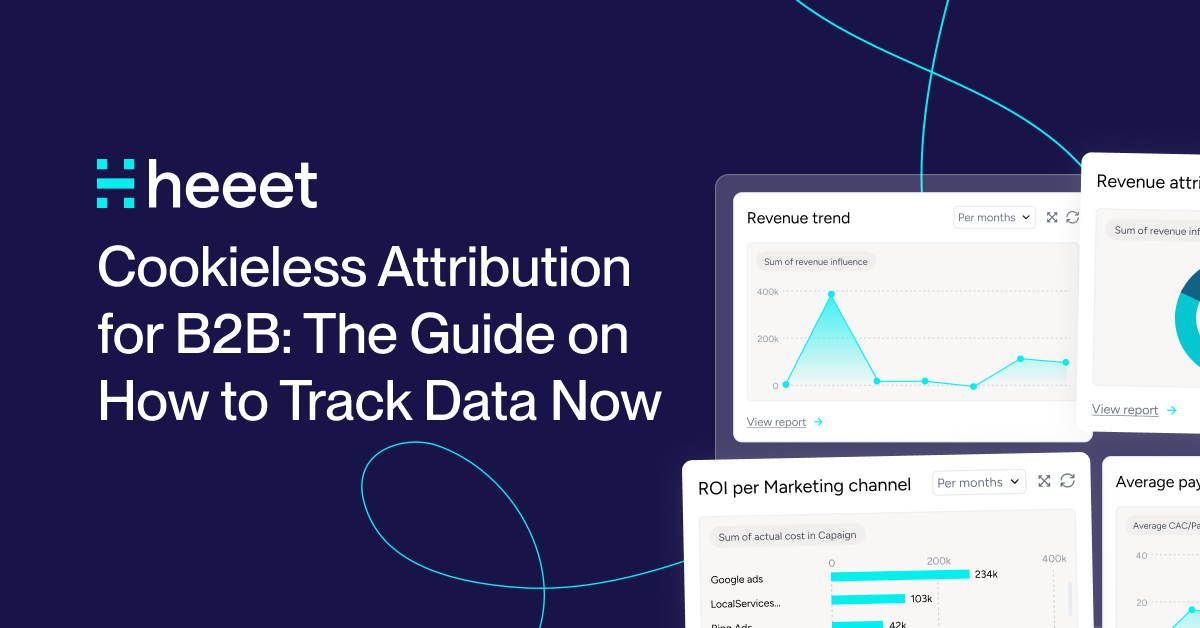
Cookieless Attribution for B2B: Complete Guide to Track Revenue in 2027
Learn how to implement cookieless attribution for B2B marketing. Master first-party data, server-side tracking, and CRM integration to prove marketing ROI despite privacy changes and long sales cycles.
.svg)
Ready to track prospects from lead to close with Heeet?
Heeet gives marketers and sales professionals at IT & Security firms turn geuss work intro informed decisions that drive revenue while meeting the same secruity technical standards you provide your clients.