
Read time :
AI Search Marketing: Why Marketing Now Owns More and More of Each Deal
The lead asks for a demo. They've already picked a winner. They just don't know it yet. That's the quiet shift inside B2B right now, and it has nothing to do with attribution dashboards or new ad formats.

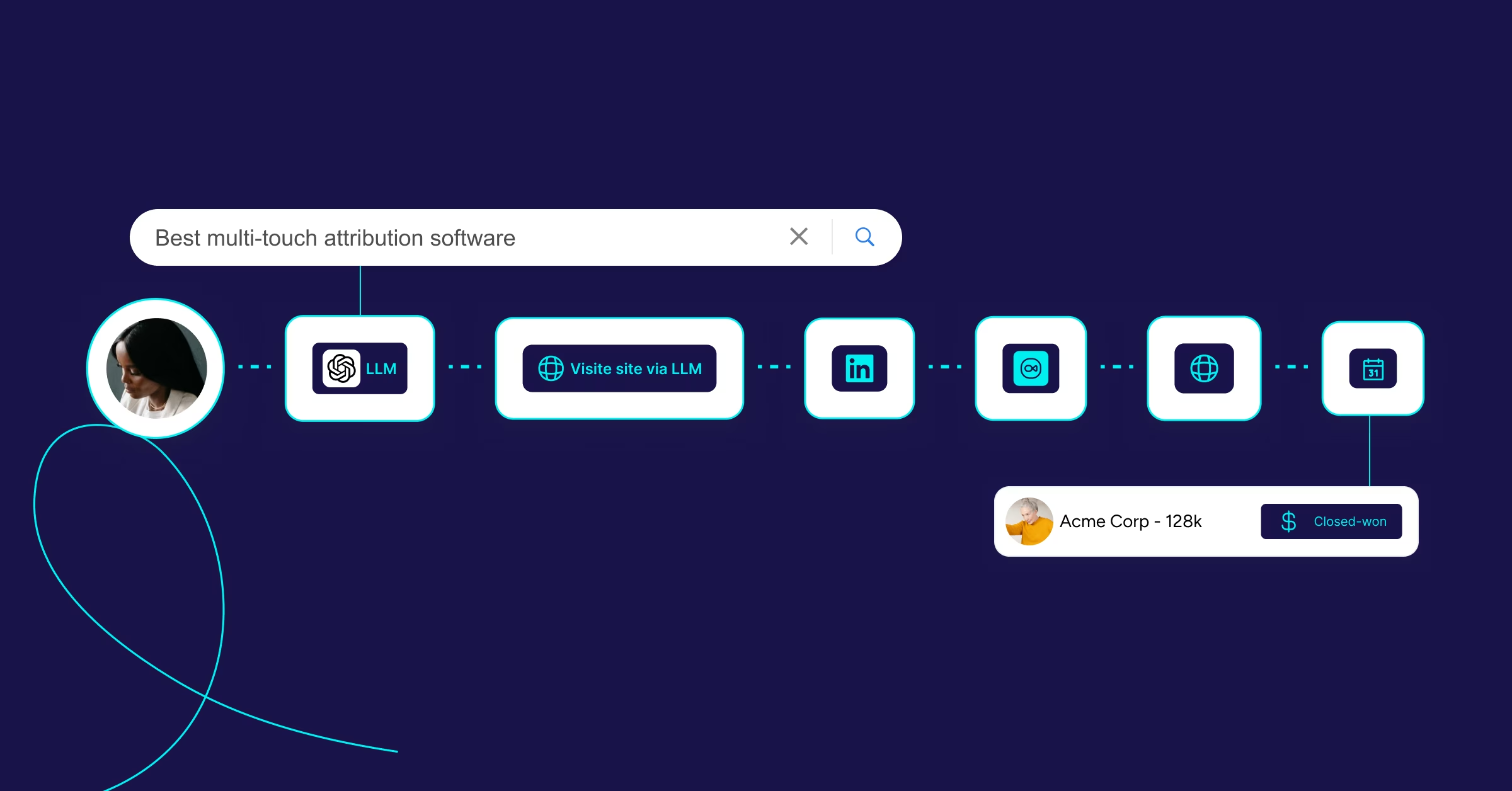

Forrester's 2026 Buyers' Journey Survey confirms that 92% of B2B buyers start their journey with at least one vendor already in mind. Forty-one percent walk in with a single preferred vendor before they ever talk to sales. The vendor who tops the list when contact starts wins the deal roughly 80% of the time.
Most of that decision is happening in places marketing has never controlled neatly: in Reddit threads, in peer Slack groups, on review sites, and now, more than anywhere else, inside an AI chatbot. That last channel is what AI search marketing is about. It is also why marketing's revenue influence is getting bigger, not smaller, even as the clicks that used to prove it are getting harder to count.
This guide is for B2B marketing leaders, RevOps, and revenue leaders trying to answer three questions at once: Is AI search actually changing GTM? What should our team do about it? And how do we measure the impact in a way the CFO will respect? We'll define the terms, ground every claim in research, and lay out a practical framework you can plug into your CRM this quarter.
What is AI search marketing, and why does it matter for B2B?
AI search marketing is the practice of making your brand, product, and content discoverable, citable, and persuasive inside AI-powered answer engines like ChatGPT, Perplexity, Google's AI Overviews, Gemini, and Claude. Instead of optimizing for blue links, you're optimizing for the answer itself, and for the shortlist it generates.
A few quick definitions you'll see throughout this piece:
- AI search: Search experiences powered by large language models (LLMs) that return synthesized answers rather than a list of links. Includes ChatGPT search, Perplexity, Google AI Overviews, Bing Copilot, and Gemini.
- AI visibility: How often, where, and how favorably your brand appears inside AI-generated answers and citations.
- LLM-driven discovery: The slice of the buyer journey where buyers learn about, compare, and shortlist vendors through AI tools, often before any sales contact.
- Generative Engine Optimization (GEO) / Answer Engine Optimization (AEO): Disciplines focused on making content easier for LLMs to extract, cite, and recommend.
It matters because the surface area where B2B buyers form their first opinion has moved. Gartner predicted that traditional search engine volume would drop 25% by 2026 as users shift to AI chatbots. HubSpot's 2026 State of Marketing report puts it more plainly: roughly half of all Google searches now include an AI Overview, and nearly 30% of marketers say their organic search traffic is already declining.
The buyer didn't disappear. They moved upstream.
How has AI search shifted the B2B buying journey?
AI search compressed the discovery, comparison, and shortlist phases into a single conversation that often happens before your team even knows the buyer exists. By the time a buyer hits your demo form, the evaluation work is mostly done.
The data points behind this shift line up with surprising consistency:
- 51% of B2B software buyers now start their research with an AI chatbot more often than with Google, up from 29% in April 2025, per G2's 2026 AI Search Insight Report (n=1,076 B2B decision-makers, March 2026).
- 71% of those buyers rely on AI chatbots somewhere in their software research.
- 80% of buyers say AI chatbots accelerated their purchasing decision.
- 44% of US online buyers primarily start product discovery in LLMs or split research between AI and traditional engines, per Bain & Company (April 2026).
- 89% of unbranded search prompts get fulfilled by third-party sources, not your owned content, in the same Bain study.
The 89% figure is the one most marketers underestimate. When a buyer asks an LLM, "What are the best multi-touch attribution platforms for B2B SaaS?", the model isn't pulling primarily from vendor websites. It's pulling from G2, Reddit, Capterra, analyst commentary, and YouTube comparisons. If your brand isn't represented in those places, with the right framing, you're invisible in the moment that matters most.
When does the buyer actually talk to sales now?
Later than you think, and with a much clearer point of view. Buyers tap colleagues, communities, and AI tools long before they reach out, and they arrive with opinions, preferences, and shortlists already forming. Forrester's State of Business Buying, 2026 reports that generative AI is now the single most cited meaningful interaction type for researching B2B purchases, outpacing vendor websites, product experts, and sales reps combined. The average buying decision now involves 13 internal stakeholders and 9 external influencers, all of whom are using AI to form their views before your team enters the picture.
Sales reps haven't been replaced. Their job changed. They used to convince. Now they confirm.
Why is marketing's revenue influence growing, not shrinking?
Marketing's revenue influence is growing because the share of the deal that gets decided before sales contact has expanded, and AI search is the biggest single accelerator of that shift. Marketing now owns more of the deal economics in everything but the closing handshake.
That's a strange thing to claim when AI referral traffic still looks like rounding error in GA4. So let's address that head-on.
Counterargument #1: "AI search traffic is too small to matter."True, for now, on volume. AI referrals account for roughly 1% of total website traffic in most B2B contexts. But traffic is the wrong unit of measure. AI search behavior is substitutional: a buyer who used to read three blog posts, four review pages, and two case studies before booking a demo now has that comparison done for them in 30 seconds. The traffic didn't disappear. The decision got compressed.
The quality side of the ledger tells a different story. Studies aggregated by Microsoft Clarity, Growth Marshal, and Pixis show AI referral visitors converting at three to five times the rate of standard organic traffic. Heeet's own client data shows that GEO-sourced leads convert at a 68% higher rate, close at a 141% higher rate, and reach revenue 3x faster than paid search traffic. Ninety percent of those visitors are first-time site visitors, which is a polite way of saying: marketing built that pipeline alone, before anyone else got a chance.
Counterargument #2: "We can't attribute AI search to revenue."You can attribute more of it than you think. AI referrals do leak into direct traffic, and some platforms strip UTM data, but the workarounds are practical: cookieless tracking, CRM-native source fields, post-conversion surveys ("How did you first hear about us?"), and matching brand-search lift to AI visibility tracking. We'll get into the measurement framework in a moment.
Counterargument #3: "Sales still closes the deal."Sales always closes the deal. The question is what's left to close. When the shortlist is already ranked, when the comparison work is already done, and when the buyer arrives quoting your product's positioning back to you, the close is faster, cheaper, and more predictable. Marketing's job didn't shrink. Sales' job got easier on the deals marketing prepared well.
Counterargument #4: "This is just SEO rebranded."It overlaps with SEO but it isn't the same. We'll address this in detail next.
Is AI search marketing just SEO with a new coat of paint?
AI search marketing borrows from SEO but works on different signals, different formats, and a different unit of success. Traditional SEO optimizes for ranking; AI search marketing optimizes for citation, recommendation, and inclusion in the answer. Both matter, but they reward different content choices.
Here's where they diverge:
Most of the work you've done for SEO still matters. Schema markup, content quality, page speed, internal linking, and topical authority all feed both systems. What changes is the editorial muscle. AI engines reward content that delivers a complete, factual, well-structured answer in the first 60 words of a section, then earns trust with specifics. Pages that bury the answer under 400 words of intro tend to lose.
And here's the part that's genuinely new: a lot of what determines whether you get cited isn't on your site at all. Ahrefs research found that brands in the top quartile for web mentions receive 10x more AI citations than those in the second quartile. Your Reddit threads, your Quora answers, your G2 reviews, your appearances in industry roundups, your podcast guest spots, your partner co-marketing posts — all of it now compounds in a new way.
How do you build AI visibility that drives revenue?
You build AI visibility that drives revenue by treating it as a three-layer system: the inputs you control, the visibility signals you can monitor, and the pipeline outcomes you tie back in your CRM. Skip any layer and you end up with vanity metrics or invisible wins.
Here's the framework we use with Heeet customers.
Layer 1: Inputs (what you control)
These are the levers that actually move AI visibility:
- Direct-answer content. Lead each section with a 40 to 60 word answer to a real buyer question. Burying the answer in narrative kills citation chances.
- Schema markup. FAQ, HowTo, Article, and Product schema help LLMs parse your content. ChatGPT's own documentation emphasizes structured content and source clarity.
- Freshness signals. Show "Last updated" dates. Refresh pricing pages, comparison pages, and statistics quarterly. LLMs preferentially cite current sources.
- Topical depth. Build clusters, not single pages. Cover the full question space around your category.
- Third-party presence. Get your brand into G2 categories, Reddit recommendations, industry roundups, comparison articles, and analyst commentary. This is where the 89% of unbranded prompts get answered.
- Citation-worthy facts. Original data, customer outcomes, and benchmarks earn more citations than commentary. Models cite the source of the number, not the page that quoted it secondhand.
Layer 2: Visibility signals (what you monitor)
You can't manage what you can't see. Track:
- Share of voice across LLMs. How often does your brand appear in answers to category-defining prompts, versus competitors?
- AI-generated impressions. Count of times your content appears in AI answers or overviews, regardless of clicks. Tools like Profound, AirOps, and Semrush's AI toolkit now monitor this.
- Citation count and source mix. Where are you cited from? Your own site, review sites, Reddit, or analyst content?
- Brand sentiment. How are you being positioned? Sometimes you're cited as the cheap option, sometimes as the enterprise option. Both matter.
- Referral traffic from AI tools. Track ChatGPT, Perplexity, Gemini, and Copilot as their own channels in analytics. Volumes are small, but quality is high.
- Branded search lift. A leading indicator. When AI visibility rises, branded searches on Google often rise with it.
Layer 3: Pipeline and revenue impact (what closes the loop)
This is where most teams give up too early. It's also where the CFO conversation happens.
- First-touch and multi-touch attribution that includes AI sources. Connect AI referral traffic, branded direct traffic spikes, and self-reported source data ("How did you hear about us?") to your CRM opportunities.
- Conversion rate by source. Compare AI-sourced leads to paid, organic, and other channels. Expect higher rates.
- Time to opportunity and time to close. AI-sourced deals often move faster because the buyer arrives pre-educated.
- Pipeline influence by content. Which articles, comparisons, or pages show up in AI answers and also appear in deals that closed?
- Revenue per AI-sourced opportunity. Average deal size and CLV tend to skew higher because AI buyers self-qualify.
Put together, the model looks like this:
Inputs → Visibility signals → Pipeline / revenue impact
If the inputs improve but visibility doesn't, your content isn't being read as authoritative. If visibility improves but pipeline doesn't, your traffic isn't reaching the right buyers, or your conversion path is broken. The framework forces honest diagnosis.
What does this change for Marketing, RevOps, and Sales?
It changes the handoff. Marketing now owns the discovery, comparison, and shortlist phases more completely than at any point in B2B history. RevOps owns the plumbing that makes that influence visible. Sales owns a shorter, sharper conversation focused on confirmation, customization, and closing.
Some practical implications:
- For Marketing: Stop measuring success only with MQLs and demo requests. Start tracking AI visibility, pipeline influence, and self-reported source. Build content that LLMs can quote, not just rank.
- For RevOps: Add AI sources to lead source tracking. Map the buyer journey to include zero-click and AI-influenced paths. Make sure attribution models credit influence, not just last-touch click.
- For Sales: Recognize that the buyer who books a demo today is not the same buyer who booked one two years ago. They've done more research. They have fewer questions and stronger opinions. Lean into validation, not pitching.
The teams who get this right stop fighting over who deserves credit and start working from a shared definition of "deals marketing prepared well." That's the alignment AI search forces, whether you ask for it or not.
How do you start? A practical 90-day plan
If this all feels like a lot, start small and instrument as you go:
- Weeks 1-2: Audit your top 20 traffic pages. Add direct-answer sections, FAQ schema, and last-updated dates.
- Weeks 3-4: Pick five high-intent category prompts your buyers ask AI tools. Run them in ChatGPT, Perplexity, and Gemini. Document who shows up, what's said, and where you're missing.
- Weeks 5-6: Add AI referrer tracking to GA4 and your CRM. Set up custom fields for AI source and a self-reported "How did you hear about us?" field on demo forms.
- Weeks 7-8: Identify your three biggest third-party citation gaps (Reddit, G2, comparison pages, podcast guesting). Plan a co-marketing or community push to close them.
- Weeks 9-12: Build the first version of your inputs → visibility → pipeline dashboard. Tie AI source to opportunities created and revenue closed.
You won't get full attribution clarity in 90 days. You'll get enough signal to make the next investment decision with confidence, and that's the unlock.
The takeaway
Marketing's revenue influence isn't shrinking, even though the clicks are. AI search shifted where buyers learn, compare, and decide, and most of that activity now happens before any sales conversation. The teams who treat AI search marketing as a measurable, instrumented channel, not a vanity score, are the ones who'll get the budget and the credit when this decade's GTM math gets rewritten.
If you'd like to see how Heeet helps B2B teams connect AI search visibility to pipeline and revenue inside Salesforce or HubSpot, book a demo. We'll show you a real dashboard, not a deck.
Other articles
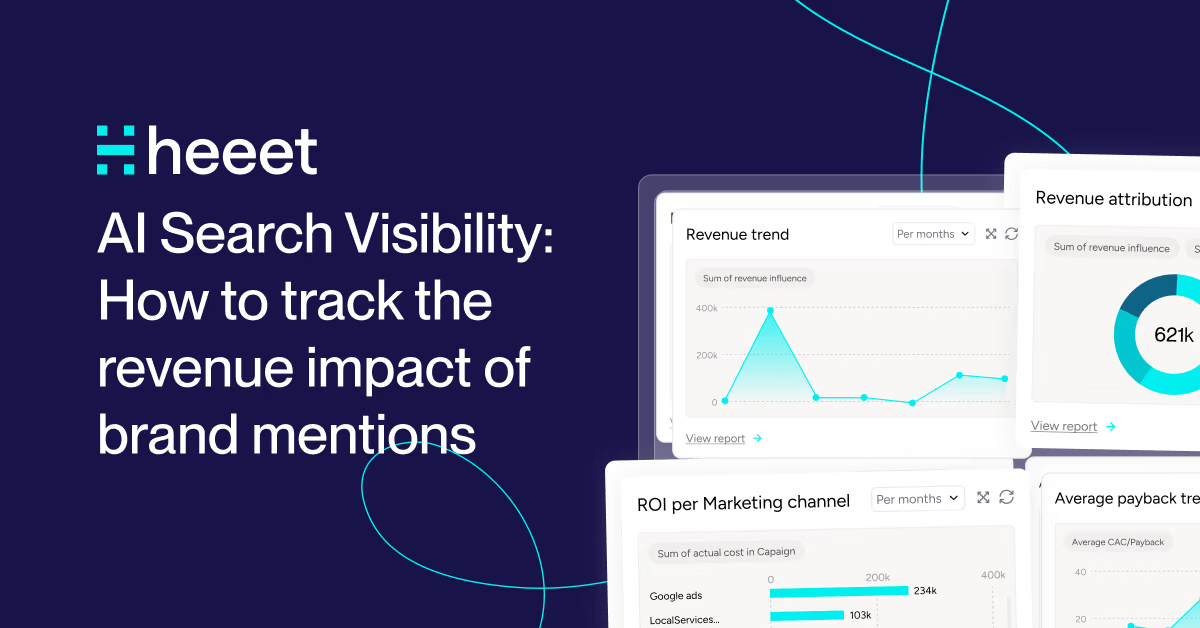
AI Search Visibility: How to track the revenue impact of brand mentions
Learn to track and measure AI search ROI with proven GEO strategies. Complete guide to LLM mentions attribution, revenue tracking tools, and conversion optimization for B2B success.
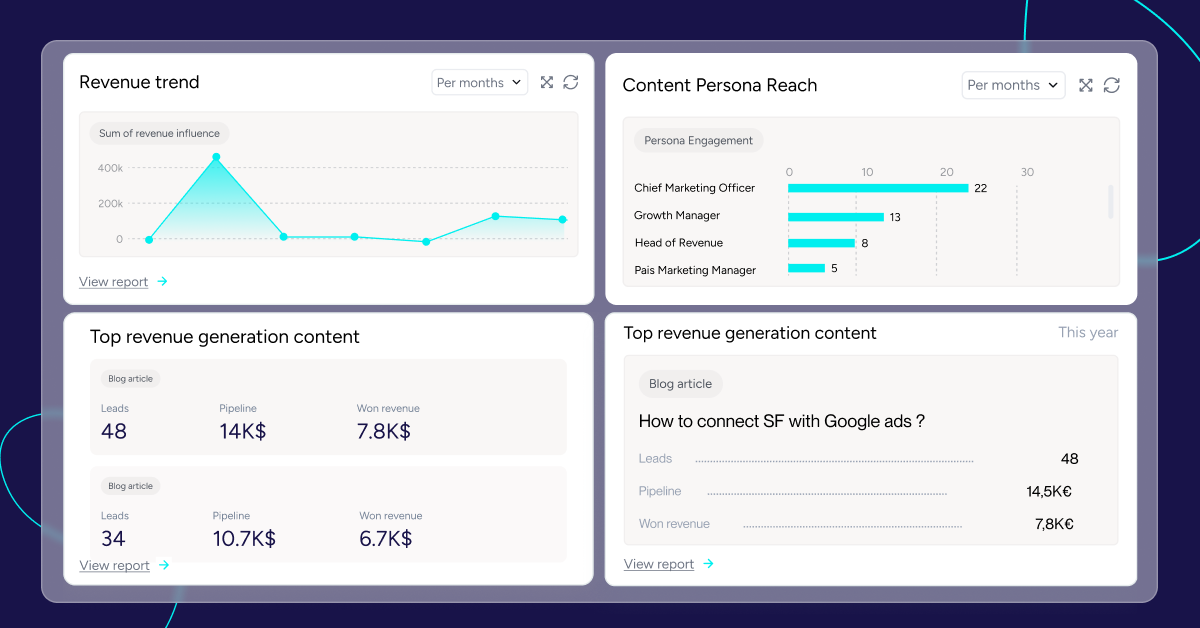
10 Best Content ROI Tools to Prove Content Drives Revenue
Compare 10 tools that connect blog posts and assets to pipeline. Features, pricing and how each handles multi-touch attribution for content teams.

15 B2B Revenue KPIs Every Revenue Leader Should Track
Track the B2B revenue KPIs that predict growth–pipeline velocity, CAC, NRR, win rate, and more. Formulas, benchmarks, and dashboard tips.
.svg)
Ready to track prospects from lead to close with Heeet?
Heeet gives marketers and sales professionals at IT & Security firms turn geuss work intro informed decisions that drive revenue while meeting the same secruity technical standards you provide your clients.