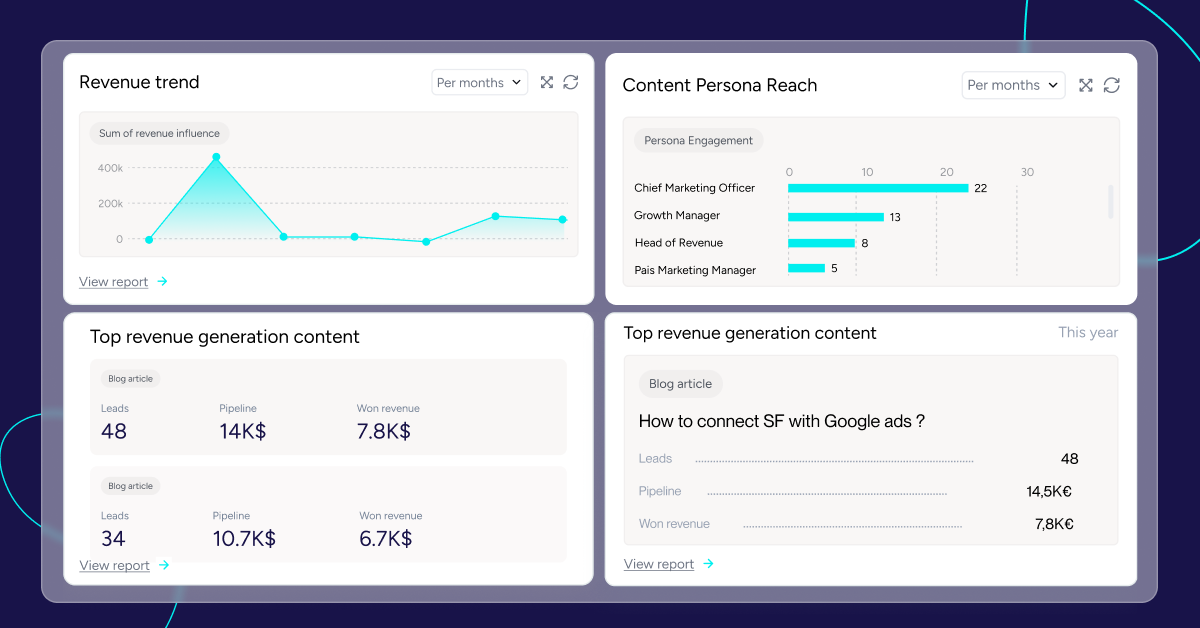



Revenue attribution software connects every marketing touchpoint to pipeline and closed deals inside your CRM. Instead of guessing which LinkedIn campaign or webinar contributed to that six-figure contract, you get data.
This guide breaks down the 11 best revenue attribution platforms for B2B teams. Each tool is evaluated on its depth of CRM integration, flexibility of attribution models, pricing transparency, and real-world fit for teams that need to tie marketing spend to revenue outcomes.
What is revenue attribution software?
Revenue attribution software tracks and assigns credit to marketing touchpoints that contribute to closed-won revenue. It connects advertising, content, events, and other channels to actual deals in your CRM, showing which campaigns generated pipeline and which drove measurable business outcomes.
Forrester's 2021 B2B Buying Study counted 27 interactions in the average purchase, up from 17 in 2019. A prospect might click a Google Ad, attend a webinar three weeks later, download a case study, then answer a sales email before signing. Without attribution software, your CRM records one of those touchpoints at best. The rest of the journey disappears.
Revenue attribution platforms capture these interactions and split credit across the journey. Some use single-touch models like first-touch. Others use multi-touch models such as linear, time-decay, U-shaped, W-shaped or data-driven. Either way, the output is the same: which investments produced revenue.
Marketing teams are expected to justify budgets with revenue, not impressions or MQLs. Few trust their own numbers enough to do it: in Forrester's Marketing Survey, 2024, 64% of B2B marketing leaders said they don't trust their organization's marketing measurement for decision-making. Revenue attribution software is the infrastructure that closes that gap.
Why do B2B teams need revenue attribution?
B2B teams need revenue attribution because complex buying journeys, long sales cycles, and multi-stakeholder decisions make it nearly impossible to understand marketing's impact using standard CRM reporting alone.
Here's what typically happens without it. Marketing runs campaigns across Google Ads, LinkedIn, organic search, webinars, and trade shows. Leads enter Salesforce or HubSpot. Sales works them. Some convert. But when leadership asks "Which campaigns drove this quarter's pipeline?", the marketing team scrambles to pull fragmented reports from five different tools and stitch together a story that may or may not be accurate.
This isn't a minor inconvenience. It creates real business consequences.
Budget misallocation is the biggest risk
Without attribution data, teams over-invest in channels that look good on paper (high volume, low quality) and under-invest in the ones that quietly produce six-figure deals. Money keeps flowing to whatever reports the most leads.
Sales and marketing alignment suffers
When marketing can't show which campaigns influenced specific opportunities, sales stops trusting lead quality. RevOps leaders lose hours reconciling reports that disagree. Sara, Business Analyst and Salesforce Admin at Heeet customer Nel Hydrogen, described the before state as starting over "over and over and over again", with gaps in the data every time. After rolling out attribution, she said: "For the first time in almost six years here, I trust what I'm putting out there."
Budget defense becomes a quarterly crisis
Every planning cycle, marketers without attribution data find themselves defending spend with engagement metrics. Click-through rates and webinar attendance don't carry weight in a boardroom conversation about revenue targets. Revenue attribution gives marketing the same language finance and sales already speak: pipeline contribution, deal influence, and ROI.
Which revenue attribution platforms are best for B2B teams?
The best revenue attribution platform depends on your CRM ecosystem, team size, budget, and the complexity of your buyer journey. Below, we compare 11 platforms across pricing, CRM integration, attribution models, and ideal use cases.
Quick comparison: 11 revenue attribution tools at a glance
1. Heeet
Best for: CRM-native B2B revenue attribution in Salesforce and HubSpot
If you've spent months trying to build attribution reporting inside Salesforce or HubSpot using native tools, you already know the limitations. Campaign member tracking is clunky. Cross-channel visibility requires manual workarounds. And the reports you do pull never seem to match what happened in the real buyer journey.
Heeet solves this by operating natively inside your CRM. It's available on both the Salesforce AppExchange and HubSpot Marketplace, meaning your attribution data lives where your sales and revenue data already lives. No external databases. No API syncing. No waiting for data to transfer between platforms.
The platform uses server-side cookieless tracking, so you get accurate touchpoint data regardless of browser privacy settings, ad blockers, or GDPR constraints. Every lead, every page visit, every ad interaction gets tracked and attributed to pipeline and revenue inside your CRM in real time.
What real teams are seeing with Heeet:
Ringover, a cloud communications platform, achieved a 24% increase in marketing-generated revenue attribution accuracy and a 14% improvement in Google Ads ROAS after implementing Heeet. "Thanks to Heeet, we get full-funnel visibility: tracking every lead, analyzing campaign performance, monitoring customer acquisition, and measuring ROI across Google, LinkedIn, and Meta," said Vincent Coulondres, Head of Growth at Ringover.
Driver Defense Team, a legal services firm where about 95% of leads come in by phone rather than forms, tripled its ROAS with Heeet and now sees page-level attribution for every form fill in Salesforce. "It truly helps you sleep better at night," said Derek Martin, the firm's marketing lead. "Knowing that if you've got 12 or 25 different campaigns, that each of those campaigns are net positive, and driving ROI."
At Nel Hydrogen, the digital team can now trace pipeline back to individual ads. "We can trace million-dollar opportunities back to a specific Google ad we placed," said Russell, Digital Communications Specialist.
Key features:
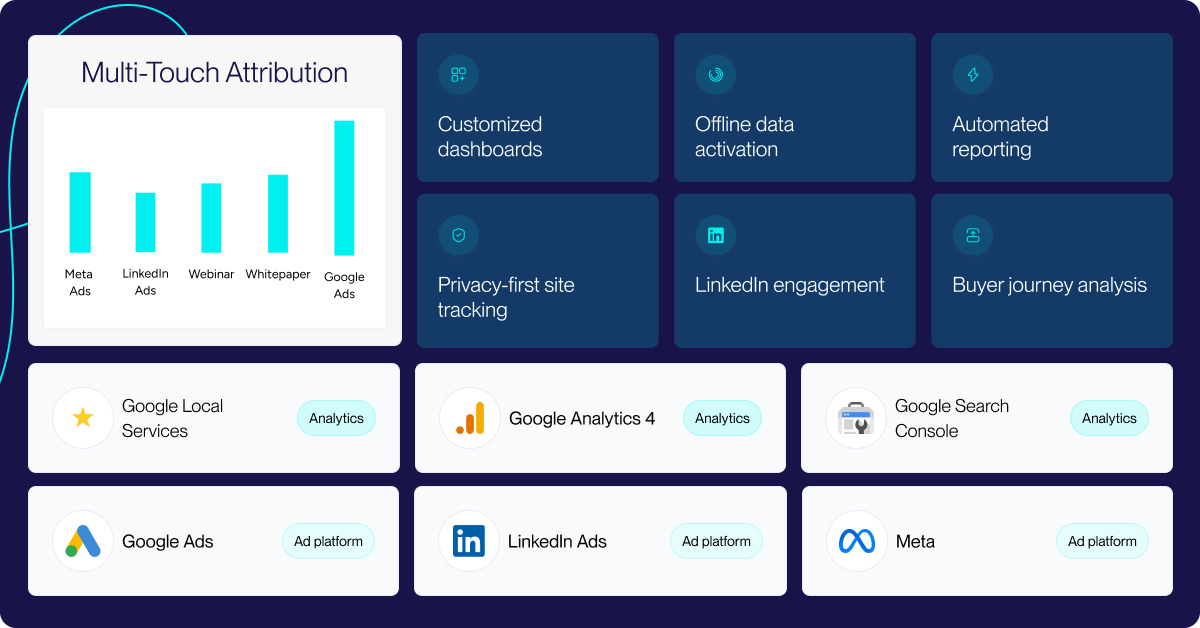
- Multi-touch attribution models (first, last, linear, U-shaped, W-shaped, custom)
- Server-side cookieless tracking with GDPR compliance by design
- Native Salesforce and HubSpot marketplace integration (data never leaves your CRM)
- Pre-built and customizable revenue dashboards
- Automatic campaign creation and member status syncing
- Cross-channel tracking for Google Ads, LinkedIn, Meta, webinars, organic content, and events
- Implementation in hours, not weeks or months
- Lead Intelligence, live since October 2026, puts the full buyer journey and an AI summary of recent activity on the lead and account record
Pricing: Published. Platform costs $790 a month for any CRM, with 3,000 new digital leads a year and a 30-day free trial. Native costs $1,490 a month inside Salesforce or HubSpot, with 6,000 new digital leads a year. Extra leads cost $95 per 100, and Enterprise is custom. Book a demo for a walkthrough.
Pros: Data stays in your CRM with no external storage. Cookieless tracking solves privacy compliance. Setup takes hours rather than the weeks required by competitors. Hands-on implementation support included.
Cons: Built for B2B sales cycles, not e-commerce. Teams on another CRM get attribution in Heeet's own interface on the Platform plan instead of on CRM records.
2. HockeyStack
Best for: Full-funnel B2B analytics and attribution
HockeyStack has built a strong reputation as an all-in-one analytics and attribution platform for B2B marketing teams. It combines website analytics, attribution, and revenue reporting in a single tool, which appeals to teams that want to consolidate their measurement stack.
The platform tracks the complete buyer journey across paid ads, organic content, and sales interactions, then attributes revenue using multi-touch and data-driven models. Its account-level tracking is particularly useful for ABM-focused teams that need to understand how multiple stakeholders within a target account engage with campaigns over time.
HockeyStack connects to Salesforce and HubSpot via API integrations, pulling CRM data into its own analytics environment. This is a key architectural difference from CRM-native tools: your attribution data lives in HockeyStack's platform rather than inside your CRM.
Key features:
- Multi-touch and data-driven attribution models
- Account-level journey tracking for ABM
- Unified analytics combining website, ads, and CRM data
- No-code dashboard builder
- Lift analysis and incrementality reporting
- Integrations with major ad platforms and marketing tools
Pricing: Not published. The pricing page is a demo request form. Older third-party estimates put entry contracts around $2,400 a month, so confirm with sales.
Pros: Comprehensive analytics beyond just attribution. Strong visualization and dashboard capabilities. Good ABM support.
Cons: Data lives outside your CRM, which creates security review friction for enterprise buyers. API-based CRM sync can introduce latency. Higher price point for smaller teams.
3. Dreamdata
Best for: B2B revenue attribution with account-based focus
Dreamdata is a B2B-focused attribution platform that maps the entire account journey from first anonymous visit to closed deal. The platform excels at connecting fragmented touchpoints across long, complex sales cycles and multiple decision-makers.
Its data model is built around the B2B buying group concept, stitching together individual contacts into account-level journeys. This gives RevOps teams a clearer picture of how campaigns influence accounts rather than just individual leads.
Dreamdata integrates with Salesforce and HubSpot via API connections and pulls data from ad platforms, website analytics, and marketing automation tools. Like HockeyStack, it hosts attribution data in its own environment.
Key features:
- Account-based journey mapping across all touchpoints
- B2B-specific data-driven attribution
- Content attribution showing which pages influence pipeline
- ROI reporting by channel, campaign, and content
- Integration with Google Ads, LinkedIn, G2, and other B2B channels
- Historical data backfill during onboarding
Pricing: Free plan at $0 a month (two months of user history, five seats). The paid Attribution & Activation tier is custom-priced.
Pros: Strong B2B-specific approach to attribution. Good account journey visualization. Content attribution capabilities.
Cons: Can be complex to configure for teams without dedicated ops resources. Data resides outside CRM. Cookie-based tracking faces limitations with privacy changes.
4. Ruler Analytics
Best for: Connecting offline conversions to digital marketing
Ruler Analytics specializes in connecting online marketing efforts to offline revenue. If your sales process involves phone calls, form submissions, and live chat interactions that ultimately close offline, Ruler bridges that gap by passing conversion data back to your ad platforms and CRM.
The platform tracks which campaigns, keywords, and channels generated each lead, then follows that lead through to revenue in your CRM. This closed-loop reporting lets you see exactly which Google Ads keyword or LinkedIn campaign produced a specific deal.
Ruler is particularly popular with agencies and mid-market companies that run significant paid search budgets and need to optimize toward revenue rather than leads.
Key features:
- Closed-loop attribution connecting ads to revenue
- Phone call tracking and attribution
- Form and live chat conversion tracking
- Revenue data sent back to Google Ads, Meta, and LinkedIn
- Salesforce and HubSpot integration via connectors
- Visitor-level tracking across sessions
Pricing: From approximately $400/month depending on traffic volume.
Pros: Strong at connecting offline conversions to online spend. Good ad platform feedback loops. Competitive pricing for mid-market.
Cons: Less sophisticated multi-touch models compared to dedicated B2B attribution platforms. Connector-based CRM integration rather than native. Cookie-dependent tracking.
5. Adobe Marketo Measure (formerly Bizible)
Best for: Enterprise teams already on Adobe and Marketo
Marketo Measure (the product Adobe acquired as Bizible) is an enterprise-grade attribution tool built for organizations already invested in Adobe's marketing products. It creates touchpoint records directly in Salesforce, giving revenue teams attribution data alongside their existing opportunity and pipeline records.
The platform's strength lies in its depth: it tracks online and offline touchpoints, supports custom attribution model weighting, and integrates deeply with Marketo Engage for campaign-level attribution. For large organizations running complex, multi-channel programs through Marketo, this integration is difficult to replicate with standalone tools.
However, Marketo Measure comes with enterprise complexity. Implementation typically takes weeks to months, requiring dedicated admin resources. Cost is significant too. Adobe sells it in tiers (Tier 1, Tier 2 and Ultimate) and doesn't publish prices.
Key features:
- Touchpoint records created natively in Salesforce
- Custom weighted multi-touch attribution models
- Online and offline touchpoint tracking
- Deep Marketo Engage integration
- ABM attribution at the account level
- Standard and custom reporting in Salesforce
Pricing: Not published. Adobe quotes by tier and database size, so expect enterprise-level pricing and get a quote.
Pros: Deep Salesforce native integration. Powerful custom model configuration. Strong for teams already using Marketo.
Cons: Extremely expensive. Complex implementation requiring dedicated resources. Overkill for teams that don't use Adobe. Adobe retired its cross-domain tracking and view-through attribution in June 2024 because both relied on third-party cookies. The tracking that remains is cookie-based.
6. HubSpot Attribution Reporting
Best for: Teams fully embedded in HubSpot Marketing Hub Professional or Enterprise
HubSpot's built-in attribution reporting starts on Marketing Hub Professional, and deal and revenue attribution need Enterprise. It provides multi-touch attribution inside HubSpot, allowing teams to see which interactions influenced contacts, deals, and revenue without purchasing a separate tool.
Contact create attribution reports come with Marketing Hub Professional. Deal create and revenue attribution reports need Enterprise. HubSpot revised its model list in 2026, replacing the U-shaped, W-shaped and J-shaped models with a new Empirical model, so check your own report builder before planning around a specific one. Because attribution happens natively inside HubSpot, there's no data transfer lag or integration configuration required.
The limitation is scope. HubSpot Attribution works best when your entire marketing and sales motion runs through HubSpot. If you're running campaigns through external platforms, using a separate CRM for certain teams, or need to track touchpoints outside HubSpot's tracking capabilities, you'll hit walls quickly.
Key features:
- Built-in multi-touch attribution models on Enterprise
- Contact-level and deal-level attribution
- Revenue attribution tied to HubSpot deals
- Content attribution for HubSpot-hosted content
- Custom report builder
- No additional setup for HubSpot Marketing Hub Enterprise users
Pricing: Included with Marketing Hub Enterprise: $3,600 a month on annual terms, plus a one-time $7,000 onboarding fee.
Pros: No additional tool to purchase if you're already on Enterprise. Zero integration complexity. Clean user interface.
Cons: Only available at Enterprise tier ($3,600/mo minimum). Limited to HubSpot-tracked interactions. Struggles with complex B2B journeys involving touchpoints outside HubSpot. No cookieless tracking.
7. Salesforce CRM Analytics
Best for: Enterprise Salesforce-native reporting and AI-driven insights
Salesforce CRM Analytics (formerly Tableau CRM) is the analytics layer for organizations running their whole revenue operation on Salesforce. Don't confuse it with Datorama, which Salesforce renamed Marketing Cloud Intelligence and still sells as a separate product. It provides pre-built and customizable dashboards, AI-powered insights through Einstein Analytics, and the ability to blend Salesforce data with external marketing data sources.
For attribution, Salesforce's machine-learning option is Einstein Attribution. It builds a data-driven Campaign Influence model. It comes with Account Engagement Advanced, not with CRM Analytics. This data-driven approach can surface patterns that rule-based models miss, but it requires significant data volume to produce reliable results.
The platform's biggest advantage is that everything lives inside Salesforce. For enterprises that won't approve data leaving their CRM environment, this matters. The downside is cost and complexity. CRM Analytics is an add-on to Salesforce, and configuring it for multi-touch attribution requires Salesforce admin expertise.
Key features:
- Einstein Discovery predictions (Plus edition); Einstein Attribution through Account Engagement
- Pre-built revenue and pipeline dashboards
- Data blending across Salesforce and external sources
- Predictive analytics and forecasting
- Native Salesforce integration (no data leaves the platform)
- Role-based access control and enterprise security
Pricing: Growth costs $140 per user per month and Plus costs $165, both billed annually as add-ons to Salesforce.
Pros: Completely native to Salesforce. AI predictions on the Plus edition. Enterprise-grade security and compliance.
Cons: Expensive add-on to an already expensive CRM. Requires Salesforce admin expertise to configure. Can be overkill for teams that only need attribution. Not available for HubSpot users.
8. Terminus (now part of DemandScience)
Best for: Account-based marketing attribution
Terminus merged into DemandScience on 12 November 2024. The combined company runs under the DemandScience name. The Terminus ABM platform includes attribution focused on account-level engagement and revenue impact. If your go-to-market runs on target account lists rather than individual leads, it measures attribution in the context of those account-based programs.
The platform tracks how target accounts engage with your advertising, website, email, and events, then connects those interactions to pipeline and revenue in Salesforce. Its attribution reporting shows which ABM tactics influence specific accounts through the buying journey.
Terminus is less of a standalone attribution tool and more of an ABM execution platform with attribution built in. Teams that run broad demand generation alongside ABM may find its attribution scope limiting compared to dedicated multi-touch platforms.
Key features:
- Account-level engagement tracking and attribution
- Multi-channel ABM campaign orchestration
- Target account identification and scoring
- Account-based advertising across display, LinkedIn, and connected TV
- Salesforce and HubSpot integration
- Pipeline and revenue reporting by account segment
Pricing: Custom pricing through DemandScience.
Pros: Strong ABM attribution for account-focused teams. Combines execution and measurement. Good account engagement scoring.
Cons: Attribution is secondary to ABM execution features. Less flexible for non-ABM attribution needs. Can be expensive relative to attribution-specific tools. Cookie-dependent display advertising.
9. CaliberMind
Best for: Mid-market B2B pipeline attribution
CaliberMind connects marketing activity to pipeline and revenue for mid-market B2B companies. Integrate, a lead management platform, acquired it in August 2026 and runs it as a dedicated product line. The platform consolidates data from your CRM, marketing automation, ad platforms, and website to create unified customer journey maps, then applies multi-touch attribution to identify which activities drive pipeline.
Its journey analytics capabilities let you see how cohorts of leads and accounts move through funnel stages, and where they stall or accelerate. This is useful for RevOps teams trying to optimize the full funnel rather than just measuring top-of-funnel marketing metrics.
CaliberMind also offers predictive analytics features, using historical patterns to forecast which leads and accounts are most likely to convert. This combines well with attribution data to help teams focus both spend and sales effort.
Key features:
- Multi-touch revenue attribution with custom models
- Unified customer journey mapping
- Predictive lead and account scoring
- Funnel analytics showing stage-to-stage conversion
- Salesforce and HubSpot integration
- Cohort analysis and trend reporting
Pricing: Custom pricing. Positioned for mid-market B2B.
Pros: Good balance of attribution and predictive analytics. Unified journey view. Mid-market positioning means less enterprise complexity.
Cons: The roadmap now depends on Integrate, which plans native integrations between the two products, with deeper interoperability slated for 2027. Fewer integrations than larger platforms. May require implementation support for complex setups.
10. Segment (by Twilio)
Best for: Customer data infrastructure that powers attribution tools
Segment isn't an attribution tool. It's a customer data platform (CDP) that collects, cleans, and routes behavioral data across your marketing and analytics stack. It appears in this list because many B2B teams use Segment as the data foundation that feeds their attribution tools.
If you're collecting data from multiple sources (website, product, mobile app, marketing platforms) and need to unify that data before it reaches your attribution or BI layer, Segment provides the plumbing. It tracks user interactions, stitches identities across devices and sessions, then sends structured data to hundreds of downstream tools including CRMs, analytics platforms, and data warehouses.
The key distinction: Segment doesn't calculate attribution. It ensures the data your attribution tool needs is complete, consistent, and available. Teams with complex data architectures often pair Segment with a dedicated attribution platform.
Key features:
- Real-time data collection from websites, apps, and servers
- Identity resolution across devices and sessions
- Hundreds of pre-built integrations with marketing and analytics tools
- Data governance and privacy controls
- Audience segmentation and activation
- Protocols for data quality enforcement
Pricing: Free plan. Team starts at $120 a month for 10,000 monthly tracked users. Business is custom-priced.
Pros: Best-in-class data infrastructure. Massive integration library. Strong identity resolution. Good data governance features.
Cons: Not an attribution tool. Requires a separate platform for attribution modeling and reporting. Can become expensive at scale. Adds complexity to the stack rather than simplifying it.
11. Funnel.io
Best for: Marketing data aggregation and normalization
Funnel.io started as a marketing data hub. It pulls performance data from more than 500 advertising and marketing platforms, normalizes it, and pushes it to your data warehouse, BI tools or dashboards. Since buying Adtriba in June 2024, it also sells measurement: Funnel Measure covers multi-touch attribution, marketing mix modelling and incrementality on the Business and Enterprise plans.
The platform excels at solving a specific pain point: marketers who spend hours manually pulling reports from Google Ads, LinkedIn, Meta, and other platforms, then trying to reconcile inconsistent metrics in spreadsheets. Funnel automates this collection and standardization.
For teams that build attribution models in a data warehouse or BI tool like Looker, Tableau, or Power BI, Funnel provides the data pipeline. Teams that want Funnel to assign credit as well need Funnel Measure on the Business plan or above.
Key features:
- 500+ pre-built connectors to marketing platforms
- Automated data collection and normalization
- Data transformation and mapping rules
- Push to data warehouses (BigQuery, Snowflake, Redshift)
- Dashboard and BI tool integrations
- Spend, performance, and conversion data unification
Pricing: No free plan, but there's a 30-day free trial. Starter costs from $300 a month billed annually. Funnel Measure is available on Business, from $600 a month, and on Enterprise.
Pros: Massive connector library eliminates manual data pulls. Strong normalization cleans messy platform data. Saves significant analyst time.
Cons: Attribution costs extra, because Funnel Measure only comes on Business and above. Without it, Funnel still needs a separate attribution or BI layer.
What features should you look for in revenue attribution software?
The right attribution platform for your team depends on six core capabilities. Missing even one can undermine the accuracy and usefulness of your attribution data.
Native CRM integration
This is the most important differentiator. Attribution software that integrates natively with your CRM (Salesforce or HubSpot) keeps data where your revenue team already works. Native integrations create attribution records directly inside your CRM, eliminating the need to switch between platforms or reconcile data across systems.
Connector-based or API-synced integrations introduce latency, potential data loss, and security concerns. When attribution data lives outside the CRM, it requires separate access permissions, adds vendor risk, and creates a dependency on external syncing schedules.
For teams evaluating options, ask: Does this tool push attribution data into my CRM records, or does it pull CRM data into its own environment? The direction matters for adoption, security, and long-term reliability.
Cookieless tracking
Chrome kept third-party cookies. Google dropped its phase-out plan in July 2024, scrapped the replacement user-choice prompt in April 2025 and later retired most of the Privacy Sandbox. Cookie-dependent tracking still loses data. Safari and Firefox block third-party cookies by default. Ad blockers strip tracking scripts.
Server-side, cookieless tracking captures touchpoint data without relying on browser cookies. This means your attribution accuracy doesn't degrade when users enable privacy settings, use ad blockers, or browse in incognito mode. For B2B teams where each lead is high-value, losing even 10-15% of touchpoint data to cookie degradation distorts attribution models.
For a comprehensive look at how cookieless tracking works in practice, see our guide on cookieless attribution for B2B.
Offline touchpoint tracking
B2B buying doesn't happen entirely online. Trade shows, conferences, sales calls, direct mail campaigns, and partner referrals all influence deals. Your attribution tool needs to capture these offline interactions alongside digital touchpoints to reflect the real buyer journey.
Look for platforms that can ingest offline event attendance data, track phone call conversions, and integrate with tools that capture non-digital interactions. Without offline tracking, your attribution model systematically under-credits field marketing and relationship-driven activities.
Multi-touch model flexibility
Different attribution questions require different models. You need a platform that supports multiple models and lets you switch between them without reconfiguring your setup.
At minimum, look for first-touch, last-touch, linear, time-decay, and position-based (U-shaped/W-shaped) models. Ideally, the platform should also offer custom model building and data-driven attribution for teams ready to move beyond rule-based approaches.
Real-time dashboards and reporting
Attribution insights lose value when they arrive weeks after campaigns run. Your platform should provide real-time or near-real-time dashboards that show pipeline influence, revenue attribution, and campaign ROI as deals progress.
Pre-built dashboards that work immediately after implementation save time. Customizable reporting ensures the tool adapts to your specific KPIs and stakeholder requirements. The best tools deliver both.
Integration breadth
Revenue attribution requires data from across your marketing stack. Evaluate how each platform connects with your ad platforms (Google Ads, LinkedIn Ads, Meta), marketing automation, webinar tools, event platforms, and content systems. Gaps in integration coverage become gaps in attribution accuracy.
How do you choose the right revenue attribution platform?
The attribution tool you pick decides which numbers marketing takes into every budget meeting for the next few years. Use these six steps to choose one that holds up.
Step 1: Audit your current attribution gaps
Before evaluating tools, document what's broken. Where does touchpoint data disappear? Which channels lack visibility? What questions can't you answer with current reporting? This audit shapes your requirements.
Step 2: Define your CRM ecosystem constraints
Your CRM is non-negotiable. If you're on Salesforce, narrow your evaluation to tools with deep Salesforce integration. HubSpot teams should do the same. The depth of CRM integration determines how much value your team extracts from attribution data.
Ask specifically: Does the tool require data to leave my CRM? Enterprise security teams increasingly reject solutions that export CRM data to external platforms. This single requirement eliminates several options.
Step 3: Map your buyer journey complexity
A SaaS company with a 30-day sales cycle and two-touchpoint journey has different attribution needs than an enterprise hardware company with 18-month cycles and 20+ touchpoints across multiple buying committee members.
Match the tool's sophistication to your journey complexity. Over-engineering attribution for simple sales motions wastes budget. Under-engineering it for complex journeys produces unreliable data.
Step 4: Calculate total cost of ownership
Don't compare sticker prices. Calculate the full cost including the tool itself, implementation time, ongoing admin resources, training, and any supporting tools required (data infrastructure, BI platforms, connectors).
A $400/month tool that requires a $1,200/month data platform plus 20 hours of monthly admin time costs more than a $1,500/month platform that runs natively in your CRM with minimal maintenance.
Step 5: Evaluate implementation timeline
Some platforms go live in hours. Others take months of schema mapping, data validation, and custom development. If you need attribution data for next quarter's planning cycle, implementation speed matters.
Ask for implementation timelines from actual customers, not just the vendor's sales team. The gap between "typical" and "real" implementation duration can be significant.
Step 6: Test with a proof of concept
The best way to evaluate attribution software is to run it against known data. Pick a closed-won deal where you know the touchpoints. Configure the tool and see if it captures the journey accurately. Any platform confident in its tracking will support this kind of validation.
For more context on building the business case for attribution investment, see our guide on how to defend your marketing budget in revenue planning season.