
Read time :
What Is a GTM Context Layer? The Data AI Needs Before It Can Answer a Marketing Question
Connect Claude to Salesforce and marketing gets an analyst. That's the promise behind Claudeforce, which has been in open beta since this month. With Sam Altman speaking at Dreamforce this week, we’re pretty sure that Chatforce will soon become a reality as well.

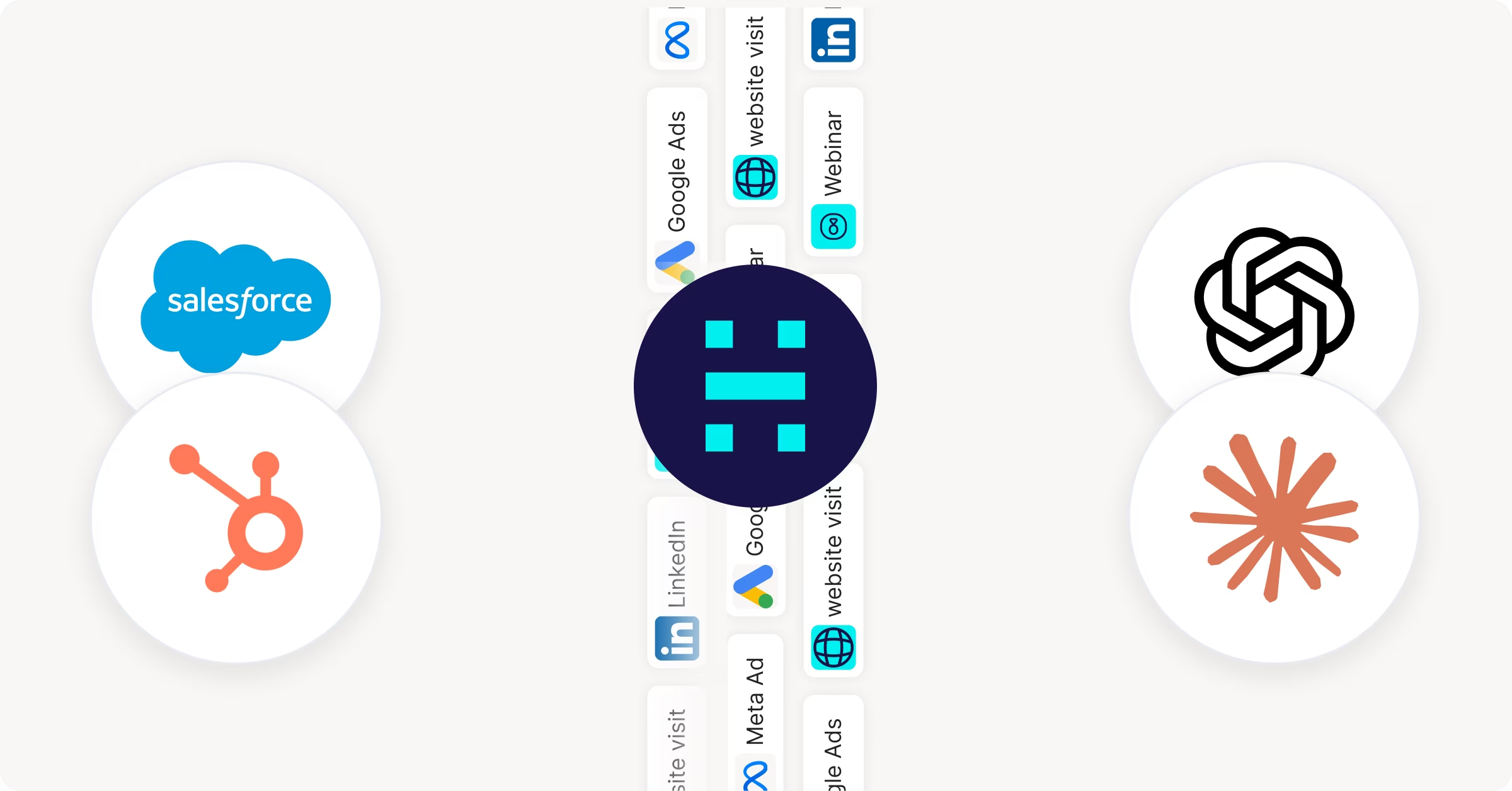

They’re both working to fulfill the promise of becoming your AI colleague connected to your CRM. The expectation is that you can ask any question about pipeline and revenue and get an answer without building the report yourself.
What you’ll end up getting is an analyst who can examine all your CRM records but says nothing about how marketing influenced the record, whether it be a contact or opportunity.
That missing information is the GTM context layer.
That means interaction with your ads. Google Ads keeps ad spend, and LinkedIn stores engagement on LinkedIn, just like the data your other ad platforms and marketing channels keep in silos.
Content engagement is another void your CRM or AI analyst can’t fill on its own. The anonymous session that occurs before the form is filled isn't saved anywhere.
Those glaring data gaps make any questions about which campaigns influenced last quarter's pipeline useless. At best, it will reply based on the Campaign Influence rows that happen to be available, without telling you which ones it couldn't see. You’ll end up with one of two answers: an explanation telling you it can’t reliably give you analysis given the lack of context, or an inaccurate answer with data it confidently delivers.
The link from a campaign to a closed deal and total revenue influence can’t be drawn without filling in the context, no matter how advanced the model is.
Heeet, just like other players in the marketing and revenue intelligence industry, is dead set on gathering the context needed so that your CRM can make the link, and your LLM of choice can reason with the right context to respond and finally act accordingly. Notion is gradually establishing itself as the context layer for a company's knowledge, providing the context their agents need to act.
Marketing, sales and revenue teams have an essential need to track what marketing has done and ensure that context is directly connected to or better yet lives in, the same place as the current revenue records. A connection between marketing intelligence and your CRM is essentially a records issue rather than an AI one, and no amount of prompting will help you overcome that.
Once the two are connected, you can leverage the high-level analysis that ChatGPT Astra or Fable 5.1 can provide, then prompt them further to orchestrate your agents from the comfort of their respective apps or command-line interface.
What is a GTM context layer?
Put plainly, a GTM context layer is a structured record of all the marketing interactions a prospect has with your company, entered into the CRM alongside the pipeline and the revenue they affected. This includes paid clicks, content reads, engagement on LinkedIn, visits through AI search, attendance at webinars, and ad costs, all of which are attached to the lead, account and opportunity records that AI tools are already able to read.
This can be complemented by other sources that build context, like enrichment tools such as Clay. Combined, teams can provide their agents the context they need to move faster with accurate data. This is the competitive edge teams with a marketing intelligence setup that delivers marketing and revenue attribution are building to streamline processes.
The context layer concept isn’t a term we’ve coined; it’s a term companies are using more and more often to describe their role as the centralizer of data, which is the “context” from multiple sources, and acting on it with AI.
Notion has become a prime example of this. When Notion launched its Developer Platform on 13 May 2026, Ivan Zhao described its approach as "any data, any tool, any agent". Notion introduced Custom Agents in February, and since then customers have built over a million.
Notion’s positioning as a knowledge base where employees work every day has made it the memory layer, a knowledge layer, and yes, the context layer for the custom agents in the platform or your AI tool of choice. Notion does not use any of these terms itself. This is our interpretation of what they are developing, and an example of how agents are no more useful than the record they can access.
Another example of a context layer being built in the marketing world is the SEO/GEO context layer that teams at AirOps and Profound are building. With access to Google Analytics 4, Google Search Console, and SEO data from several indexes, primarily Google’s, alongside their AI visibility data, they’re centralizing the data needed to pilot your content strategy so your seen and recommended.
With an abundance of context layers finding their place in the marketing stack, you’ll start to see a very common workflow for B2B companies as follows: Notion contains all the knowledge of the company, such as documents, decisions, plans, and meeting notes; AirOps or Profound hold the search and content context, and Salesforce or HubSpot contains what the company sells, namely accounts and deals together with closed revenue. Heeet, among other competing tools, is positioning itself to provide the marketing and GTM context that lives outside a knowledge base, SEO context, and your CRM, completing the picture for your agents wherever you deploy them.
The GTM context layer is that gap.
There's one thing to deal with since "verified marketing data" is of no use unless it's clearly defined; in this case, it has three specific meanings: touchpoints that are stored as CRM records according to the CRM's permission rules; ad costs that are synchronized hourly from Google, LinkedIn and the other platforms instead of being entered into a spreadsheet at the end of each month; and each credit being reconciled back to the amount for a closed and won deal using a model that was selected by your team and is also available for them to examine. Nothing can refer to one of those three points if it's to use the word.
.avif)
Claude and ChatGPT can’t answer marketing questions from a CRM alone
AI can only reason with the records the CRM contains, since CRMs were designed to store information about relationships and deals, not marketing interactions, that context is out of their reach unless you install a bevy of MCPs and connectors. Even then, nothing is being placed in a single centralized place to create a source of truth that can provide the accurate attribution and customer journey data that is tied to the pipeline and revenue in your CRM.
The GTM context layer is what pulls it all together.
Other tools hold ad spend, impressions, anonymous web sessions, LinkedIn engagement, and multi-touch credit. Heeet brings it all together. For this reason, we can answer attribution questions with confidence.
Marketing intelligence requires four different data streams:
- Expenditure and performance data from advertising platforms.
- Web and content engagement data, including sessions that occur before visitors identify themselves.
- Pipeline and revenue data.
- Self-reported source data—the free-text response to “How did you hear about us?”—which usually outperforms the other attribution models in the stack.
Gaps in the CRM’s own integrations
Salesforce and HubSpot also have shortcomings in data entry and access. While your CRM holds the pipeline and revenue data, a few AI limitations are native to CRM systems that can give your AI tool the wrong context :
- The connector that HubSpot has for Claude can’t read custom objects, which is a big gap for teams.
- The missing contact roles and campaign membership in Salesforce can’t be fixed with AI. That also rings true for missing data in HubSpot.
The extent to which Salesforce Campaign Influence is realized depends on Contact Roles; in the organizations we visit during onboarding, the completion rate ranges from 30 to 50 percent, which limits what any multi-touch model based on it can show.
When you go through dashboard you can spot the gap, but the chat answer conceals it.
If a report shows that 4% of the pipeline is from marketing, the CMO will notice the gap and then search for it. But if Claude produces a paragraph of confident analysis regarding three campaigns, the gaps leave you with faulty reporting.
We constantly hear new prospects repeat time and time again that their attribution tool broke for the same pain: sales reps not associating contacts with opportunities.
Put a number on it. A team spending $42,000 a month on Google Ads asks Claude for return by channel. The CRM holds no cost field for those campaigns. So the model does what any analyst would do with the same datat: it answers the question it can answer, about deal counts and stage progression, and the $42,000 never enters the calculation.
What does Heeet write into Salesforce and HubSpot?
Heeet writes first-click, last-click, and every touchpoint in between onto the lead, account, and opportunity; creates and refreshes paid campaigns with cost, impressions, and clicks every hour; records content reads and LinkedIn engagement by known contacts; and assigns revenue credit per touchpoint using the model you configure—all of it as native CRM records.
The specifics, because this is the part that decides whether an AI tool has anything to work with:
- Paid clicks from Google, LinkedIn, Bing, Meta and Reddit, with the campaign auto-created in the CRM and cost attached to it.
- Organic and AI-search visits classified by engine, so a session that started in ChatGPT, Perplexity, Gemini, or Claude arrives labelled instead of arriving as direct.
- Page views and page actions, including ungated downloads.
- LinkedIn organic engagement by contacts already in the CRM.
- Webinar and event membership, recorded as post-acquisition influence rather than as a fresh lead source.
- Self-reported source, kept as its own influence line instead of being overwritten by the last click.
- Sales activity sits next to marketing activity, so the touchpoint count reflects the full relationship.
Heeet also answers the contact-roles complaint. Heeet calculates influence at account level within the opportunity window. A marketing touch on any contact at that account counts toward the deal whether or not a rep remembered to add the person as a Contact Role.
How do you ask Claude a marketing attribution question in Salesforce?
Connect Salesforce to Claude through the Salesforce in Claude plugin (open beta since September 2026) or through the Salesforce MCP server in Claude Code. Check which objects your user can see. Then ask in ordinary language. The answer will only be as complete as the campaign, cost, and touchpoint records in those objects.
Some context on what shipped
Salesforce and Anthropic announced the partnership on 26 August 2026. Salesforce in Claude arrives with 37 prebuilt skills covering meeting prep, deal health and pipeline review, built on AIforce, which Salesforce calls the "harness" that exposes its data and workflows through MCP servers, APIs and CLI tools. Permissions are managed centrally. Claude Code is named as a component. Dario Amodei framed the point as bringing intelligence "into the systems where much of the world's commercial activity happens."
Read the list of 37 skills and see what's missing. Not one of them is about marketing performance. Marketing gets the interface, but none of the skills or the data.
Here's how to work through it, assuming your admin has enabled the plugin:
- Connect the plugin → Your Salesforce admin enables Salesforce in Claude, or you add the Salesforce MCP server to Claude Code yourself.
- Here’s the expected outcome: Claude returns a list of the objects it can read.
- Here’s the pitfall: it inherits your Salesforce permissions exactly. A marketer without Opportunity read access gets nothing back about revenue. The model won't say why.
Also make sure you audit accuracy before you ask anything real:
- Prompt it to list the fields it can reach on Campaign, CampaignMember, CampaignInfluence and Opportunity, and to say which are populated rather than merely present.
- Expected outcome without a context layer: Campaign cost blank, no web records, no ad records.
- With Heeet in place: influence records, campaign cost, impressions and clicks, all carrying values.
Start by asking a simple revenue question like "Which campaigns influenced the most opportunities in Q3, with cost and revenue credit?" See how that works and whether it’s accurate.
Now start asking the questions your CFO will:
- cost per pipeline-influenced opportunity, split by channel.
With spend on the CRM record, the model can start reasoning and give you the aanswers.
Save the prompts that worked as a skill or a saved query so the team stops rebuilding the same question every quarter and stops getting slightly different answers each time.
We're connecting Claude to our own demo org this month to produce the walkthrough screenshots. The honest position on timing is that the plugin is in open beta. Object coverage is moving. Check it on the day you set this up rather than trusting a list published in September.
What about HubSpot? The same layer, a different data model
HubSpot's remote MCP server went generally available on 13 April 2026, and its connectors carry HubSpot context into Claude, ChatGPT, Gemini and Copilot. The connector reads contacts, companies, deals and engagements. It can't read custom objects. It also never sees ad spend or anonymous sessions. So Heeet writes that data into the standard objects the connector can reach.
HubSpot's own line about this is a good one: "AI doesn't know your business, now it can with HubSpot." I agree with it. The question is what "your business" includes by default.
Three things it doesn't. Revenue attribution and multi-touch models sit behind Marketing Hub Enterprise, which lists at $3,600 a month. Those models credit only interactions HubSpot tracked, leaving out anything that happened on a platform HubSpot doesn't own. And ad spend, despite living inside HubSpot's own Ads tool, never reaches the attribution reports.
Here's how HubSpot build writes touchpoints and cost to Deals, Contacts, and standard properties the connector can read, and keeps the attribution model on our side because HubSpot's model set won't let you configure one the way most teams need. That came up in a Rocketlane demo in August 2026. It comes up most weeks.
One expectation, and it is an expectation rather than something shipped. HubSpot shipped Run Agent as a workflow step in July 2026 and an Agent CLI in June. We expect the read-only connector and the workflow agents to converge. When they do, the marketing record sitting on the object is what those agents will act on, which makes it worth writing now rather than after.
Where does this go next?
Today, the GTM context layer answers questions. Soon, it will feed campaign ideas, targeting, and assets to a tool that executes through MCP connectors into the ad platforms and back into the CRM, so marketers spend their hours deciding what to run instead of setting it up.
We're working towards building that reality. Some peices in that scenario already exist:
- Offline conversion triggers push closed-won revenue back to Google Ads and GA4.
- Audience activation sends CRM segments to the platforms.
- Journey analytics surface the paths that convert fastest,
- and persona-level content performance already informs LinkedIn targeting in demos we run today.
Picture the version that isn't built yet. Claude reads the journey data on your opportunities, tells you the three paths worth prioritizing this quarter, drafts the LinkedIn campaign aimed at the persona that converts on that content, and pushes an exclusion audience to Google Ads. Hence, you stop paying to reach people already in a deal cycle. You approve it, or you don't, with your human in the loop. Don’t forget them.
Nothing in that scene requires a new interface. All of it requires the record on the object, and someone to ask AI the right questions.
Ready to track prospects from lead to close with Heeet?
Heeet gives marketers and sales professionals at IT & Security firms turn geuss work intro informed decisions that drive revenue while meeting the same secruity technical standards you provide your clients.