Read time :
The GTM Harness: Why Your Team's AI Is Only as Smart as the Data It Can Reach
Where AI harnesses for sales and marketing actually live, what context they need, and what leadership gets out of them.



If you've ever asked an AI assistant "which campaigns actually drove pipeline last quarter?" and received a beautifully formatted, completely confident answer that didn't match a single number in your CRM, it's because the harness you're working with isn't connected to the data it needs to give you the answers.
Every marketing team has AI integrated into their stack, but few have wired it into the systems where the truth lives. The truth is defined by several things that unfortunately all live in separate places:
- Ad performance in your ad platforms
- Pipeline and revenue in your CRM
- Web analytics in GA4 and Search Console
- Marketing automation and email outreach tools
Beyond those silos, enterprise-level B2B teams use data lakes or warehouses to store massive amounts of customer interaction data, managed by a data engineer.
Another constant in the stack of mature teams scaling marketing campaigns and ad spend across channels is attribution and ABM tools that give marketers more context wherever they work.
No matter the level of AI maturity within an org, we can all see that the gap that teams face isn't a model problem. The models are excellent. It's a harness problem.
We're all looking to harness the truth within a single interface, but as we can see above, that entails getting the plumbing right behind the command line or your AI workplace of choice.
We call the behind-the-scenes wiring that lets everyone in an org work with the data they need to feed agents a harness. Whether it's dev, HR, legal, finance, or, of course, marketing and sales, everyone needs a harness to ensure they have the right context.
What we mean exactly by a "harness"
First off, a harness is everything wired into your workspace that turns a model's limited knowledge of your company and competition into subject-matter expertise. It has five elements:
- The model selection: the reasoning engine, increasingly interchangeable, depending on the task's complexity.
- The tools: connectors and MCPs that let it read from and write to your CRM, docs, ad platforms, analytics and project tools.
- The context: what it knows about your company, your market and your numbers before you type a word.
- The agents and skills: They work not only on your set instructions, but also feed off the context you provide. Needless to say, you need to keep a steady stream of updated context to keep them working effectively.
- The guardrails: who can use it, what it can touch, and what leadership can see. When you're working with client and revenue data coming from your CRM ir's important to note who has access
The model gets the headlines. The harness decides whether the output is useful on a Tuesday afternoon when your VP asks why paid social spend went up while SQLs went down.

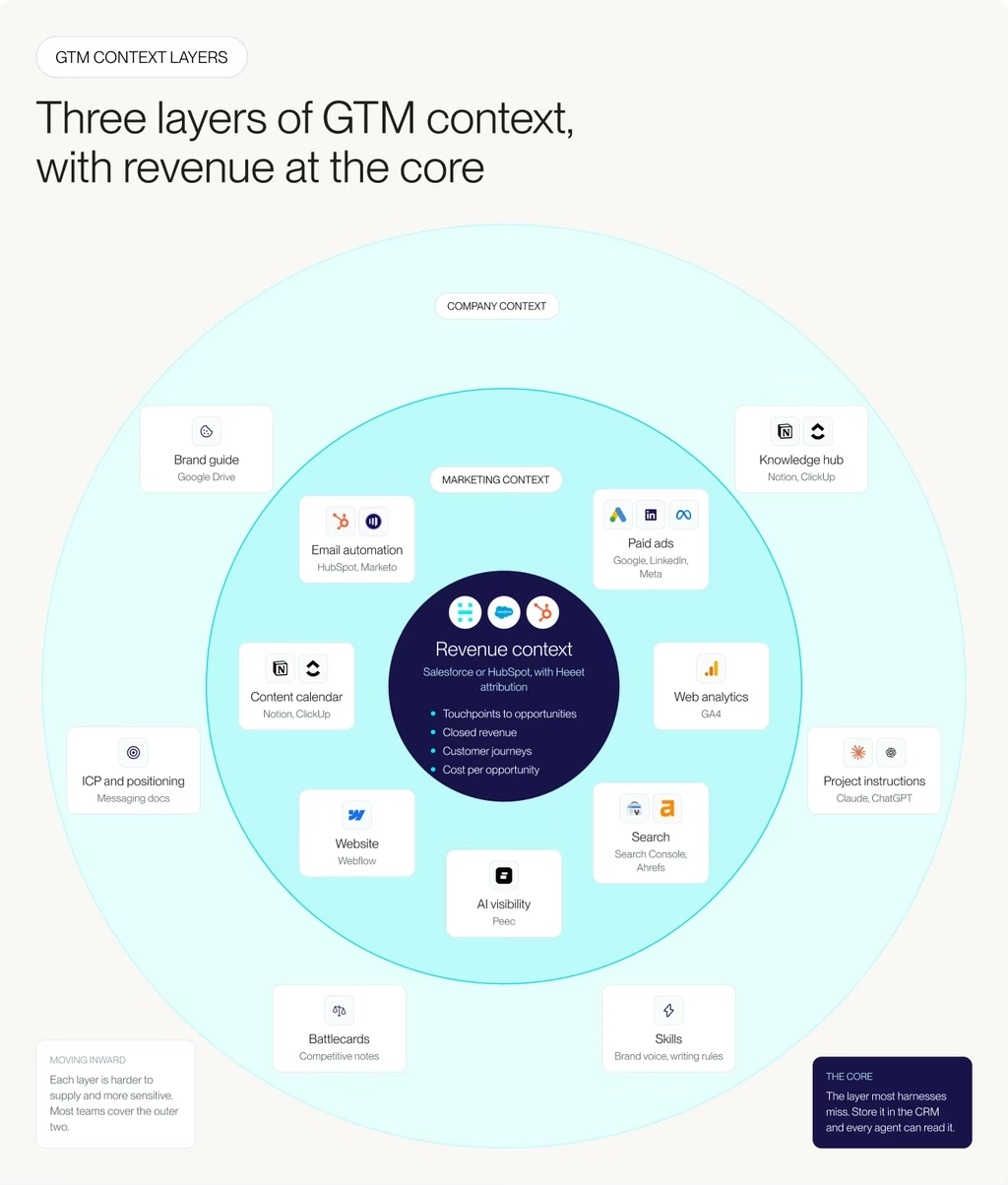
The three layers of context GTM teams need
The idea is to bring as much context as possible. For GTM work, marketers need three layers, each harder to supply than the last and more sensitive because you're wiring it into an AI tool.
Your company context
Positioning, ICP, brand voice, messaging, competitive notes, playbooks. Every team has this in place; we've all spent time keeping company docs up to date: uploading the brand guide, writing project instructions, describing products in detail, and building battlecards.
Your marketing context
Campaigns, content inventory, channel performance, SEO and AI visibility data. It's harder because it's scattered across a dozen platforms; while connectors are catching up fast, that still doesn't mean AI can reliably link leads to marketing context across different data sources. That would require the model to reconcile data from touchpoints to leads, accounts, and opportunities while calculating acquisition cost across paid campaign touches, events, and more. This is where revenue context comes into play.
Your revenue context
Which touchpoints influenced which opportunities, what closed, at what value, and through which journey; as mentioned above, this layer tells you what is actually driving revenue and at what cost. I avoid calling this revenue intelligence, since the term is most often used by tools like Gong and Clari, along with other call-recording and email analysis tools. I think their definition is too narrow and doesn't capture the ad-cost and customer-journey elements that account for content consumption from first click to close.
Bonus context: outside signals
I said three, but here's the fourth. While you can amass first-party data to start your GTM motion or optimize retargeting and messaging, finding new clients in market based on signals adds another layer of context. Solutions like ZoomInfo, Cognism, Apollo, and Clay, along with other waterfall enrichment tools, bring the data you need to target quality leads. I don't classify this as marketing context, but it's closely tied and used daily to start the GTM motion.
Combining all three to create an efficient agent
We've all spent our time as marketers giving AI access to the first two layers. That largely consists of documenting your work and company context in a knowledge base, whether it's Notion, ClickUp, or something else. You've also linked every marketing tool under the sun not only to provide context, but to use MCPs and connectors to avoid interfaces and get work done faster.
We argue that the third layer is not only the most sensitive but also the hardest to provide in your harness, and thus to agents.
An AI with the first two layers but not the third is a junior hire that hasn't learned the language of revenue yet and still needs reminders to measure, analyze, and optimize based on the numbers instead of intuition, copying competition and trends. Plug in the third layer, and you get a revenue-focused colleague who looks at what works, at what cost, and where you can reallocate budget and focus efforts to scale pipeline and revenue.
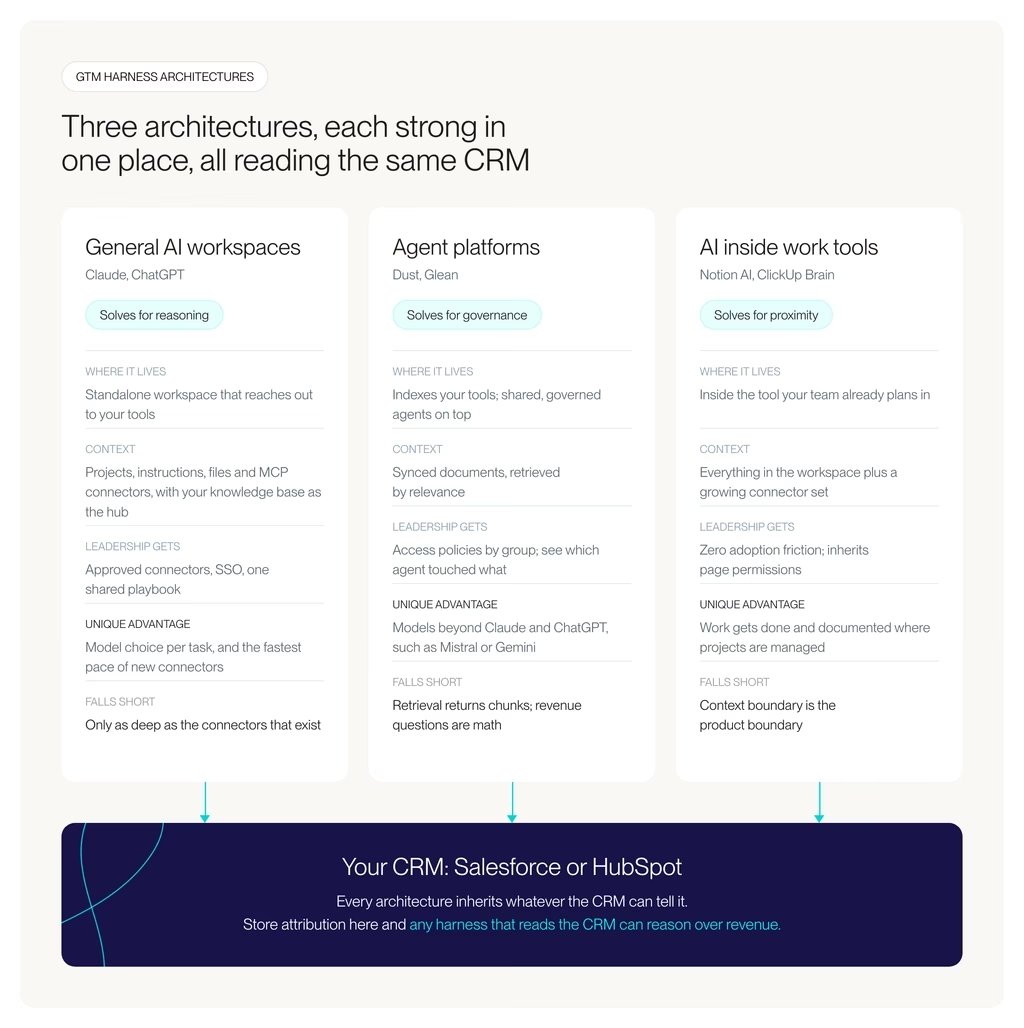
Where harnesses live today: three architectures
You don't need another comparison article; you'll likely need to stick with the tools you already have for the foreseeable future. You need to know what kind of harness you're building, and how to fill the gaps, because each one trades off reach, governance, and depth differently.
1. General AI workspaces (Claude, ChatGPT)
Where it lives: A standalone workspace that reaches out to your tools. Think Claude Team and Enterprise, or ChatGPT Business and Enterprise.
How it gets context: Projects, instructions, uploaded files, and connectors built on the Model Context Protocol (MCP). One connector worth mentioning is your knowledge base, which every team constantly updates and uses to feed company context to Heeet. At Heeet, we use Notion as the hub for all company info, strategy, and documents that feed Claude agents. Without it, we couldn't move as quickly or manage projects as fast. It works the same way for ChatGPT and ensures everyone in your org works with the knowledge hub plugged into their harness.
You set permissions for which departments can see, use, and export data in your separate tools, like Notion or Salesforce, and your admin can put them in place.
What leadership gets: Admin control over which connectors are approved, single sign-on, and one consistent playbook rolled out to every rep and marketer.
Where it falls short: Reach depends entirely on which connectors exist for each tool and how deep they go. Being able to include unofficial MCPs or vibe-coding your own all depends, of course, on the security policy of your org. On the CRM side, Claude's deepest Salesforce experience is still early, and we're thoroughly testing it to see how well it stacks up to Agentforce in Salesforce for certain tasks, and what marketers can actually get done with the connector now live. For more, read our initial testing and insights here.
Unique advantage:
The upside is much more transparency in model selection for each task, since we're all familiar with setting up agents with the right models or simply choosing a model before prompting. Another obvious benefit is the scale at which Claude and ChatGPT add new features and connectors. They set the pace, and everyone else catches up or gets left behind after each update.
2. Agent platforms on company knowledge (Dust, Glean)
Where it lives: This is an additional layer that indexes your company's tools and lets teams build shared, governed agents on top. Dust leans toward agents that do work; Glean started as enterprise search and grew agents from there.
How it gets context: Broad connector libraries that sync and index documents, conversations and records, then retrieve the relevant context when someone asks a question.
What leadership gets: This governance-first architecture lets org admins manage access from an additional layer instead of from each platform outside of the harness. Glean lets admins combine access, behaviour, and usage rules into a single policy scoped to specific groups or agents. If you need to know exactly which agent touched which data, this is the strongest story.
Where it falls short: Retrieval is built for documents, and revenue questions are math. Dust's own documentation is refreshingly honest about this: semantic search often falls short on quantitative questions because it returns chunks ranked by relevance, which is why Dust built a SQL-based tool to fill the gap.
You're also limited to a certain number of connectors and MCPs, depending on your subscription type. That costs nothing to set up.
Looking closer at Glean, it caps tool calls per agent run and truncates oversized tool responses, recommending batching or warehouse queries for large datasets. Then there's commitment. Glean doesn't publish pricing, and buyer reports suggest a roughly 100-seat minimum. That's a non-starter for many orgs; it seems like Glean is laser-focused on the enterprise segment.
Unique advantage: Much like Perplexity, these agent platforms allow you to use models outside of the Claude or ChatGPT universe, such as Mistral or Gemini, so you're not tied to the limits of one model or another
3. AI built into work tools (Notion AI, ClickUp Brain)
Where it lives: Inside the tool your team already uses to plan, document and project manage.
How it gets context: Everything in the workspace, plus a growing set of connectors.
What leadership gets: There's zero adoption friction here as your entire org probably has access to the tool. If your team already lives in Notion or ClickUp, the AI is right there, and it inherits existing page permissions.
Where it falls short: The context boundary is the product boundary. Independent 2026 reviews describe Notion AI as operating only inside Notion: connectors read from outside sources, but agents can't write back to tools like Slack or Gmail. Notion added a Salesforce connector, but reading a CRM through a workspace tool is far from reasoning over attribution data. Notion's latest update to Notion AI may be a turning point, but only time will tell, as it was released a few days ago.
ClickUp Brain is a paid add-on, and user feedback on ClickUp's forum describes the assistant giving confident instructions that turned out to be wrong and relying on stale information.
These tools are excellent at organizing work. While they're both racing to become the hub for all work, they weren't designed to be where revenue gets understood.
Unique advantage: As I mentioned above, projects are managed here, so the work gets done and documented, whether by the employee or the agent, in Notion or ClickUp.
The common failure: no harness fixes a broken data foundation
A common pattern runs through all three options. Each architecture solves a different problem: reasoning, governance or proximity. None of them solves revenue context on its own. They all inherit whatever your CRM can tell them, then bring in marketing context, and, more specifically, ad performance and cost, from several sources via connectors.
If your attribution lives in a spreadsheet someone updates on the 3rd of every month, the harness reads a stale export. If it lives in a tool outside the CRM, that's one more connector that may not exist, may be read-only, or may disagree with the pipeline numbers sales sees every day. And if touchpoints never made it into the CRM at all, the AI fills the gap with something plausible. That's how confident fiction ends up in the board deck.

You can treat this with another attribution layer. Attribution platforms including Heeet's, among others on the long list, link marketing, ad costs, and the pipeline and revenue in your CRM so you can see the customer journey. Just keep in mind that most add another layer outside the CRM, adding complexity and another place where your revenue data is used to recreate the truth.
That's why we built Heeet the way we did for Salesforce and HubSpot. Heeet connects every marketing touchpoint to the opportunities and revenue it influenced, and stores that data natively in Salesforce and HubSpot. The customer journey, content ROI, paid ads ROI and lead intelligence for sales all live as CRM data, governed by the same permissions as everything else.
The consequence for AI is simple: any harness that can read your CRM can reason over your revenue truth. You don't need to pick the "right" architecture for attribution if it lives in your CRM.
What this looks like in practice
Here's how I run content at Heeet.
I work in Claude, connected to Notion (our editorial calendar and content inventory), Webflow (the site), Ahrefs (search data), Peec (AI visibility), Slack and Google Drive. Company context lives in Notion: project instructions and custom skills: company knowledge, product knowledge, brand voice, writing rules, our internal linking method.
The revenue layer comes from Salesforce.
With Claude connected to our CRM, it reads Heeet's attribution data directly, so a question like "which articles influenced the most pipeline this quarter, and which of those are losing rankings?" gets answered from real sources instead of a guess. The same setup works with HubSpot.
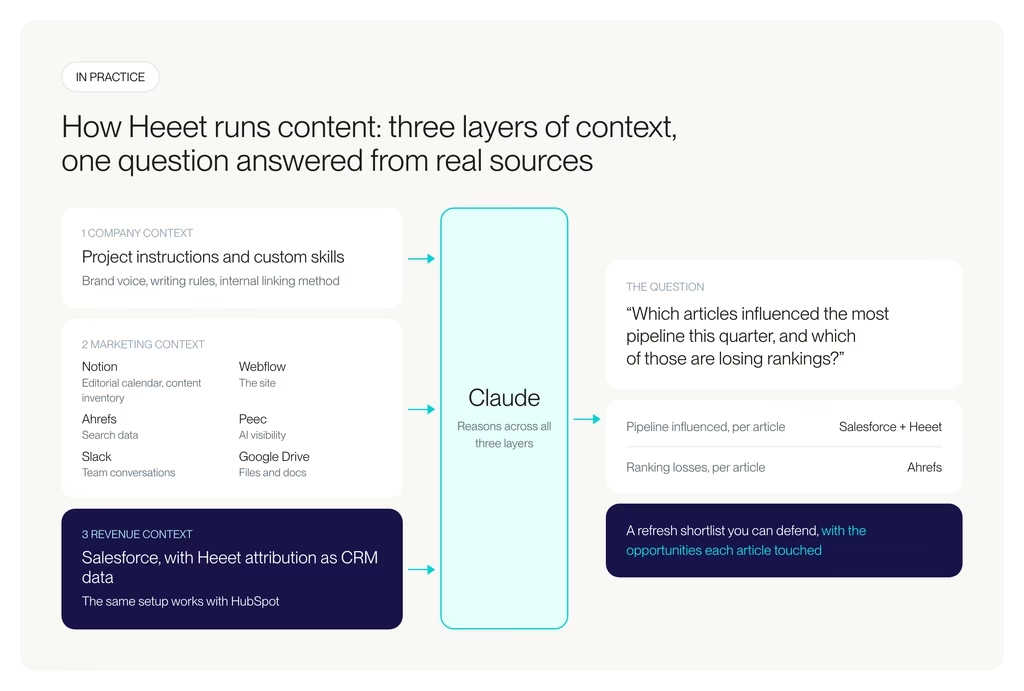
While this setup speeds things up, the real difference is that the output is defensible and comes from a single source, so marketing, sales, and revenue teams use the same numbers to attribute pipeline and revenue. When I recommend refreshing an article, I can show the opportunities it touched. When leadership asks what content is worth it, the answer comes from the same CRM data that drives sales forecasts.
What leadership should ask before scaling any harness?
Whichever architecture you choose, four questions decide whether it informs the org or produces more content:
- Can it reach revenue data, or only revenue documents?
- Do all teams get the same numbers? If marketing's AI and sales' CRM disagree, you've automated constant arguments.
- Who controls access, and can you see which agents touch it? Governance is a requirement, not a phase-two item.
- Where does the data actually live? Every copy outside the CRM is another version of the revenue truth, pieced together and shipped back to your CRM.

The bottom line
The harness conversation usually starts with "which AI should we buy?", and rightfully so. It seems like every tool we've learned to love is trying to replace every tool's UI and become the default workspace. Keep the foundation in mind, and have an answer for "what will our AI know and how? "
Pick the architecture that fits how your teams already work. Then give it the one layer of context that turns activity into answers. When marketing touchpoints and revenue outcomes live together in your CRM, every agent you deploy stops guessing and starts proving what's driving growth.
Sources
- Claude Cowork plugins updates, eesel AI
- Company knowledge in ChatGPT, OpenAI Help Center
- Claudeforce: Salesforce Meets Claude, SalesforceTime
- Glean Agents at Glean:GO 2026, Glean blog
- Agent execution limits, Glean docs
- Understanding LLM limitations, Dust docs
- Glean alternatives and pricing, Atlan
- Notion AI Review 2026, Fast.io
- Notion AI review 2026, eesel AI
- ClickUp Brain review, eesel AI
- Two weeks with ClickUp Brain: honest feedback, ClickUp forum
Ready to track prospects from lead to close with Heeet?
Heeet gives marketers and sales professionals at IT & Security firms turn geuss work intro informed decisions that drive revenue while meeting the same secruity technical standards you provide your clients.