

Read time :
How to Prove Marketing’s Impact on Sales-Sourced Deals (Beyond MQLs)
You and sales both know marketing shaped that deal, but your CRM's limited tracking doesn't capture or prove marketing’s real impact on sales-sourced deals.

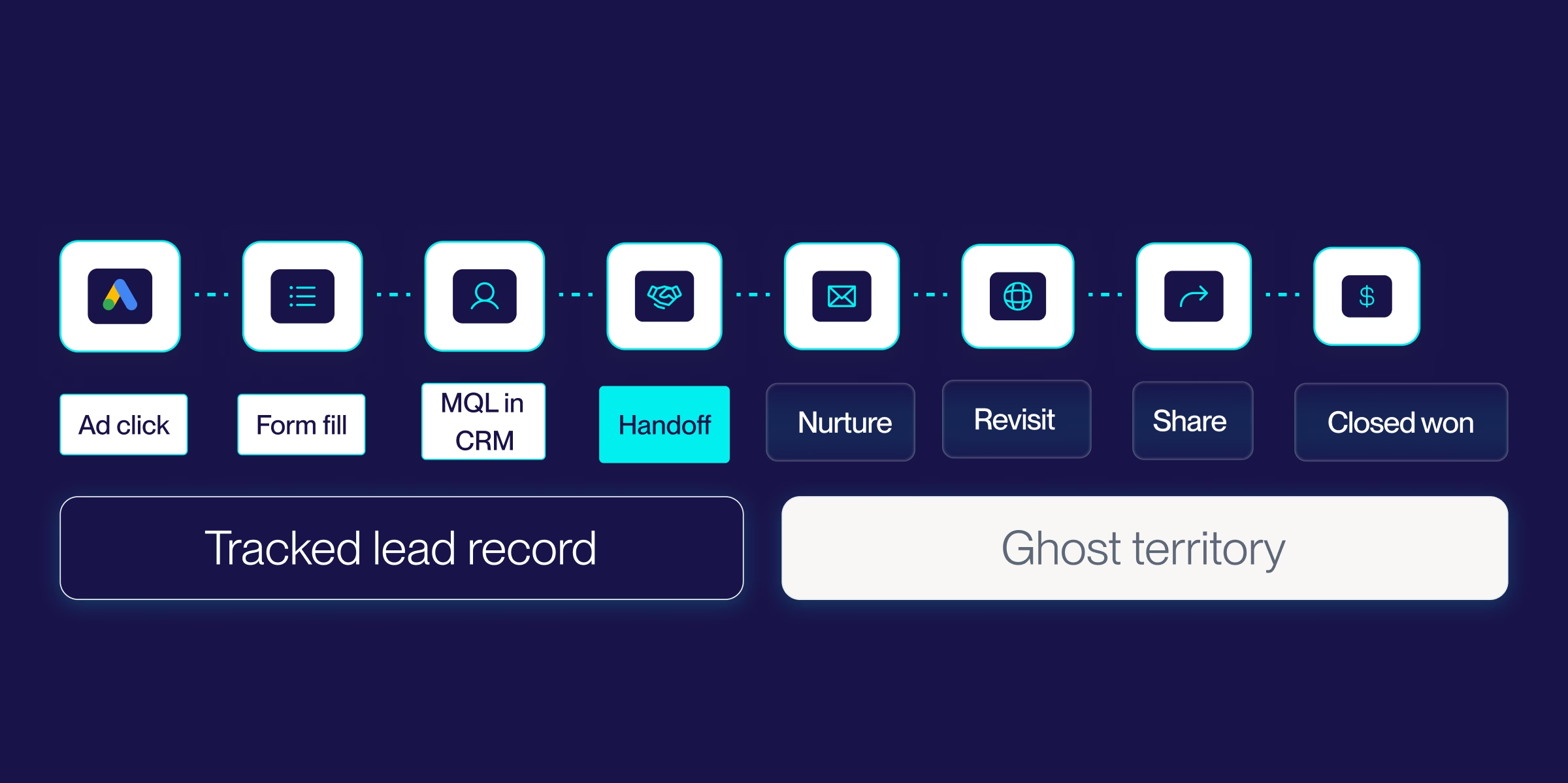

Pipeline reports feature “Sales-sourced. Outbound.” so all credit goes to the AE. There’s no mention of the webinar top prospects attended in Q1, the three case studies downloaded during evaluation, or retargeting impressions that kept your brand top-of-mind as the buying committee deliberated.
Don’t let this become an expensive pattern in your B2B org. Misalignment between sales and marketing is costing B2B companies due to uninformed allocation decisions. A big chunk of that tax is paid because marketing doesn't get credit for the work that moves late-stage deals and ends up seeing cuts to campaigns or content that accelerate deals. You can fix it. But the fix is less about better reporting and more about deciding who owns the truth.
Here’s how proving marketing’s impact on sales-sourced deals looks when your data exists where deals actually happen.
How do you prove marketing’s impact on sales-sourced deals?
Track every post-MQL touchpoint against opportunities, measure influenced revenue and pipeline velocity, and report in the same system sales and finance use. Attribution outside the CRM is consistently challenged, but inside, the debate ends.
Three things have to be true at once.
- The touchpoints have to be captured. Webinars, case-study downloads, ad clicks, content engagement, and sales-shared assets all get logged on contact and opportunity records.
- Credit has to be assigned transparently. A multi-touch attribution model shows how influence is distributed across the journey, rather than hidden in a black-box algorithm.
- The data has to be available where decisions are made. That’s the Salesforce or HubSpot opportunity record, not a separate dashboard that only marketing opens.
Miss any one of those, and you’re back to “did marketing help?” in the QBR.
Why does marketing get erased from sales-sourced deals?
Marketing gets erased from sales-sourced deals because traditional CRM attribution was built to track formal campaign membership, not real buyer behaviour. Cold calls and rep-created opportunities don’t generate campaign records. So every touchpoint that happened before or after the rep’s outreach quietly disappears from the data. It’s not a reporting oversight. It’s a structural blind spot.
Three specific failures contribute to this erasure.
Last-touch bias. Most CRM reports credit the last action before the opportunity. If a rep’s cold call is the “last touch,” the webinar and case studies before it are invisible. The pipeline’s top number shows a moment, not a journey.
Post-MQL tracking falls short. Most systems stop tracking marketing touches at handoff, as if buyers stop engaging after the sales call. They don’t, but your data says otherwise.
Manual contact-role gaps. When reps create opportunities without associating with every influenced contact, attribution breaks. Six on the buying committee. Two get tagged. Marketing’s influence on the other four disappears.
The cost of these failures is not academic. Marketing loses credibility in budget season. Sales inherits credit that isn’t wholly theirs, then wonders why their win rate drops when marketing pulls back. This is the pattern Heeet has written about in how RevOps teams close the attribution gap, and it’s the single biggest reason teams end up defending marketing spend in revenue planning season with activity metrics instead of revenue data.
What’s the difference between a marketing-sourced and marketing-influenced pipeline?
A marketing-sourced pipeline is an opportunity where marketing generated the first touch. Marketing-influenced pipeline refers to opportunities where marketing touched contacts at any point in the journey, regardless of who created the record. In a B2B buying motion with six or more stakeholders per deal, the influenced pipeline is almost always larger than the other. Most teams only report on sourcing, which means they lose credit they've earned.
Here’s the best way to think of the two metrics.
The mistake most teams make is reporting only sourced metrics that CFOs see and tie directly to budgets. Shifting the conversation to include the influenced pipeline doesn’t replace sourced: it means showing marketing’s real footprint.
Where does marketing show up after the MQL handoff?
Marketing shows up everywhere in a sales-sourced deal once you look. Buyers don’t stop researching after a rep’s first call. They validate. They share. They revisit. Each of those moments leaves a trace you can capture if you’re tracking at the opportunity level, not just the lead level.
Here are four places marketing quietly moves deals along after the handoff:
- Content that supports active evaluations: Prospects read case studies to validate the rep’s pitch. They share blog posts with peers on the buying committee. They revisit pricing pages before internal meetings. If you’re tracking engagement by contact and account, every one of those moments shows up on the opportunity.
- Nurture campaigns that re-engage stalled deals: A deal goes cold for six weeks. An automated nurture email with a relevant analyst report lands at the right moment and restarts the conversation. The rep takes the callback. Revenue attribution that counts the touch gives marketing credit for the save.
- Sales-enablement assets shared inside active cycles: One-pagers, ROI calculators, battle cards, proposal templates: marketing builds them, sales uses them. When reps share those assets via tracked links or CRM-logged activities, the engagement is attributed back to marketing rather than disappearing into a private email discussion.
- Account-Based Marketing (ABM) retargeting focuses on open accounts: Your search and LinkedIn campaigns keep marketing front and center for these accounts over a six-month evaluation period. Twenty views of your ads and content, distributed among members of the buying committee, measurably shorten sales cycles in accounts that see the ads compared with those that don’t. That’s influence worth measuring.
Which metrics prove marketing influence on revenue?
Metrics that prove marketing influence include influenced pipeline value, marketing-attributed revenue, pipeline velocity by channel, and influenced-deal win rate. Each metric answers critical CFO questions. Omitting any leaves leaves a gap that finance will spot.
Influenced pipeline value: The total dollar value of open and closed opportunities where at least one contact engaged with marketing. Answers “how much pipeline did marketing touch?” This is the number most teams under-report.
Marketing-attributed revenue: Closed-won revenue with partial or full credit assigned to marketing via your attribution model. Answers “how much closed revenue does marketing own?” The specific percentage depends on your model, but the number itself is the one leadership remembers.
Pipeline velocity by marketing channel: How quickly opportunities move through stages, segmented by which marketing channels touched them. Answers “Which channels accelerate deals?” This is where you find the unglamorous channels that shorten cycles by 30%, and nobody was crediting.
Influenced the deal win rate: Win rate on marketing-influenced opportunities versus non-influenced opportunities. Answers “Does marketing improve outcomes?” A higher win rate on influenced deals is how you turn a correlation argument into a causation argument.
When Ringover, a B2B SaaS communications platform, implemented Heeet’s native attribution layer, they saw a 24% improvement in marketing-generated revenue attribution accuracy and a 14% lift in Google Ads ROAS once closed-won revenue was syncing back into their bid optimization. “With Heeet, we get full-funnel visibility across Google Ads, LinkedIn, and Facebook,” said Vincent Coulondres, Head of Growth at Ringover. Those numbers are what full-funnel attribution looks like when the data stays where the deals live. The foundation for all of it is connecting activities to closed revenue at the opportunity level, not the lead level.
How do you track post-MQL touchpoints in your CRM?
You track post-MQL touchpoints by registering every contact and account interaction as a first-party event, associating those events with opportunity records (not just contacts), and surfacing the data directly in Salesforce or HubSpot. If you have to export to a report, reps will stop checking it.
Five steps, in order.
- Capture every touchpoint at the contact and account level. Page views, email opens, ad clicks, content downloads, webinar attendance, call attendance: all of it gets logged on individual contact records and rolled up at the account level for ABM visibility. Server-side tracking handles the cookieless reality so the data survives browser changes.
- Associate content engagement with open opportunities, not just contacts. This is the single move most teams skip. Linking engagement to the opportunity record (and not burying it in contact history) makes influence visible during the deal cycle, not after the fact.
- Build influence fields on the opportunity record. Three custom fields do most of the work: a “Marketing Influenced” checkbox, a “Last Marketing Touch Date” field, and a “Marketing Touches Count” roll-up. Reps see them. Sales leadership sees them. Finance sees them.
- Choose an attribution infrastructure native to your CRM. If your team runs on Salesforce, use native Salesforce attribution. If you’re on HubSpot, the equivalent is HubSpot's native attribution. CRM-native means the data never leaves, no manual exports, no warehouse lag, no second login for your reps.
- Build CRM reports that show marketing activity by deal stage. A report that filters opportunities by stage and overlays marketing touches reveals the patterns sales leadership cares about: which stages marketing accelerates, which ones it stalls at, and which channels belong to which stage.
Follow this sequence, and you'll go from blind to operational in 2 to 4 weeks. Skip the CRM-native requirement, and the rest of the work produces reports your reps will never read.
Which attribution model works best for influenced-deal reporting?
For proving marketing’s impact on sales-sourced deals, avoid single-touch models and use a multi-touch model that distributes credit across the journey. U- or W-shaped attribution works best for most B2B companies because they capture the moments that matter most: first touch, lead creation, and opportunity creation, in the case of U-shaped attribution. Linear works for content-heavy funnels. Custom-blended models fit longer cycles, where post-opportunity touches deserve weight.
The important thing to note is that no attribution model, single-touch or multi-touch, is one size fits all. Your product service has a unique buyer journey that needs to be tracked. What needs to be prioritized in B2B orgs is how you track the lead after the handoff. You can decide how to weigh credit as you wish, but without the tracking, you’re left without the data to show marketing’s impact and the insight to tweak your attribution approach.
That’s why we advocate for the custom-blended model approach that leverages tcapable tracking. It’s worth the effort and investment in longer cycles where post-opportunity touches (case studies during evaluation, ABM ads during proposal review) need to be revealed and deserve heavier weighting than top-of-funnel awareness. The key is documenting your methodology so sales and finance trust the math.
The single most useful piece of expert advice we can give you here at Heeet, is not to rely solely on first-touch and last-touch for sales-sourced deals. Single-touch models force an artificial choice. In a rep-sourced deal, first-touch is often credited to the outbound cold call. Last-touch often credits the last rep email before close. Marketing disappears twice in the same report.
Whichever you pick, the one rule is write it down. Most credit issues stem from undocumented models, not from wrong ones. For a full breakdown, see " Picking the Right Attribution Model for Your B2B Sales Cycle.
How do you present marketing influence to your CFO?
You present marketing influence to your CFO by leading with dollars (not activity), showing win-rate and velocity differences between influenced and non-influenced deals, and anchoring every claim to a specific closed-won opportunity the CFO can verify. Vague influence numbers get questioned. Specific ones paired with deal evidence get funded.
Three moves that change the conversation.
Lead with revenue, not volume. “Marketing influenced $4.2 million in closed-won revenue this quarter, across 38 opportunities, with an average deal size 22% larger than non-influenced deals.” That sentence beats any dashboard screenshot. Lead with the number you want finance to remember.
Show influence against the win rate and cycle time. The single most persuasive slide in a CFO meeting compares influenced deals against non-influenced deals on win rate and days-to-close. If your influenced deals win at 38% and non-influenced at 24%, that fourteen-point gap is your budget case. Velocity differences work the same way.
Anchor with deal-level evidence. Pull two or three closed-won opportunities and walk the CFO through every marketing touch on the opportunity record. Webinar on day 47. Case study download on day 83. ABM ad exposure from day 100 onward. The deal-level story is what separates attribution-as-reporting from attribution-as-proof.
This is also the conversation where marketing-influenced reporting stops being a marketing deliverable and starts being a shared RevOps output. Sales, marketing, and finance all working off the same opportunity-level data is what the larger category of revenue intelligence looks like in practice.
Stop fighting over credit. Start measuring influence where deals live.
If you’re arguing about who sourced the deal, you’ve already lost. The only attribution that ends that argument is the one sitting on the opportunity record, which both teams already open every morning.
That’s the wedge Heeet has been built around since day one. Multi-touch attribution, content tracking, ABM measurement, and ad-platform revenue sync all run natively inside Salesforce and HubSpot. Reps see marketing influence on the opportunity record. Sales leadership sees win-rate differences between influenced and non-influenced deals. Finance sees revenue reconciled to campaigns. Nobody has to open a second dashboard to trust the number.
That’s what it looks like when marketing’s contribution to sales-sourced deals stops being a debate and starts being data.
See Heeet in your CRM. Live in hours, not weeks.
Other articles
Are you separating marketing driven VS sales driven acquisition costs and interactions?
CAC (Customer Acquisition Costs) a metrics calculating how much you spent to acquire customers by dividing marketing + sales costs per the number of customers within a specific period of time
First-Touch vs Multi-Touch Attribution: Which Model to Use
See how first-touch, last-touch and multi-touch credit revenue differently, with examples of what each model hides and which fits a B2B sales cycle.

Sales and Marketing Attribution Conflict: How RevOps Solves the Credit War
Discover why sales and marketing teams fight over attribution and how RevOps can fix it. Learn multi-touch attribution strategies that align B2B GTM teams and drive revenue instead of conflict.
.svg)
Ready to track prospects from lead to close with Heeet?
Heeet gives marketers and sales professionals at IT & Security firms turn geuss work intro informed decisions that drive revenue while meeting the same secruity technical standards you provide your clients.