
Read time :
Proving and Protecting SEO ROI in the Age of Scaled AI Content with Agents
As a content writer and SEO enthusiast myself, I wanted to share what we do at Heeet to create content, show you how we prove it’s generating pipeline and influencing revenue, and share how we’ve started using analyst agents to focus on reporting.

.avif)

You’ve either fallen into one of two camps when it comes to scaling content with AI. The side that has dived in without hesitation and tried every AI content tool on the market, or you fall on the side that has tied AI into your writing workflow tentatively with structures, ideation and research.
Either way, writers and SEO experts not only feel the pressure to show leadership they use AI to produce more at a faster pace, but also to prove the ROI of said tools for their SEO efforts.
Measuring SEO ROI means showing that organic search generated real pipeline, not just sessions. That means being able to tie engagement to leads and track the buyer journey from first click to close.
As a content writer and SEO enthusiast myself, I wanted to share what we do at Heeet to create content, show you how we prove it’s generating pipeline and influencing revenue, and share how we’ve started using analyst agents to focus on reporting.
First, a quick look at the risks of scaled content that are being felt after chagnes in Google's latest core updates.
The risks in sudden traffic drops that come with AI content at scale
In May 2026, Lily Ray published an unsettling analysis of sites that are scaling content with AI to chase rankings and openly credited AI content platforms for their growth. She did the legwork and tracked more than 220 websites that had publicly credited AI content tools for their growth. Across that group, 54% had lost at least 30% of their peak organic traffic. 39% lost half. Almost a quarter lost three-quarters of it.
Her data, drawn from third-party tools like Ahrefs and Sistrix, showed a recurring pattern: pages climb quickly over six to twelve months, traffic peaks within three to six months of that, and then a steep decline erases most of the gains, often dropping below where the site started. It’s what’s become known as the “Rank and Tank” effect.
Why AI-content scaling puts organic revenue at risk
Here’s what changed under the SEO lead’s feet as I mentioned in the intro. AI removed the publishing speed limit and raised expectations from leadership, who want to know how you’re leveraging AI to boost AI visibility. This leads teams to the decision to push out thousands of pages in a single quarter, and for a while, many of them rank.
Then updates happen at Google and ChatGPT, and they don’t.
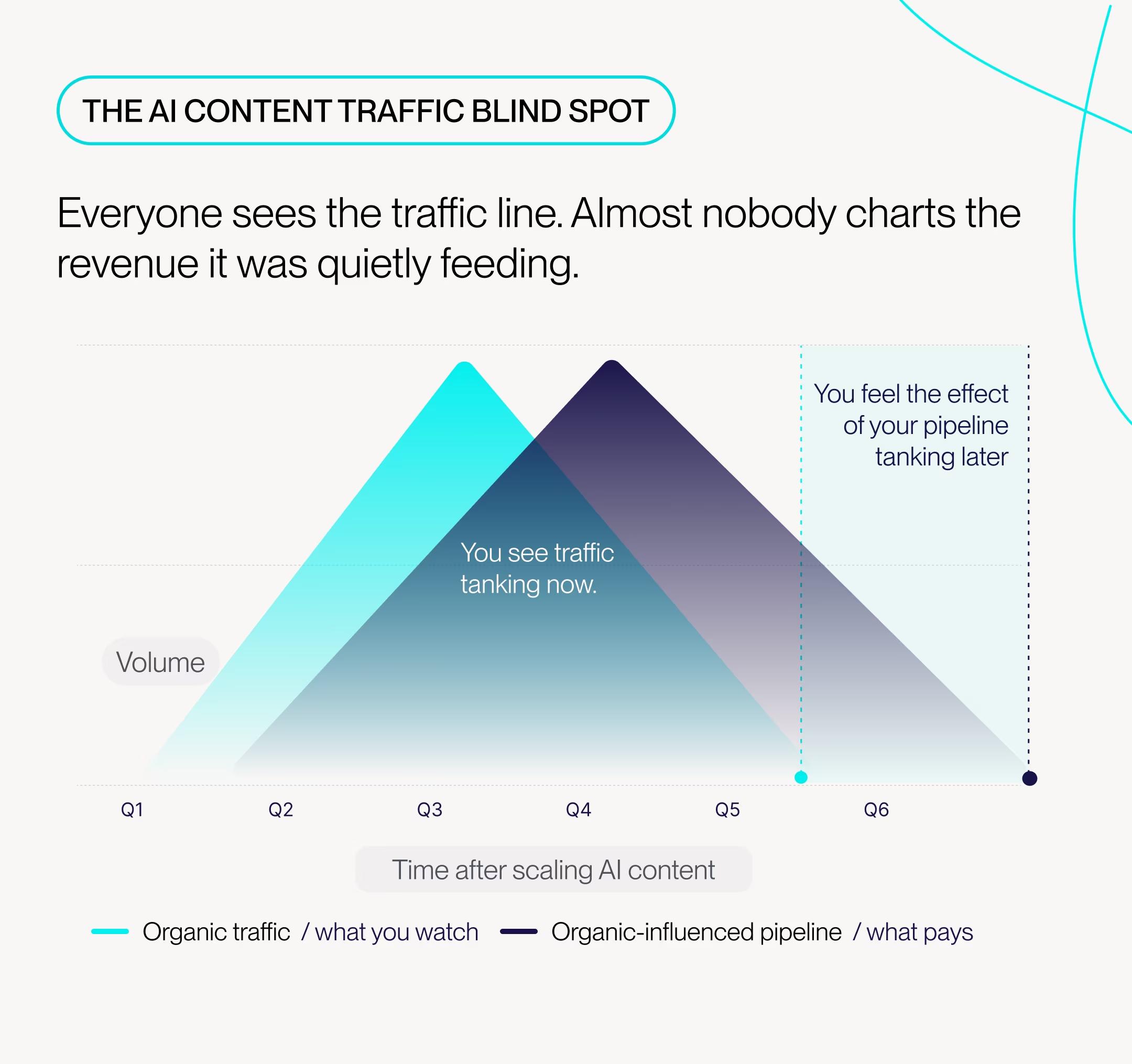
If you’re living in the LinkedIn or X SEO algorithm, you’ve seen the charts of traffic cliff dives that have been circulating, but the other half of the SEO ROI problem that should be closely followed is the drop in pipeline resulting from the roller coaster-like drops. The problem is almost nobody can measure it effectively.
Connecting traffic losses to revenue, this is the part traffic tools miss. Let’s say the content you were scaling was generating revenue-driving traffic. When the AI-scaled pages tank, you don’t just lose sessions; you lose the early-journey touches that were feeding pipeline. And because organic influence closes months later, you feel the traffic drop in your analytics today and the pipeline drop two quarters from now, long after the moment you could have acted.
A team watching only sessions sees a scary chart. A team that ties those pages to revenue influence sees which deals-in-progress just saw the page that started them tank and the projected dip in future pipeline.
That’s the case for measuring the downside as carefully as the upside.
The scaled-content patterns most exposed to a tank.
Reviewing top-traffic URLs across the declining sites, Lily Ray identified eight recurring page templates. They all share one useful trait for anyone doing the monitoring: they leave a clear URL fingerprint, which lets you group them and monitor them as a set.
None of these are inherently bad and can be relevant articles that provide real value to your audience. They also rank, which is why teams build them. However, the risk shows up when they’re scaled by templates and so-called second-company brains, until the pattern itself becomes the signal Google demotes. For example, the 100+ comparison guides may not be the best call. Everything in moderation, but above all, think of providing unique value if youre considering publishing the articles below, just as any other content:
- Comparison pages at scale: Pattern: /blog/[product-A]-vs-[product-B], published across most head-to-head matchups in a category. Inside Lily Ray’s dataset, this stretched to framework-vs-framework and even concept-vs-concept pairings unrelated to the publisher’s business. Another issue with this type of article is that you honestly haven't used the competitor's product.
- The “What is X” glossary: Single-term pages built for AI citation. Pattern: /glossary/[term] or /resources/what-is-[term], often scaled across multiple languages from one template. Machine-translated glossaries without human review tend to drag down sitewide quality.
- The “Best [X] for [Y]” listicle: The affiliate-era template, now the most familiar AI-content play. Broad-category and narrow-niche variants both showed up. Again, going past the bias, Google doesn’t like this because you haven’t used the other products in your list.
- The self-promotional listicle: A “best” list where the publisher ranks itself #1, usually with no evidence it tested the competitors, which is exactly what Google asks for on review pages. Once Lily Ray dug into a late-January 2026 traffic event, many sites running dozens to thousands of these dropped hard on roughly the same day, around January 21, 2026, most aggressively in B2B services. Are you seeing a theme? When you compare yourself to tools you haven’t used, you’ll have to tread lightly.
- The competitor-vs-alternatives page: Pattern: /blog/[competitor-brand]-alternatives, or a dedicated landing page for every named competitor in a category. One site in the dataset had most of its top-traffic pages built around individual competitor names.
- Programmatic location and language scaling: One template multiplied across every city, state, or language a search engine will index, with little unique content per page, often for locations where the company has no real presence. Google has been penalizing this for a decade.
- The FAQ farm: One question per page. Pattern: /faq/[full-question], engineered for extraction: question in the URL, answer in the first line, bullets, schema at the bottom. Google announced it was deprecating FAQ rich results, which tells you where this is heading.
If several of these describe your subfolder, that’s not a reason to panic. It’s a reason to measure. The point of naming the patterns is so you can review a dashboard or point an agent to them, and let it tell you, in pipeline terms, whether the risk is theoretical or already showing up in your numbers.
Before you can start reviewing the link between ungated content and revenue, you’ll need the tools to follow the journey.
The problem is most B2B teams don’t have the tools to show revenue impact
In B2B, tracking the revenue impact of organic visits is notoriously hard to prove because the value shows up months after the initial visit. As a result, opportunities in your CRM are credited to the sales rep or paid channel that most recently touched the deal, rather than to the blog post that started it.
The disconnect is structural. Without the tracking mechanisms, connectors to centralize data, and attribution tools in place, there’s no way to see how organic traffic from search engines influenced deals that close months later. B2B teams struggle to connect data from Google Analytics, which reports on who landed, what they read, and whether they filled out a form, with their CRM, which shows which opportunities opened, which deals closed, and how much they were worth.
Nobody owns the bridge between them. So SEO gets measured by traffic and rankings because that is what SEO tools can see. The cost of that gap is real. When budgets tighten, the channel that can only show sessions loses to the channels that can show a clear link to revenue, even when the first one quietly fuels the second.
This is where teams can also get caught in the efficiency trap that AI has made so easy to fall into: fighting for more rankings and traffic by publishing content at scales that are not humanly possible. The result? You jump on the trend of listicles and best-of articles that come across as biased, but you know are getting cited in AI-overviews and LLMs. The list of AI-visibility tactics goes on, and so has the number of articles brands continue to publish, even in the face of severe corrections that category-leading brands like ClickUp and HubSpot have lived with.
What ends up happening? Google launches another Core Update that affects everyone, but especially sites that have been abusing AI-generated content, as detailed in Lily Ray’s article above.
The lesson is that traffic and rankings may not be worth the correction months down the line, and, more importantly, what good are they if you don't have the tools to prove they drive revenue?
Let’s start by going over why your organic traffic isn't being credited.
Why do organic page visits get under-credited for revenue?
Organic page visits get under-credited because they usually do their work early in the journey, far from the closed-won moment that single-touch attribution rewards. A buyer reads three of your articles in month one, and finally closes 13 months later after 100 more touches across ten channels. The content that started it gets nothing because of a tooling issue.
On top of the inability to track organic visits months before the deal, there’s a new obstacle affecting them. A growing share of organic discovery now happens inside AI answers that never send a click. While we think it’s in the interest of Google and LLMs to start sending more traffic to sites, it will be ever more selective, making it all the more important to measure the traffic you do get from these channels.
How does organic revenue influence actually work?
Quick recap. Organic revenue influence is the pipeline and closed-won revenue that organic search touched at any point in the buying journey, credited by multi-touch attribution and tied to the page that drove the visit. It credits the article, the guide, and the comparison page for the deals they helped create, beyond the sessions they generated.
When measured correctly, it answers three questions SEO leads should be able to cover with real figures:
- Which specific pages actually drive pipeline, beyond drawing visits?
- How much closed revenue did organic influence last quarter?
- How does SEO’s revenue compare to paid and other channels, on the same basis?
Here’s an example of how this was applied at Heeet, specifically where we noticed lower traffic but revenue influence from articles covering particular subjects versus traffic from other articles that didn’t lead to pipeline.
With tracking in place and credit attributed, we found that our Salesforce-related content drove visits that eventually led to a demo. Among the articles that drove demos was our offline conversion article for Google Ads, dedicated to Salesforce users. That’s the signal we needed to start refreshing existing content and build more useful content that shows Salesforce users how to address the attribution and tracking gaps in their CRM.
We’ve put this same system in place for B2B teams across industries dealing with the same SEO ROI dilemma. With Salesforce's tracking and attribution, Russel from Nel found the first answer to SEO ROI almost by accident. Looking at the customer journey, he noticed “so many people were going to the resources page before filling in a form,” so he focused on improving it. With the page-level revenue influence identified, that turns hunches into a ranked list of content to optimize.
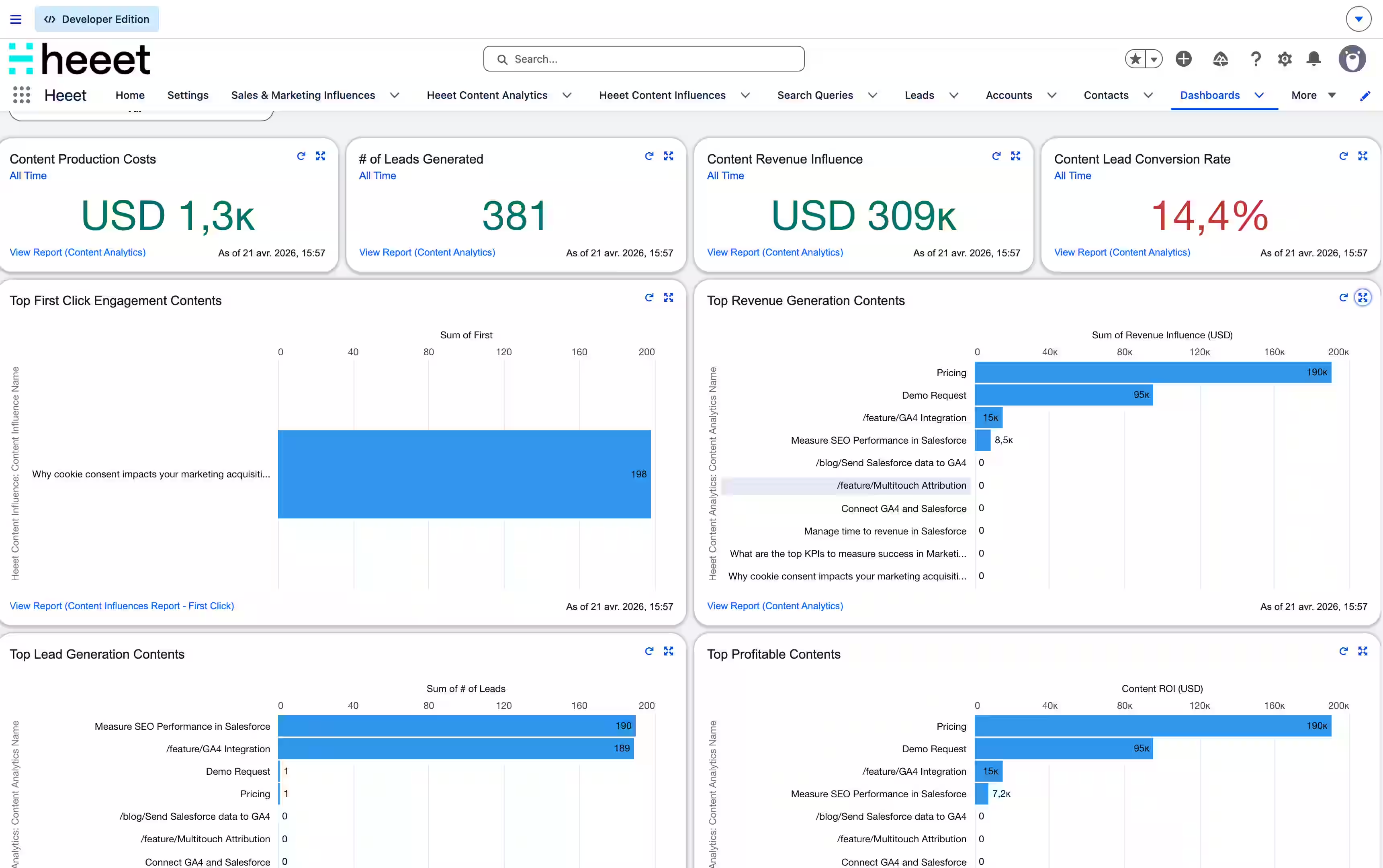
Spotting which articles generate AI-visibility and traffic without revenue-influence
Looking at the flip side in terms of performance, at Heeet, the tracking showed us that the content we created for AI visibility was drawing visits and ranking well on Google, but ultimately led to nothing. Then came the May update, and what did we notice? These articles jumping on AI trends were being cited, but they didn't recommend us as the ideal solution.
While we’re still testing a few strategies and wouldn’t blame anyone for moving forward with tactics that drive short-term traffic and visibility, we stress that the short-term gains don’t matter if there’s no revenue impact to go with them.
So, by all means, find the solution and strategy that work for you, but be aware of the risks and ensure you can accurately measure the rewards.
How to measure SEO ROI with the Analyst Agent
Heeet’s Analyst Agent answers SEO revenue questions in plain language straight from Salesforce, where the pipeline lives, so an SEO lead can connect pages to revenue without exporting from GA and reconciling by hand. You ask, it reads the records, and it answers with the opportunities attached. The same agent that proves what organic earns is the one that watches for what it’s losing. For more info on how it works for every team, check out our intro article.
Step 1: Ask the revenue question, not the traffic question
Type it directly:
“Which organic landing pages influenced closed-won revenue last quarter, and how much pipeline did each one touch?”
The agent reads the touchpoint and opportunity data in Salesforce and returns pipeline and revenue by page, with the deals behind each.
Step 2: Build the channel comparison
Ask the questions that defend the budget:
- “How does SEO-sourced pipeline compare to paid and outbound this quarter?”
- “Which blog posts influenced our top 10 deals by value?”
- “How fast do organic-sourced leads convert compared to other channels?” (Ringover found pages cited by LLMs produced visitors who converted roughly twice as fast.)
This is the moment Fátima’s setup earns its keep. In her words: “Heeet is a must-have for SEO analytics in Salesforce. I can see exactly which pages are driving leads and revenue, and the reporting makes it easy to measure ROI and compare with other channels without operating multiple tools.” One source of truth, the same one finance reads.
Step 3: Set the reporting cadence
Different questions want different clocks. Configure three:
- Weekly: an early-warning alert. Mark any high-revenue page, or any at-risk pattern group, where organic-sourced touchpoints or influenced pipeline drop against the trailing four-week average.
- Monthly: an organic revenue influence summary, ranked by page, delivered to your marketing Slack channel and into Salesforce. You walk into planning with revenue per page, not a rankings export.
- Quarterly: the strategic view. Which topics produced deals, which patterns are decaying, and how SEO-sourced pipeline compares to every other channel on the same basis.
Step 4: Alert on shifts that matter
Tell the agent to flag when a high-revenue page’s influence drops. A ranking loss or a conversion problem shows up here before it hits the quarterly number, which is the only window when you can still do something about it.
The Analyst Agent runs on Agentforce inside Salesforce, so the revenue it ties to each page is the revenue your company already books. That’s why the SEO number finally holds up next to paid in a budget meeting.
EEAT photo brief #3: A Slack message from the Heeet Analyst Agent showing a weekly drop alert on a comparison-page subfolder, with pipeline-at-risk called out. Alt text: “Weekly SEO drop alert from the Heeet Analyst Agent, showing organic pipeline at risk by page group.”
How to build a scaled-content risk report with the Analyst Agent
If you scaled AI content to rank, this is the report worth setting up first. The idea is simple: group your organic-influenced pipeline by the URL patterns most exposed to a tank, then watch those groups as leading indicators of revenue at risk.
1. Group pipeline by URL pattern
Point the agent at the fingerprints from the section above:
“Group organic-sourced pipeline and touchpoints by landing-page URL pattern for the last four quarters. Buckets: pages matching /vs/ or [a]-vs-[b], /glossary/ and /what-is-, /best-, [brand]-alternatives, programmatic location and language pages, and /faq/. Show influenced pipeline and touchpoint volume per bucket, per quarter.”
Now you can see, in revenue terms, how much of your pipeline leans on template pages versus pages a competitor couldn’t reproduce with the same prompt tomorrow.
2. Set a drop threshold on each bucket
“Alert me weekly if organic-sourced touchpoints or influenced pipeline from any of those page groups falls more than 20% below its trailing four-week average.”
That threshold is the early-warning line. A comparison-page bucket shedding touchpoints for three straight weeks is the tank arriving, and you’re seeing it while there’s still pipeline to defend rather than after the deals stop coming.
3. Pair it with your rank tracker.
Heeet sees the revenue consequence: which page groups are losing the visits that feed deals. Ahrefs, Sistrix, or Search Console sees the leading traffic and ranking signal. Run them side by side, and you get the full chain, ranking movement today into pipeline movement next quarter, instead of one half of it.
4. Review the concentration risk quarterly.
“What share of our organic-influenced pipeline came from template page patterns last quarter versus a year ago, and is that share rising or falling?”
A healthy program watches as share drifts down over time, while original, hard-to-copy pages carry more of the load. A program heading for trouble watches it climb, right up until the day it doesn’t.
What changes when SEO can prove and protect revenue
When an SEO lead can show revenue, the conversation with leadership alters shape. You stop defending the program with traffic charts and start reporting pipeline contribution like any other revenue channel. The roadmap gets sharper because you can see which topics drive deals and which only drive visits.
Add the downside view and the job changes again. You’re no longer the last person in the building to learn a subfolder tanked. You’re the one who marked it a quarter early, in the currency the board cares about, and reprioritized before the pipeline showed the damage.
That’s the difference between an SEO lead who reports what happened and one who saw it coming.
Rankings prove your pages get found. A tank proves how fast that can reverse. The work now is to hold both numbers at once: what organic search earns, and what it’s about to lose, tied to the pipeline your company already books. Do that, and you stop reacting to charts and start acting on revenue.
Other articles
AI Search Visibility: How to track the revenue impact of brand mentions
Learn to track and measure AI search ROI with proven GEO strategies. Complete guide to LLM mentions attribution, revenue tracking tools, and conversion optimization for B2B success.

Multi-Touch SEO Attribution: The Best Solution?
Tracking SEO ROI is difficult. Multi-touch attribution can help measure it. Here’s how to do it.
Creating the Revenue-Driven Content Flywheel: A Framework for B2B Content That Drives Pipeline
Learn how to build a revenue-driven content flywheel that connects content to pipeline and revenue. Replace the outdated funnel model with a compounding system that turns every asset into measurable ROI.
.svg)
Ready to track prospects from lead to close with Heeet?
Heeet gives marketers and sales professionals at IT & Security firms turn geuss work intro informed decisions that drive revenue while meeting the same secruity technical standards you provide your clients.