

Read time :
B2B Customer Journey Mapping in 2026: Understanding AI’s impact and Why Most Maps Miss Revenue
Customer journey mapping has never faced more obstacles despite having more tech than ever to trace winning paths. Not only are deals stalling, according to Forrester, which reports that 86% of B2B purchases stall mid-cycle, but AI is taking touches away from the journey due to zero-click influence.

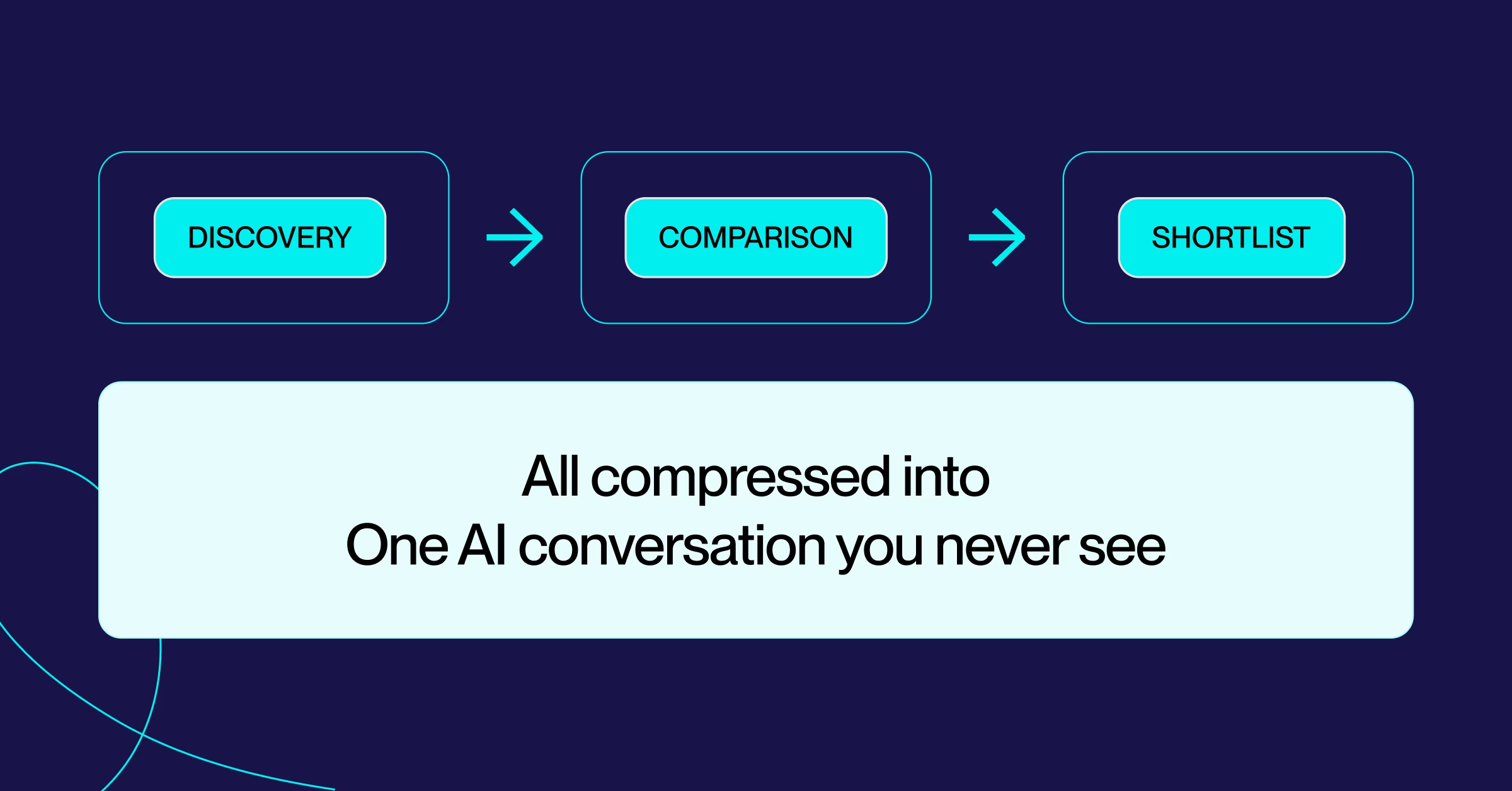

This article examines the new obstacles AI poses and the flaws of most journey-mapping solutions. We also provide a guide for CMOs and VP Marketing leaders looking to move beyond decorative maps. You’ll finish this read with an understanding of what modern customer journey mapping is, why most B2B maps fail, proven frameworks, and, more importantly, how to build journey maps that tie directly to pipeline, revenue, and the CFO’s budget talks.
What will evolve in this article in the months to come? How AI is affecting the customer journey. With Google’s new core update bringing the biggest change to the search bar in the last 20 years, AI-mode changes, and the recent influx of traffic from ChatGPT. Bookmark the article for regular updates.
LLMs are camouflaging, and we believe they are, at the same time, shortening the path to revenue. Every B2B buyer is comparing and pre-ranking their shortlist using AI before they ever speak to a salesperson. The race to include AI in the customer journey map, despite the prevalence of zero-click influence, is on, and there’s currently no straightforward way to read beyond the slim direct traffic from LLMs, aside from self-attribution and customer interviews.
Before we go further into AI’s influence, let’s define customer journey tracking.
What Is Customer Journey Mapping?
Customer journey mapping is the task of tracing all the interactions buyers have with your company, from the first signal to the closed-won, so you can start attributing revenue outcomes to channels, campaigns, and content. In 2026, the modern definition is more operational than visual. The goal isn't a static poster. It's a live system that connects the buyer behaviour to pipeline and revenue.
We see journey maps as key infrastructure, not just deliverables for leadership.
A complete map captures four building blocks:
- Stages. The phases buyers move through, from problem identification to renewal.
- Touchpoints. Every digital and offline interaction with your company
- Buying group. The seven-or-so roles that make a B2B decision, not a single persona
- Revenue signal. What each touchpoint contributes to the pipeline and closed revenue
Which teams take on this task on in 2026? The answer is everyone tied to revenue:
- Marketing leads the campaign and content engagement, both pre- and post-conversion.
- RevOps owns the data plumbing.
- Sales validates the friction points.
- If you want to go further, customer success maps the engagement after the sale.
If any of those three to four owners is missing, your map isn’t showing the path from start to finish.
Why Most B2B Customer Journey Maps Don’t Pay Off
Most B2B journey maps fail for three structural reasons:
- They’re built on assumptions rather than engagement with touchpoints tied to revenue-driving clients in the CRM.
- They map the behaviour of a single stakeholder rather than the buying committee.
- They’re not mapping by category or buyer type.
- They live in an isolated Google Sheet and are presented in a deck rather than in a living, evolving revenue platform like CRMs or attribution platforms, where evolution can be tracked, strategy can be measured, and next steps planned.
They’re built on assumptions, not behaviour.
Journey maps shouldn’t start with a 90-minute workshop filled with post-its and guesswork. The result is a deliverable everyone agrees with, but no one in the room has seen how real buyers decide. The map reflects beliefs, not actual performance data across channels tied to closed-won clients in the CRM.
When we compare the real touchpoint sequence for the last 50 closed-won deals to the workshop map, they rarely match.
They map the buyer, not the buying group.
The persona is dead as a planning unit for B2B. Forrester’s 2026 State of Business Buying report finds that the average B2B purchase involves 13 internal stakeholders and 9 external influencers, and that 74% of buyer teams experience unhealthy conflict.
A persona-based map cannot capture any of that. The CFO and the VP of IT aren’t following two parallel journeys. They’re arguing over the same one.
They’re not mapping by buyer type
Your small to mid-sized buyers aren’t going down the same wormhole enterprises do before making a purchase decision. They’re playing with very different budgets, most likely prioritizing different features, and dealing with different volume needs. If you have different product types and pricing plans, the journey will not be the same.
They live in pasted together sheets and slide decks, not in the CRM
Marketing often has a beautiful journey map, and RevOps has Salesforce. The two never sync. Marketing tracks engagement; sales tracks pipeline. No one has proven that journeys lead to pipeline.
Across 20 intelligence reviews from Heeet demos, we can guarantee you the real pain isn’t missing a map; it’s having one that doesn't reflect the reality in Salesforce or HubSpot.
How Is B2B Customer Journey Mapping Different in 2026?
Today, 80% of buyer research now happens before sales contact (Gartner), 90% or more of journeys begin in untrackable dark-funnel channels, the buying group has grown to 13+ internal stakeholders, and AI is significantly altering the journey. LLMs have become the buyer’s primary research partner, with 89% of B2B buyers using generative AI (Forrester).
It’s a major driver of the increased influence of marketing in the buyer journey, as LLMs crawl far and wide to find answers to B2B buying questions. That means your content and customer reviews, or those of your competitor, are being consumed by the LLM instead of your buyer, then packaged into the comparative table of features LLMs build for your prospective buyer.
This discovery and procurement workflow gives buyers a pre-ranked shortlist with pros and cons without having to visit your site. When they do fill out the form and the demo arrives, the prospect may have already made their decision before walking into the sales conversation.
AI is driving the 80% rule, but that could change
Sales' new job is to confirm, validate, and customize the offer for the prospect. Prospects already know what your product offers. Gartner highlighted this new dynamic; findings show B2B buyers spend only 17% of their purchasing time in direct contact with vendors. For the most part, they’ve already made up their mind if they’re asking for a demo. That means the journey is becoming harder to track. Forrester’s 2026 data shows that 87% of buyers prefer independent research before talking to sales. With AI putting a big red bow and the research delivered in seconds, most of the trip is, by design, invisible to your tracking.
So what could change? Funny enough, the zero-click influence.
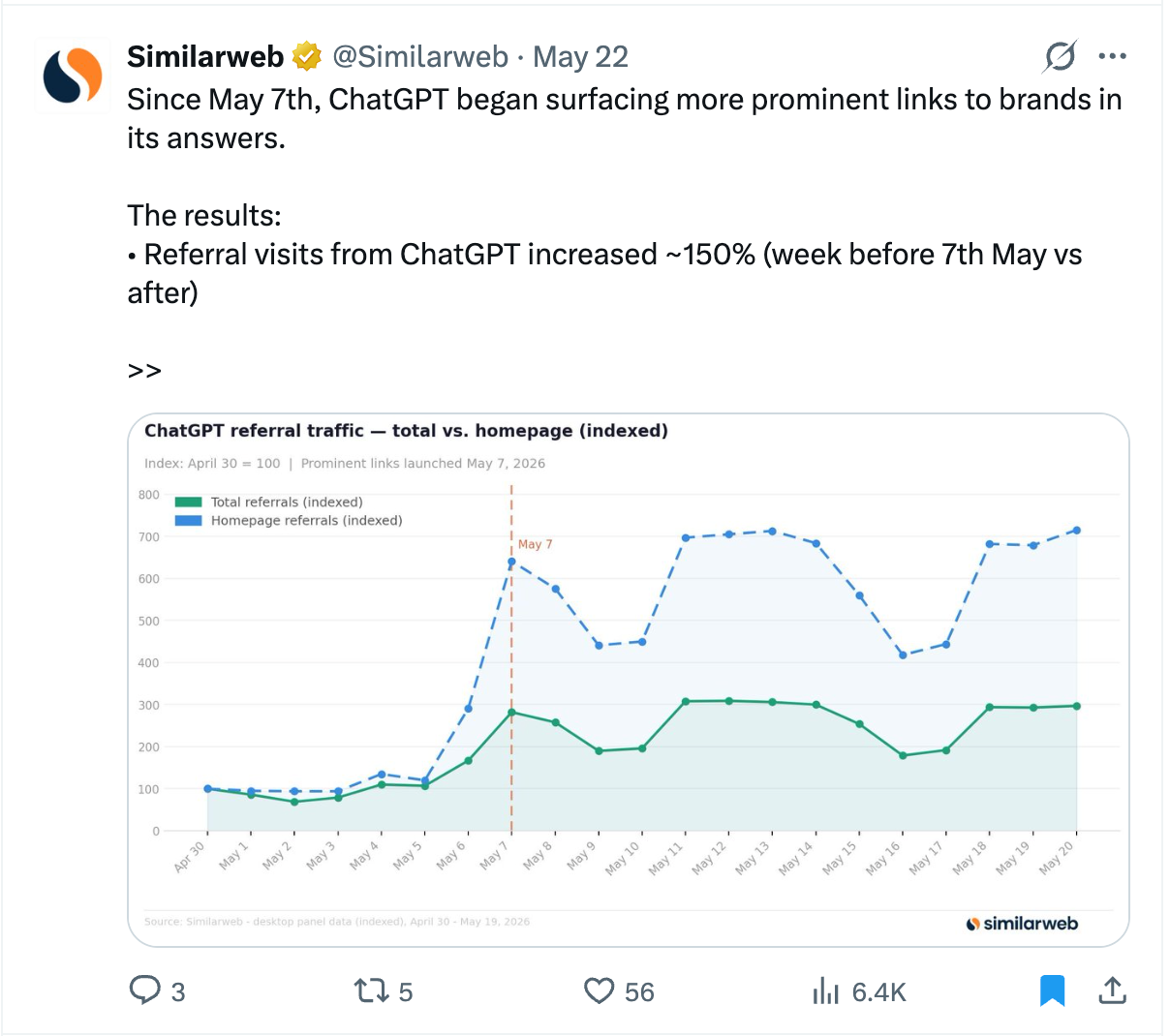
Recent news of more links being included in ChatGPT’s answers since May 7th is bringing smiles back to SEO experts, as the zero-click influence phenomenon may see its impact reduced. Early indications suggest that this may be because ChatGPT’s new 5.5 Instant model, which is the default at the moment, is focused on speed and providing targeted branded links.
This is a big win for everyone. Our intuition tells us to expect more referral links from other platforms in the future, as LLMs begin driving traffic to sponsored content when ads become the new normal.
Here’s the evidence from Similarweb below.
The dark funnel before AI still exists
Not breaking news, but there’s even more you can’t see along the path to closed-win. Private Slack groups, peer communities, podcasts, and analyst reports have always been touchpoints you can’t track. None of those touchpoints leaves a tidy attribution trail. So keep in mind that no journey map is foolproof. You still need the “how did you hear about us” section on the form and to ask the question during demos and sales calls to put your real journey into perspective.
Head’s up, if you’re still including LinkedIn engagement, including likes, comments and shares of your posts in the dark social category, think twice. LinkedIn engagement can be tracked with various tools, including Heeet’s, to bring engagement signals into your CRM so you can track touches along the journey.
What Are the Stages of a B2B Customer Journey in 2026?
Modern B2B journeys are more granular, involve more decision makers and processes, and occur before the purchase is made. The three-stage funnel of the early 2010s isn’t going to cut it in 2026. We decided to use Gartner’s B2B Buying Jobs framework of problem identification, solution exploration, requirements building, supplier selection, validation, and finally consensus creation, to better reflect how a 6-10 person committee actually decides to buy.
While this is an example, the last thing you should do is generalize. Each buying journey is unique to each business and its product. Define the right stages with their accompanying signals, touchpoints and revenue implications.
Stage 1: Problem Identification
The buyer is living with pain and comes to realize it’s a problem worth solving, but is only seeking content to better understand the issue they're facing.
Common touchpoints
Think AI search, Reddit threads, forums, and educational content covering the common pain point. This naturally leads to the second stage.
Stage 2: Solution Exploration
With the problem identified, the buyer starts mapping out possible solutions via content, comparisons, podcasts, and reports. They're not ready to buy. The buyer is learning about the category, not your product.
Common touchpoints
They’re discovering content from high-authority blogs, visiting the sites of industry-leading providers, and, of course, seeing what AI answer engines recommend.
Stage 3: Requirements Building
The buying group defines its own criteria, whether it be features, security needs or data hosting concerns.
Common touchpoints include
Webinars, framework content, comparative tables built with an LLM, and internal stakeholder conversations are taking place.
Stage 4: Supplier Selection
Your clients are now creating their shortlist, and a definitive feature list is being fine-tuned.
Common touchpoints: product pages, pricing pages, review sites (G2, Capterra), peer references, demos. Note that these are all the pages that ChatGPT and similar tools will reference at this stage of the journey. Don't wait for an inbound form fill; the shortlist builds whether or not you provide input.
Stage 5: Validation
The buying group confirms the choice through references, trials, and final research after an initial demo and conversation with sales.
Common touchpoints include
Case studies, customer references, security reviews, and technical deep dives. When it comes to case studies, it may be best to ungate them for LLMs crawling your site. Don’t view this stage as a formality; this is where deals die.
Stage 6: Consensus Creation
The buying group reaches an internal agreement. Here, 86% of stalls occur (Forrester). This is the money time, so to speak, when the decision is finally made, or the decision to purchase is put aside. Stressing the time-to-value your product offers versus your competitors' has been our biggest differentiator at Heeet during this stage.
Common touchpoints
Enablement materials for your champion, business case PDFs, executive briefings, and procurement workflows that explain the final steps and initial setup in detail. Don't mistake a sold individual for a sold deal.
What Touchpoints Should a B2B Customer Journey Map Track?
A complete B2B customer journey map tracks four categories of touchpoints: online touchpoints captured automatically (ads, content, demos), offline and manual touchpoints that have to be logged (events, intros), dark funnel touchpoints that can only be inferred (communities, podcasts, AI answers) and CRM-internal touchpoints that map to opportunity progression (proposal sent, security review, contract redline). Most teams only track the first category.
Electronic touchpoints
The ones you're tracking by default are paid ads, organic search visits, content downloads, email engagement, webinar registrations, demo requests, and pricing page visits. The good news: they are easy. The bad news: they are the smallest category.
Offline and manual touchpoints
Events, conferences, dinners, peer intros, partner referrals, and sales calls that started cold. These arrive in your CRM via Excel imports, badge scans, and manually keyed activity logs. They are also the largest single category of friction we see across Heeet demos. Lyyti, Kameleoon, Kolsquare, and Foncia all flagged event ROI as their number-one or number-two attribution pain because the data doesn’t flow into Salesforce automatically.
Dark funnel touchpoints
Slack and Discord communities, peer-to-peer recommendations, podcasts, analyst reports, and AI-generated comparisons. You can’t track these directly. You can only infer them from the order in which other signals show up. When a buyer goes from zero awareness to a pricing-page visit in 48 hours, the dark funnel did the work.
CRM-internal touchpoints
Opportunity stage changes, proposal sends, contract redlines, security questionnaires, and procurement reviews. These are touchpoints too. And they are often the slowest part of 6- to 12-month cycles. Front-loading them, as top-quartile teams do, can compress enterprise deals by 3 to 6 weeks (Forrester).
How Do You Build a Customer Journey Map That Drives Revenue?
Building a customer journey map that drives revenue takes five steps: start with revenue rather than personas, map the buying group, connect every touchpoint to a CRM object, quantify friction with cycle-time data, and refresh the map quarterly. Most teams skip steps 1 and 3, then wonder why their map ages out within a quarter.
Step 1: Start with revenue, not with personas.
Pull your last 50 closed deals from Salesforce or HubSpot. For each, reverse-engineer the actual touchpoint sequence: the first signal, every engagement across marketing and sales, every opportunity-stage move, and the closed-won timestamp. This isn't theoretical work. It is reading what your data already says.
This is where most maps and most CRMs disagree. Sara, the Business Analyst and Salesforce admin at NEL, lived this for almost six years before Heeet went live. “The fact that we trust our data, for me, is bigger than time savings. For the first time in the almost six years I’ve been here, I trust what I’m putting out there. I can at least defend it.”
Step 2: Map the buying group, not the buyer
Identify the seven canonical roles in your typical deal: project sponsor, champion, economic buyer, technical evaluator, financial controller, end user, and blocker. For your top-tier target accounts, name the actual humans in each role. This is where you can see what content helped each stakeholder in the deal eventually validate or disqualify your product internally. It may be the technical content, information about security and data, or feature pages.
This is the content goldmine marketing needs to answer the frequently asked questions that AI is looking to answer. Then design content and engagement to plug the gaps in the buying group’s consensus-building process.
Step 3: Connect every touchpoint to a CRM object
This is the step most teams skip. Every touchpoint, digital or offline, needs to land on a CRM record: a Campaign, a Campaign Influence row, an Opportunity, or an Activity. If it doesn’t, it doesn’t exist in your revenue system.
The Salesforce-native approach uses Campaign Influence to roll up multiple touchpoints to a single opportunity without requiring sales reps to manually maintain Contact Roles. The HubSpot-native approach uses Attribution Reports tied to deal records. Whichever stack you’re on, the principle is the same: a touchpoint that doesn’t connect to a revenue object can’t be measured.
This is where Heeet earns its place in the conversation. CRM-native attribution moves journey data into the same system where the pipeline lives, so the map and the forecast can finally be the same artifact.
See how Heeet tracks every touchpoint inside Salesforce and HubSpot. Book a demo here.
Step 4: Quantify friction
For each stage, measure two things: average time-in-stage and stage-to-stage conversion. Then look for the gaps. The Emblaze research found that 54.5% of B2B deals show fundamental misalignment between how the seller frames the problem and how the buyer perceives it. Resolving that single gap lifts win rates by 38%. Most of that friction is measurable in your CRM today if anyone bothers to look.
Step 5: Refresh quarterly
Buyer behaviour shifts faster than persona documents can be updated. A journey map updated once a year is a journey map describing last year. Most mature teams run a 90-minute quarterly review against fresh closed-won data and update the map in place. Annual reviews are for personas. Quarterly reviews are for systems.
How Do You Connect Customer Journey Mapping to Pipeline and Revenue?
Connecting customer journey mapping to revenue means treating the map as a measurement system rather than a slide. Three metrics matter most: pipeline velocity (how fast opportunities move stage-to-stage), multi-touch revenue attribution (how much credit each touchpoint earns toward closed deals), and friction cost (how much extended cycles cost in delayed revenue). Companies with formal journey programs report 16.8% shorter sales cycles, 24.9% higher marketing ROI, and 3x referral growth (Aberdeen/ CX).
Pipeline velocity is the cleanest CMO metric. It collapses everything else into a single equation: (opportunities × deal size × win rate) ÷ cycle length. If a journey improvement compresses your cycle by 10 days on a $250K ACV motion closing 80 deals a year at a 15% win rate, you’re recognizing roughly $2.5M in incremental revenue annually from cycle compression alone.
Friction cost is the one CMOs underuse. Oxford’s research suggests that companies without formal customer journey management programs leave roughly 3% of revenue at risk from poor experience friction. For a $50M B2B business, that’s $1.5M annually. The number gives you the case for the project.
Multi-touch attribution translates the map into per-touchpoint revenue credit. It ensures you move past the limitations of single-touch models that completely ignore touches and post-acquisition engagement. Time-decay, U-shaped, W-shaped, and full-path models each have their place. Pick one, run it consistently, and stop pretending the platform-native numbers in Google Ads tell you anything about the pipeline.
Ringover ran exactly this playbook with Heeet. Their setup started as a first-touch model and evolved into a multi-touch model as their growth team matured. The results were measurable inside Salesforce:
- 24% increase in marketing-attribution accuracy
- 14% improvement in Google Ads ROAS through automated revenue-based conversion sync
- 3x more pipeline from paid media versus their previous tracking
- 80% increase in paid contribution to revenue
- 50% of inbound leads now traced to SEO, with 25% of pipeline sourced from organic
"A must-have for tracking paid acquisition and ROI in Salesforce. With Heeet, we get full-funnel visibility, tracking every lead, analyzing campaign performance, monitoring customer acquisition costs and measuring ROI across Google Ads, LinkedIn, and Facebook." Vincent Coulondres, Head of Growth at Ringover.
"We can track tens or even hundreds of marketing KPIs, but without a clear link to pipeline and revenue, they remain surface metrics and can lead to biased decisions." — Saniya Chainani, Growth Marketing Manager at Ringover.
The Most Common Customer Journey Mapping Mistakes CMOs Make
Most CMO-commissioned journey mapping projects fail in predictable ways: treating it as a one-time deliverable rather than an operating discipline; over-mapping every segment before acting on any of them; disconnecting the map from RevOps systems; and failing to define success metrics before the kickoff meeting.
The shortlist of mistakes worth calling out:
- Mapping as a project, not a discipline. A one-and-done workshop produces a one-and-done map. The teams that get value run a continuous cadence.
- Over-mapping. Trying to chart every segment, persona, and edge case before acting on any of them. Pfizer’s commercial AI team calls this “boiling the ocean.” Start with one motion, deliver a measurable result, then expand.
- Disconnecting the map from the RevOps. A map that doesn’t live in the same system as the pipeline is a map on which nobody acts.
- Ignoring the procurement and legal. Forrester finds that procurement professionals are decision-makers in 53% of B2B purchases and often engage from the start, not at the end. Most maps treat them as an afterthought.
- Treating all signals as equal. A pricing-page visit and a casual blog read aren’t the same signal. Without stage-weighted scoring, your sales team chases the wrong leads.
- No success metric defined upfront. If you can’t say what specific number this journey will move, the work won’t move a number.
What Customer Journey Mapping Software Should B2B Teams Use?
Customer journey mapping software falls into three categories: visual diagramming tools (Miro, Figma, Lucidchart) that produce artifacts but not data; standalone CX platforms (Glassbox, Quadient) that record digital behaviour but live outside your CRM; and CRM-native attribution platforms (Heeet plus native reporting in HubSpot and certain Salesforce add-ons) that connect touchpoints directly to the pipeline. For B2B CMOs with revenue accountability, only the third category survives a CFO discussion.
The honest answer is that most mature B2B teams use category 1 for discovery work and categories 3 and 4 for the operational system, so they can start planning and taking actionable measures. Category 2 has a place in product-led motions but rarely earns its cost in pure B2B sales-led environments.
What Does Mature Customer Journey Mapping Look Like in 2026?
Mature customer journey mapping in 2026 has five traits: it’s continuous rather than quarterly, it’s account-level rather than persona-level, it’s CRM-native rather than slide-based, it accounts for the dark funnel and AI-mediated research, and it ties to a small set of revenue metrics any executive can read in under 60 seconds. Organizations hitting all five report 54% greater marketing ROI (Growth Molecules) and 118% pipeline conversion lifts when paired with contact-level ABM (Influ2).
Use this as a quick diagnostic for your own program:
- Level 1 (static map): A slide deck. Reviewed once a year. Lives in marketing.
- Level 2 (persona-based): Maps personas, not accounts. Some touchpoints tracked.
- Level 3 (touchpoint-tracked): Online touchpoints flow into CRM. Offline is still a manual.
- Level 4 (account level + revenue-linked): Account-level views. Multi-touch attribution. Friction quantified.
- Level 5 (live revenue system): Continuous, account-level, CRM-native, friction-quantified, refreshed quarterly. The map is the pipeline view.
Most B2B teams sit at Level 2 or 3 today. The jump to Level 4 is when Aberdeen's ROI numbers start to appear.
Turn Your Customer Journey Map Into a Revenue System
You don’t need a perfect customer journey map. You need a map that’s wired into the CRM, that refreshes every quarter, and that tells you which touchpoints are moving the pipeline forward and which are just generating activity. That’s a system. And once you have it, the CFO conversation gets a lot shorter.
The teams winning at this in 2026 aren’t the ones with the prettiest slides. They’re the ones who stopped treating journey mapping as a marketing exercise and started treating it as a revenue discipline owned by RevOps, validated by sales, and reported in dollars rather than impressions.
Ready to map every touchpoint to revenue inside your CRM? Book a demo to see how Heeet connects the customer journey to pipeline and closed-won revenue inside Salesforce and HubSpot.
Other articles

Introducing Customer Journey Analytics: How to See Which Channels, and Campaigns Lead to Revenue
The new Heeet feature tracks and analyzes every engagement a buyer has with your brand, from the first ad click to the signed contract. Instead of isolating individual touchpoints, it connects them into a sequence that reveals how deals progress through your funnel.
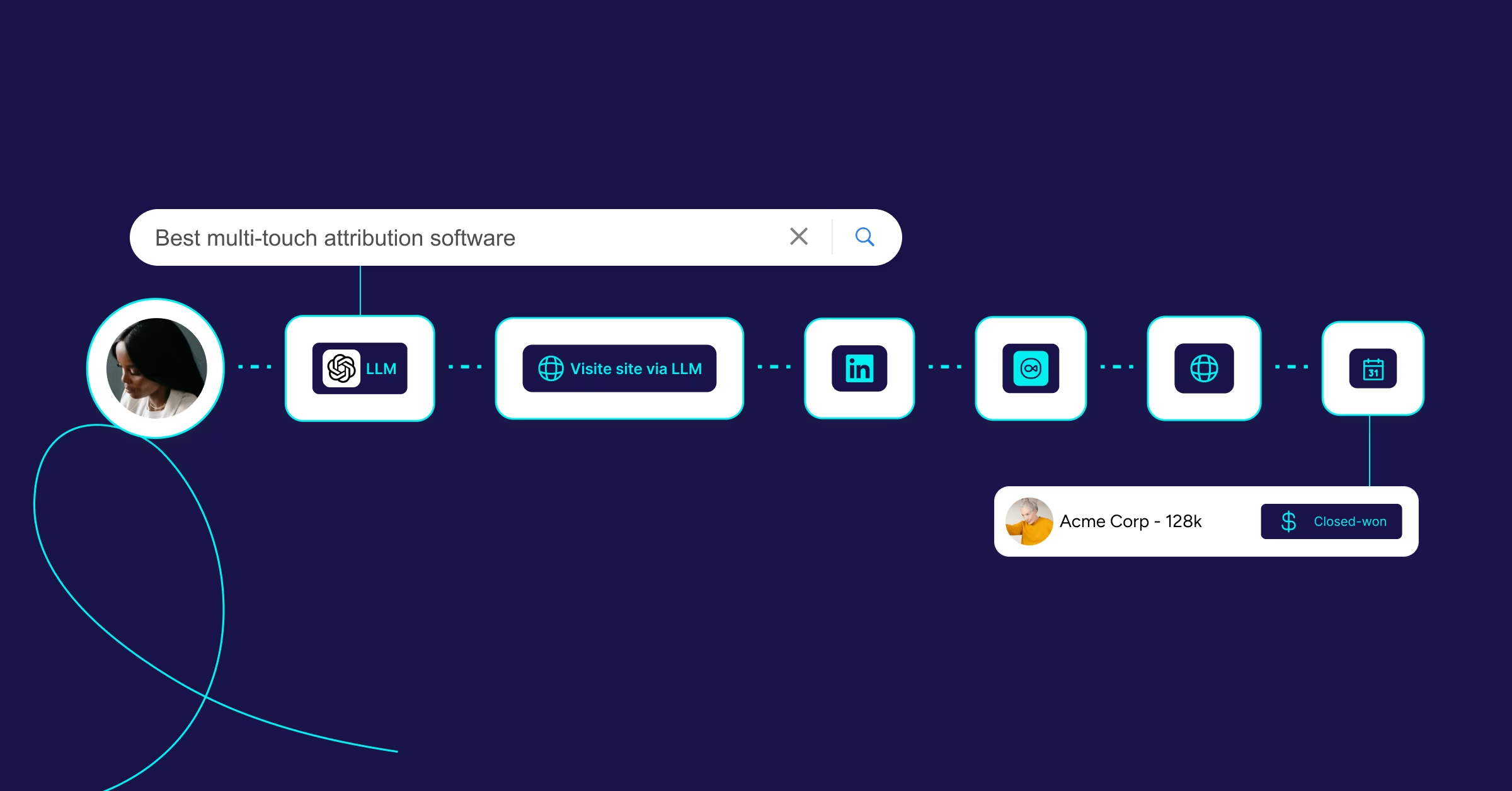
AI Search Marketing: Why Marketing Owns More of the Deal
AI search marketing is reshaping B2B buying. Learn how LLM discovery shifts influence to marketing—and how to measure AI visibility in your CRM.
AI Search Visibility: How to track the revenue impact of brand mentions
Learn to track and measure AI search ROI with proven GEO strategies. Complete guide to LLM mentions attribution, revenue tracking tools, and conversion optimization for B2B success.
.svg)
Ready to track prospects from lead to close with Heeet?
Heeet gives marketers and sales professionals at IT & Security firms turn geuss work intro informed decisions that drive revenue while meeting the same secruity technical standards you provide your clients.