

Read time :
MQL vs SQL: Aligning Marketing and Sales to Bridge the Handoff
It is important to understand the difference between the two acronyms, MQL and SQL, and the reason why the handoff from marketing to sales is such a contentious issue—cough cough—the nuance is found in the quality and the ability to demonstrate the impact that marketing has on the entire buyer journey.



What is the difference between an MQL and an SQL?
A lead is considered an MQL if their profile and behaviour indicate they’re worth pursuing with marketing touches, and are not quite ready to be handed off to sales. In the case of a SQL, sufficient buying intent has been demonstrated. The best examples of real buying intent are, for example, requesting a demo, visiting the pricing page, or asking a direct question about contracts. These are the tells that should alert sales to make contact immediately. The distinction lies in the level of intent and in who is responsible for taking the next action.
Here's the side-by-side:
What the table doesn't show you is that marketing continues to play a role once an MQL becomes an SQL. We'll go into more detail on that below.
What constitutes a marketing qualified lead (MQL)?
An individual who is a marketing qualified lead is somebody who matches your ideal customer profile and has interacted sufficiently with your marketing efforts to show real interest, even if they haven't yet requested to speak to sales. For example, a director at a company of the target size who has read three of your articles, downloaded a benchmark report, and visited your website twice this month.
The two factors that determine whether a lead is an MQL are fit and behaviour. Fit refers to firmographic criteria—such as the correct industry, the right company size, the appropriate role, and the right region. Behaviour consists in what the person does; for instance, a student who downloads your guide as part of a class project might accumulate a lot of engagement points, but since they don't match the criteria for fit, they are not an MQL even if they open many emails.
Common MQL triggers marketing teams score on:
- Multiple visits to high-intent pages (product, case studies)
- A content download that takes real effort to consume, like a report or a template
- Webinar attendance, especially staying to the end
- Newsletter subscription paired with repeat site visits
The term "qualified" has a great deal of significance in this context and is performing a role that most teams realize. An MQL is a marketing decision stating that a lead is worth taking sales' time soon. If sales frequently disagree with this, then the definition is incorrect. We'll return to this point later.
What constitutes a sales-qualified lead (SQL)?
A lead is sales qualified when it has moved from a state of interest to one of intent; they have taken some action which shows that they are looking into making a purchase, and the sales representative should then start talking to them quickly, preferably on the same day.
The behaviours that turn an MQL into an SQL are the ones that cost the buyer something, usually time or a small commitment:
- A demo request or a "contact sales" form
- Repeat visits to the pricing page
- Views of a comparison or competitor-alternative page
- Direct questions about implementation, security, or contract terms
The behaviour of people looking at the pricing page is one of the most revealing indicators. At Ringover, 33% of the leads who visit the pricing page become sales opportunities. Once a third of those reading your pricing page turn into pipeline entries, then the act of viewing the page ceases to be a vanity metric and becomes a routing rule.
What place do MQL and SQL occupy in the funnel (and what about SAL and PQL)?
MQL and SQL represent two of the links in a longer sequence. The traditional B2B lifecycle goes through Subscriber, then Lead, then MQL, then SAL, then SQL, then Opportunity, and finally Customer. Each stage involves a transfer of responsibility, and it is at the point when moving from MQL to SQL that disagreements happen since that’s when marketing stops taking charge and sales takes the baton.
Two terms are worth pinning down because they sit right next to SQL and get muddled:
A Sales Accepted Lead (SAL) is an intermediate stage which some organisations include between a Marketing Qualified Lead (MQL) and a Sales Qualified Lead (SQL). The marketing team passes on an MQL, after which sales formally accepts it as something worth pursuing, and it only becomes an SQL once a sales representative has confirmed genuine interest. The reason for having the SAL stage is so that poor handovers can be picked up early on, before they damage the trust between the two teams.
A product qualified lead, or PQL, arises in a completely different way. In companies that are product-led, a PQL is a person who uses a free trial or freemium product and reaches a usage level which indicates that they will buy. A PQL can skip over the MQL stage because actual use of the product is a stronger indicator than any marketing touch.
Although the ladder is only a model, real buying journeys seldom follow it in a straightforward manner. It’s possible for buyers to ask for a demonstration before becoming a MQL. With zero-click influence from LLMs being felt more and more, teams optimizing for GEO will see an influx of leads going straight to demo.
Why is there such controversy surrounding the handoff from MQL to SQL?
At that point two costly problems come together: sales fail to trust the quality of the leads, and marketing loses sight of them as soon as the lead becomes someone else's record. If either one of these is mishandled, then the two teams cease to believe each other's figures.
Quality should be given the priority. Since sales has a limited amount of time, any MQL that isn't properly qualified is equivalent to the salesperson spending their afternoon on someone who never was going to make a purchase.
This brings up an uncomfortable question about scoring itself.
The use of point-based lead scoring is gradually losing popularity, at least in the version that most teams originally adopted.
If a deal is finalized six weeks after the handover, who should be given the credit?
How can you construct MQL and SQL criteria that sales people trust?
Begin with the deals you've already won, not with a scoring template. Take the two or three quarters' worth of opportunities that have been closed and won and look back at them: what did those buyers have in common before they turned into SQLs? For example, the industries they were in, the sizes of their companies, the particular pages they looked at, the content they used.
A criteria model that holds up usually blends three inputs:
- What is the firmographic question? Does the lead correspond to the characteristics of your most successful customers?
- The question regarding intent is this: are they carrying out the actions that your closed-won buyers carried out before they made their purchase?
- The recency of activity refers to how recent it is; for example, visiting a pricing page today is more significant than visiting it four months ago.
Then connect it to the CRM so that the stages become real rather than being entries that someone updates on Fridays.
In HubSpot the Lifecycle Stage property advances a record through the stages of Lead, then Marketing Qualified Lead, and then Sales Qualified Lead, with workflows being able to promote the lead automatically when the specified criteria are met.
Another step which distinguishes the teams that trust their handoff from those that debate about it is to establish a feedback loop. Whenever sales rejects an MQL, that rejection must be sent back to marketing together with the reason for it, and that reason must then influence the next scoring process. A handoff without a way for feedback to return is merely a wall with a hole in it.
What is a good rate of converting MQL to SQL?
There is no single figure that applies to all cases, and if anyone gives you a figure without first checking what your industry is, they are merely making an educated guess. Conversion rates vary greatly from sector to sector. The best thing to do is to compare your situation with that of other companies in your own industry and then monitor your own trend over time.
The First Page Sage looked at client data from 2019 to 2025 and published conversion rates from MQL to SQL by industry (the update was on 23 December 2025). An example of this is:
In the first page Sage never states a single "healthy" figure, and this restraint is a sign of honesty. A rate of 13% is about average in the B2B SaaS sector but would be alarming in the case of business insurance. The figure only has meaning in relation to your own sector and your own history.
To calculate it is simple: take the number of SQLs produced over a period and divide it by the number of MQLs generated in that same period, then multiply by 100.
MQL-to-SQL or SAL conversion rate = (SQLs ÷ MQLs) × 100
The problem lies in the timing; leads which were generated in March may do not turn into SQLs until May, and therefore a simple calculation on the same month underestimates the performance of a business with a slow sales cycle. When your sales cycle is long, you should group the leads by the month in which they entered and then measure their conversion rate once the cohort has had time to mature.
How can I show marketing's influence after the MQL handoff?
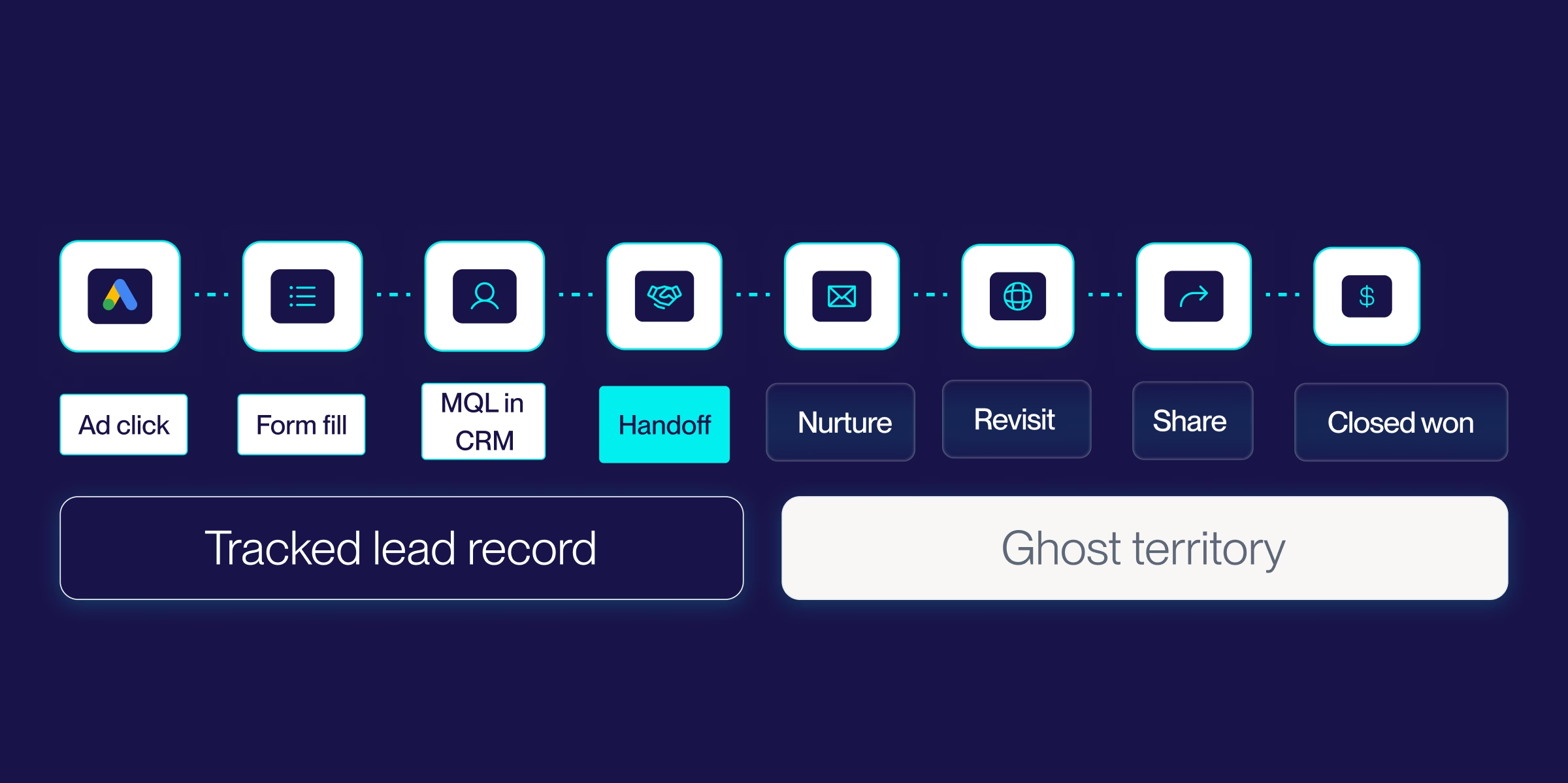
You follow all the touchpoints throughout the entire customer journey and then connect these touchpoints to the sales opportunity and the revenue contained in your CRM.
The reason is also mechanical. In most CRMs, the marketing interaction data is stored on the Lead record. When a lead converts, the system then generates two new objects: a Contact and an Opportunity or a Deal, at which point the trail can be broken.
Two ideas cause the fog to lift.
The marketing-sourced pipeline consists of deals in which marketing was the source of the lead, while the marketing-influenced pipeline includes deals where marketing came into contact with the buyer at any stage, even many months after the handover.
This is precisely the type of task that Heeet was designed to handle. We are able to monitor touchpoints without using third-party cookies, link them to the lead and the opportunity directly within Salesforce and HubSpot, and maintain the sequence throughout the transfer between objects so that the activity that comes after the MQL remains visible.
The thing that matters most to me is alignment payoff. Nel, a client in the energy sector explained how their situation had changed from having two teams that "weren't even speaking the same language" to being able to "trace million-dollar opportunities back to a specific Google ad". After both parties had access to the same journey data, the credit dispute mostly disappeared since the record made it clear who had done what.
Best practices for managing the MQL-to-SQL handoff
Prepare an SLA that covers both directions. Marketing will commit to achieving certain volume and quality standards regarding MQLs, while Sales will promise to respond within 24 hours and provide structured feedback for each lead it rejects. An SLA which only measures the output of marketing is merely half a contract.
A few practices that make the handoff hold:
Keep regular meetings on lead quality with sales providing the specific leads that were rejected and marketing supplying the data explaining why they scored that way, focusing on the criteria rather than assigning blame.
Recycle rejected leads back into nurture instead of discarding them. A "not now" is rarely a "never."
Build one shared dashboard both teams trust, drawn from the same source. A higher-education customer of ours put it well: once leadership, sales, and finance all "see the same numbers," every team starts working from a single source of truth instead of its own spreadsheet.
Aim for a handoff both teams believe in, backed by data neither side can wave away. That holds up far better than a "perfect" scoring model marketing builds on its own.
Other articles
Prove Marketing Impact on Sales-Sourced Deals
Learn how to prove marketing’s impact on sales-sourced deals by tracking post-MQL touchpoints in the CRM and reporting influenced pipeline and revenue.
B2B Customer Journey Mapping 2026: AI to Revenue
Learn how B2B customer journey mapping changes in 2026 as AI reshapes research—plus frameworks to connect touchpoints to pipeline, velocity, and revenue.
Managing Pre and Post Lead Acquisition marketing activities in Salesforce
Track both pre and post lead acquisition activities in Salesforce. Measure true campaign ROI and full customer journey attribution
.svg)
Ready to track prospects from lead to close with Heeet?
Heeet gives marketers and sales professionals at IT & Security firms turn geuss work intro informed decisions that drive revenue while meeting the same secruity technical standards you provide your clients.