
Read time :
The Honest Limits of CRM-Native AI for Marketing and Revenue Intelligence
Connecting ChatGPT or Claude to your CRM was supposed to end the pain of attribution analysis. One natural-language question, one clean answer, no more spreadsheet gymnastics. So why are RevOps and marketing ops teams still pulling reports the old way?

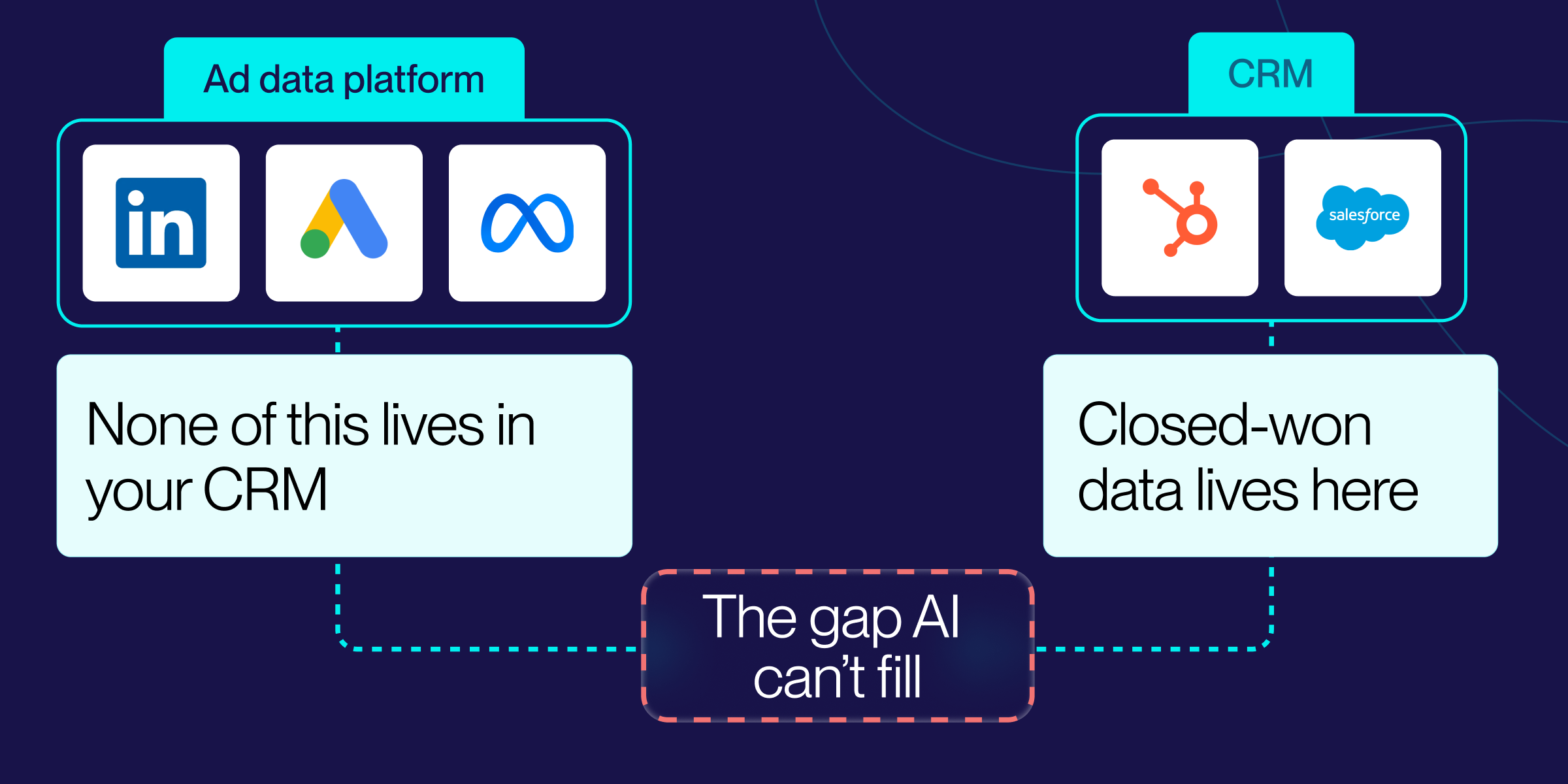

The connectors work. The AI is fluent. And yet the questions you most want to ask, like which paid channels accelerated last quarter's closed-won deals or which webinar series produced pipeline that converted within 90 days, still don't return clean answers. The frustration is real, and you're not imagining it.
Here's the honest read: the limit isn't the AI. It's not the connector either. It's the data the AI is allowed to see, and the data that was never in your CRM to begin with.
This guide breaks down what HubSpot's and Salesforce's AI integrations can do today, where they fall short for marketing and revenue intelligence, and what it takes to close the gap. No vendor pitch. Just the specifics.
What are HubSpot and Salesforce promising with their AI integrations?
HubSpot and Salesforce are pitching AI integrations as the layer that turns your CRM into a conversational analyst. Both promise natural-language access to pipeline data, automated insights, and bidirectional updates without context-switching.
HubSpot's AI stack centers on Breeze (its native AI suite) plus official connectors for Claude and ChatGPT. The Claude connector launched in mid-2025 and lets users query HubSpot data, generate visualizations, and create or update records from inside Claude's chat window. As of late 2025, HubSpot also rolled out an official MCP (Model Context Protocol) server, opening the door for Claude Code, Cursor, and any other MCP-compatible client to interact with HubSpot CRM, marketing, and sales data programmatically.
Salesforce's AI stack revolves around Agentforce, its agentic AI platform, plus the recently announced Agentforce Sales app for ChatGPT. The ChatGPT integration entered open beta in December 2025 and is expected to reach general availability in early 2026. Like HubSpot, Salesforce ships its own MCP server too, plus the Agentforce Trust Layer that governs how data flows between ChatGPT and Salesforce. If your team is mid-evaluation, our piece on preparing your team for Agentforce covers the data-readiness side of this rollout.
The pitch on both sides is the same: ask a question in plain English, get an answer pulled from your CRM, and update records without leaving the chat. On paper, it should solve the marketing attribution problem.
In practice, it doesn't. The gap isn't where most teams expect.
What can you really do today with these AI integrations?
You can do more than you might think. Here's what works well right now across both ecosystems.
HubSpot + Claude or ChatGPT lets you:
- Query lifecycle stages, deal stages, and pipeline summaries in natural language
- Filter contacts by engagement (opened email, didn't click, scored above X)
- Generate charts and pivot views from existing CRM data
- Create new contacts and deals, log notes, and update standard properties
- Pull lead source and UTM parameter breakdowns for standard objects
Salesforce + Agentforce Sales in ChatGPT lets you:
- Prioritize uncontacted leads and active opportunities
- Update deal stages, including closed-won, from the chat
- Generate account plans with priorities, KPIs, and risks, then save them back to Salesforce
- Delegate follow-up tasks to other Agentforce agents
- Reassign leads and opportunities to specific reps or queues
Both integrations also respect existing user permissions. If a sales rep can't see a deal in the CRM, they can't see it through the AI either. That alone is meaningful for governance.
For day-to-day sales work, this is genuinely useful. Reps stop toggling between five tabs to update an opportunity. Marketing teams can ask "show me contacts who attended the April webinar but haven't booked a demo" and get a real answer.
But marketing and revenue intelligence isn't day-to-day sales work. It's a different question.
Where do the limits start for marketing and revenue intelligence?
Six concrete limitations show up the moment you try to use these integrations for serious attribution analysis. Each one has been documented either in the vendors' own docs or by practitioners who've put the integrations through their paces.
1. Custom objects are invisible to the AI
HubSpot's Claude connector cannot read custom objects. If your team uses custom objects to track marketing touchpoints, attribution events, ad clicks, or product-line-specific conversion data, the AI literally can't see them. This is documented in HubSpot's own integration material. For mid-market and enterprise teams running serious attribution architecture, this is a wall.
Salesforce's Agentforce Sales ChatGPT app is in open beta and currently focuses on standard objects. Custom object support is on the roadmap for general availability, but until then, anyone running custom Lead, Opportunity, or Campaign Member extensions is querying a partial dataset.
2. Cross-channel ad spend doesn't live in the CRM
This is the one that breaks marketing intelligence outright. Your Google Ads spend, your LinkedIn impressions, your Meta CPL data, your TikTok video views: none of it sits inside HubSpot or Salesforce by default. The AI is reading a CRM. The CRM doesn't have ad data.
So when you ask "which channel produced the best ROI last quarter," the AI calculates whatever it can from contact source fields and form fills. It can't reconcile $0.43 CPLs with $87,000 closed-won deals. It can't tell you cost per pipeline-influenced opportunity. It doesn't have the spend side of the ratio.
3. Multi-touch attribution is mostly absent
HubSpot ships first-touch and last-touch attribution by default. Anything beyond that requires third-party tooling or custom-built reports. The Claude connector inherits whatever attribution model you've set up, which for most teams means last-touch by default, which then means the AI confidently reports that the demo request form drove all your revenue.
Salesforce Campaign Influence is more flexible, but it depends on accurate Campaign Member records, which in turn depend on disciplined campaign tagging that few teams maintain at scale. If you'd like the deeper backstory, our guide to Salesforce marketing attribution walks through where Campaign Influence works and where it breaks.
4. Sensitive Data settings can silently block engagement data
This one is sneaky. If your HubSpot account has Sensitive Data enabled, the Claude connector cannot access engagement data: emails, calls, meetings, tasks, and notes. The AI will not warn the user. It will just return answers that appear complete but lack the touchpoints that matter most for attribution.
Practitioners have flagged this as a recurring source of bad analysis. You ask "which contacts engaged with the nurture sequence," the AI returns an answer, and the answer is missing every email open and meeting because of a setting nobody remembers turning on.
5. Audit attribution gets ambiguous
Bidirectional connectors mean the AI can write back to your CRM. HubSpot logs these changes in the Audit Log to "the user and the Claude connector." Salesforce's Agentforce Trust Layer attributes ChatGPT-driven actions to the connected user.
That's fine when one rep updates one deal. It gets murky when an Agentforce agent reassigns 40 leads, an SDR's ChatGPT instance updates 12 opportunity stages, and the marketing ops team can't tell what changed because of human action versus AI action. For teams that take governance seriously, this matters.
6. The AI is fluent. Your data is incomplete.
This is the meta-limit that frames everything else. Claude and ChatGPT are extraordinary at reasoning over data. They are not extraordinary at inventing data that doesn't exist. If your CRM doesn't contain ad spend, multi-touch attribution credit, cookieless web analytics, or first-party engagement signals from outside the CRM, the AI cannot reason about them. It will produce confident answers built on whatever's there. Which often isn't enough. This is the exact gap that how RevOps closes the attribution gap covers from the operations side.
What about security, privacy, and governance?
Both HubSpot's and Salesforce's AI integrations have credible security postures. HubSpot's connector respects user-level permissions and runs through OAuth. Salesforce's Agentforce Trust Layer governs how data flows to and from ChatGPT, and Anthropic confirms it doesn't train on data shared through the HubSpot connector unless customers explicitly opt in.
The interesting privacy story isn't whether these integrations are secure. It's the governance side effects nobody talks about.
Permission inheritance can backfire. Once a HubSpot Super Admin enables the Claude connector for all users, that access can't be globally revoked. Each user has to disconnect themselves, and uninstalling the connector doesn't remove user-level access. For teams in regulated industries, that's a compliance hold.
Sensitive Data Properties are excluded. HubSpot's Claude connector explicitly does not access custom Sensitive Data Properties, including Personal Health Information. If your attribution data lives anywhere near custom sensitive fields, you're querying around it.
Write actions need approval workflows. Both HubSpot and Salesforce recommend setting write tools to "needs approval" by default. If you don't, the AI can quietly modify records. Most teams underestimate how often this matters at scale until they audit changes a quarter later.
No delete operations. Neither HubSpot's connector nor Agentforce's ChatGPT app allow the AI to delete records. That's a feature, not a bug, and worth knowing.
The takeaway: governance is workable, but the defaults aren't necessarily safe. Configure them deliberately.
Do HubSpot and Salesforce provide the centralized data needed to leverage AI?
The short answer is no, not by default. Both CRMs were built to manage customer relationships, not to centralize marketing performance data. That distinction matters more than most AI integrations admit.
Marketing intelligence requires four data streams unified in one place: ad platform spend and impressions, web and product analytics, CRM pipeline and revenue, and content engagement signals. HubSpot and Salesforce contain stream three. They contain pieces of stream four. Streams one and two live somewhere else, usually in Google Ads, Meta Ads Manager, LinkedIn Campaign Manager, and a Google Analytics property nobody trusts anymore. For a deeper breakdown of what a complete revenue intelligence framework looks like when it sits inside the CRM, the architecture matters more than the AI does.
When you ask a Claude connector or an Agentforce agent for an attribution answer, here's what happens. The AI queries the CRM. The CRM has form fills, deal stages, and lifecycle data. It does not have your $42,000 monthly Google Ads spend reconciled to the contacts that came from those campaigns. It does not have view-through impressions from Meta. It does not have UTM-tagged page visits sitting on standard contact records. So the AI generates an answer using what's there, and the answer is structurally incomplete.
This is the centralization problem. AI is a commodity now. Anyone can connect ChatGPT or Claude to a CRM. What separates teams that get useful AI-driven insights from teams that don't is whether the data sitting underneath the AI is complete enough to be worth asking about.
For a deeper dive on why first-party data matters more than ever for this exact reason, our piece on implementing first-party data in multi-touch attribution covers the architecture in detail.
How does Heeet close the gap inside HubSpot and Salesforce?
Heeet sits as native Salesforce attribution and as attribution native to HubSpot, centralizing the data streams that marketing intelligence requires. So when your team queries the CRM through Claude, ChatGPT, Agentforce, or Breeze, the AI is reading a complete dataset instead of a partial one.
Here's how that maps directly to the six limits above.
- Custom objects problem: Heeet writes attribution data to standard CRM objects (Campaign, Campaign Member in Salesforce; Deals, Contacts, custom properties in HubSpot). The AI can read everything because it lives where the AI is allowed to look.
- Ad spend problem: Heeet syncs spend, impression, and click data from Google Ads, Meta, LinkedIn Ads, Bing, TikTok, Reddit, and Google Search Console directly into your CRM. Cost per pipeline-influenced opportunity becomes a query the AI can answer.
- Multi-touch attribution problem: Heeet ships linear, U-shaped, W-shaped, time-decay, and full-path attribution models that write credit to CRM-native fields. Ask Agentforce or Claude "which channels influenced last quarter's closed-won deals," and the math is already there.
- Engagement data problem: Heeet's cookieless first-party tracking captures touchpoints that Sensitive Data settings might otherwise hide and stores them on contact and deal records the AI can read.
- Audit ambiguity: Heeet writes attribution updates with clear provenance, separating system-driven attribution updates from human or AI-driven record changes.
- Incomplete data: Heeet eliminates the meta-limit by giving your AI a CRM where every relevant marketing signal is unified, queryable, and current.
The result: your existing ChatGPT connector or Claude connector becomes meaningfully more useful, because you've fixed the data underneath it. No new chat interface to learn. No replatforming. The AI just starts answering the questions it couldn't answer before.
Vincent Coulondres, Head of Growth at Ringover, summarized the shift this way: "Thanks to Heeet, we get full-funnel visibility, tracking every lead, analyzing campaign performance, monitoring customer acquisition, and measuring ROI across Google, LinkedIn, and Meta." That visibility is exactly what your AI integration needs to give you a real answer.
Capability comparison: CRM AI alone vs. CRM AI with Heeet
Conclusion: AI is the wrapper. Your data is the substance.
The AI integrations from HubSpot and Salesforce are real. They work. For sales reps updating deals and marketing managers checking pipeline summaries, they shave hours off the week. None of that is wasted.
But marketing and revenue intelligence is a different problem. It requires the AI to reason over the full picture: every dollar of ad spend, every touchpoint, every channel, every model, all reconciled to closed revenue. The connectors don't deliver that picture. They deliver the part that lives inside the CRM, which has never been the whole story.
Once you fix the data architecture underneath, the AI becomes useful in the way it was always supposed to be. Same connector, same chat window, dramatically better answers.
If you've connected Claude, ChatGPT, Agentforce, or Breeze to your CRM and felt the gap between what the AI promised and what it returns, the fix isn't a different AI. It's a complete dataset. That's the layer Heeet adds, natively, inside the CRM you already use.
Ready to make your AI integration finally answer the questions you've been asking? Book a Heeet demo and see what your existing AI tools can do once they're reading complete attribution data.
Frequently asked questions
Can ChatGPT or Claude read custom objects in HubSpot or Salesforce?
HubSpot's Claude connector cannot read custom objects as of May 2026. Salesforce's Agentforce Sales app for ChatGPT supports standard objects in its open beta, with custom object support expected at general availability. Teams running serious attribution architecture on custom objects will see partial answers from the AI until those gaps close.
Does Agentforce in ChatGPT support multi-touch attribution?
No, not natively. Agentforce queries whatever attribution model is already configured in Salesforce. Salesforce Campaign Influence supports multi-touch logic, but it depends on accurate Campaign Member records and disciplined campaign tagging. Without an attribution platform writing credit to CRM fields, the AI typically reports first-touch or last-touch results.
What does HubSpot's Claude connector access?
HubSpot's Claude connector accesses contacts, companies, deals, tickets, and standard engagement data (emails, calls, meetings, tasks, notes), subject to user permissions and Sensitive Data settings. It cannot access custom objects, custom Sensitive Data Properties, or data that lives outside HubSpot, including ad platform spend and external analytics.
Can the HubSpot or Salesforce AI integrations track ad spend?
No. Neither integration pulls ad spend, impressions, or click data from Google Ads, Meta, LinkedIn, or other paid channels by default. To analyze cost per pipeline opportunity or true channel ROI through the AI, you need that data centralized inside the CRM first, which is what Heeet handles natively.
Is the Salesforce Agentforce Sales app for ChatGPT generally available?
The Agentforce Sales app for ChatGPT entered open beta in December 2025 and is expected to reach general availability in early 2026. Eligibility requires either an Agentforce for Sales Add-on license or Agentforce 1 Edition, plus a ChatGPT subscription. Check Salesforce's release notes for the most current GA status.
Other articles
AI Search Visibility: How to track the revenue impact of brand mentions
Learn to track and measure AI search ROI with proven GEO strategies. Complete guide to LLM mentions attribution, revenue tracking tools, and conversion optimization for B2B success.
Content Marketing ROI Analytics: Measure & Prove ROI in 2026
Learn how to measure content marketing ROI and connect every blog post, landing page, and asset to pipeline and revenue.

Best Attribution Model for B2B SaaS: Finding Revenue Drivers in 2026
B2B SaaS deals are rarely simple. That’s why ensuring you have the best attribution model suited to your B2B sales cycle is essential to give you clarity
.svg)
Ready to track prospects from lead to close with Heeet?
Heeet gives marketers and sales professionals at IT & Security firms turn geuss work intro informed decisions that drive revenue while meeting the same secruity technical standards you provide your clients.