

Read time :
Revenue Intelligence for B2B: How to Replace Gut-Feel Forecasting With Data You Trust
Learn how revenue intelligence unifies CRM, sales, and marketing data to replace gut-feel forecasts with trustworthy deal signals and actionable insights.

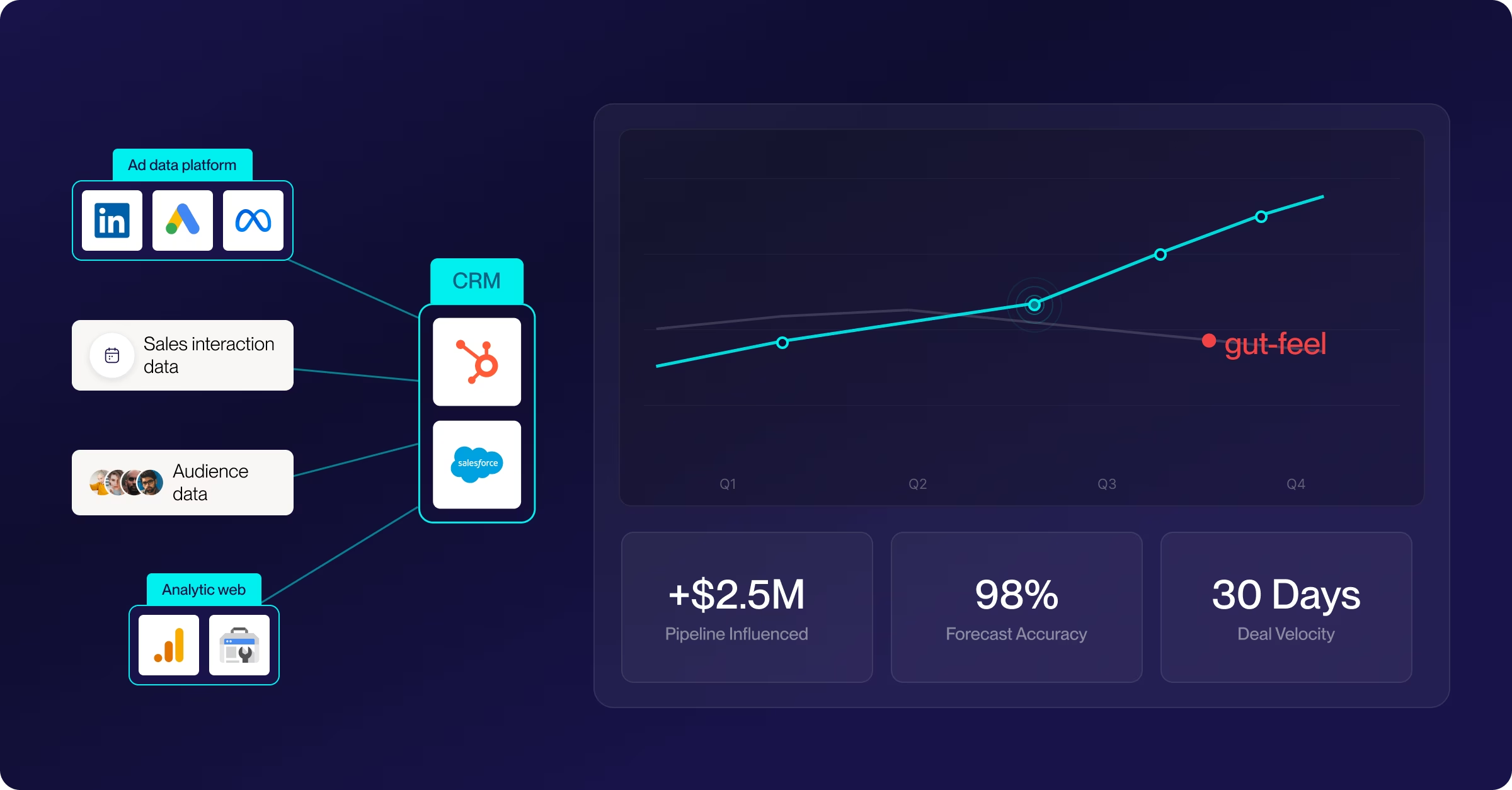

B2B revenue teams sit on more data than ever, yet most can’t tell you which campaigns, content pieces, or sales motions drive revenue without spending hours scouring data from exported CSVs inside spreadsheets. The data exists, but it’s scattered across several tools living in their own silos; nobody agrees on the definitions; by the time someone pulls a report, the deal data is stale, and the opportunities you're trying to move forward are either closed or lost.
Revenue intelligence exists to remove that roadblock. Done right, it replaces forecast theatre with real deal signals. Done wrong, it becomes another dashboard nobody trusts, in a tool no one outside of RevOps uses.
Here’s what the revenue intelligence means, how it works, and the one decision that determines whether revenue intelligence earns its keep or quietly joins the pile of tools people forgot they bought.
What is revenue intelligence?
Revenue intelligence captures customer interaction data across CRM, sales, and marketing systems, then uses analytics to turn that data into specific, revenue-linked recommendations. It replaces gut-feel forecasting with decisions backed by data that shows what has already closed, what is closing now, and what continues to stagnate.
It sits on top of three capabilities:
- Data aggregation. Multi-touch tracking that pulls records, campaign data, ad spend, and engagement signals into a single place for revenue attribution.
- Pattern recognition. Using journey analytics and multi-touch tracking to find relationships between activities and outcomes (which touchpoints accelerate deals, which content appears in winning journeys, and where revenue leaks).
- Action. Translating the analysis into specific recommendations: reallocate budget, focus on specific accounts, replicate this journey pattern.
Traditional reporting shows you what happened last quarter. Revenue intelligence shows you what’s happening now, what’s likely to happen next, and what to do about it.
Why does revenue intelligence matter for B2B teams?
Revenue intelligence matters because B2B buying has become too complex for instinct alone, and most of the buyer journey now takes place before sales ever get in touch. A single enterprise deal touches dozens of marketing moments, multiple buying committee members, and weeks or months of sales activity. Without a way to connect those touchpoints to outcomes, you’re guessing with the budget.
Three specific things break when you don’t have revenue intelligence in place.
Budget gets allocated by volume, not impact. Campaigns that generate MQLs get funded. Campaigns that generate pipeline but fewer leads get cut. Six months later, pipeline dries up, and nobody can explain why.
Forecast accuracy collapses in long cycles. If you can’t see which signals correlate with closed deals, you forecast based on rep optimism. Rep optimism is not a data source.
Sales and marketing argue about credit instead of compounding it. Marketing says it sourced the deal. Sales says the rep closed it. Finance says neither version reconciles with the numbers in Salesforce. Everyone walks away frustrated. This is the pattern Heeet has written about at length in how RevOps teams close the attribution gap, and it’s the single biggest cost of not having shared revenue data.
There’s a real dollar figure behind the pain. Forrester Research has estimated that misalignment between sales and marketing costs B2B companies roughly 10% of annual revenue. For a $50 million company, that’s $5 million of leaked upside every year. Revenue intelligence is how you stop paying that tax.
For the same reason, it’s also the foundation for defending marketing spend with revenue data during budget season.
How does revenue intelligence work in practice?
Revenue intelligence works by collecting every meaningful customer interaction into a single data layer, running AI analysis across that layer to identify revenue-relevant patterns, and then surfacing those patterns as actions your team can take. The quality of the output depends entirely on where that data layer lives.
The workflow has three phases.
Phase 1: Collect and unify. Every touchpoint gets captured: CRM records, website visits, content downloads, ad clicks, email engagement, webinar attendance, sales call transcripts, opportunity-stage changes. In most teams, this data lives in 6 to 10 separate tools. Revenue intelligence stitches it together so a LinkedIn ad click on Tuesday and an opportunity-stage change on Friday can be joined to the same account.
Phase 2: Analyze. Journey analytics display the most frequent winning patterns spanning sources without manual data manipulation. Which content assets appear most often in winning deal journeys? Where do deals typically slow down? Which combinations of touchpoints accelerate close rates? This is where connecting activities to closed revenue stops being aspirational and starts being measurable.
Phase 3: Recommend and act. Insight without action is trivia. The platform surfaces specific moves: shift spend from this channel to that one, focus on these three accounts showing buying signals, flag these stalled deals to sales leadership this week.
The decision that determines whether any of this works is where the data layer lives. If you build it in an external warehouse, you end up with a parallel system nobody on the sales floor opens. If you build it inside the CRM where your reps already work, the intelligence gets used. That’s the wedge Heeet has been built around from day one.
How is revenue intelligence different from marketing attribution and revenue operations?
These three terms get used as synonyms, and they shouldn’t be. Revenue operations is a function (the team). Marketing attribution is a technique (crediting touchpoints). Revenue intelligence is the data and AI layer that powers both. They stack. They don’t compete.
Here’s the clearest way to think about it.
What metrics does revenue intelligence track?
Revenue intelligence tracks metrics that link activity to revenue, not vanity counts. The goal is always the same question: did this activity generate, accelerate, or expand a deal? The four metrics that matter most in a B2B context are pipeline influenced, cost per acquisition by source, content influence on closed deals, and sales cycle length by entry path.
Pipeline influenced by channel: How much sales pipeline has every marketing channel touched? Organic search, paid ads, events, webinars, content, and SDR outbound: each is measured by its real impact on open opportunities, not just lead volume.
Cost per acquisition by source: What does it cost to acquire a customer through each channel, end to end? This comparison exposes efficiency gaps and shows you where to shift the budget.
Content influence on closed deals: Which specific content assets appear most often in winning buyer journeys? A well-ranked blog post is nice. For example, when you find out which blog post shows up in 40% of closed-won journeys, that’s real insight into a revenue-driving asset.
Sales cycle length by journey path: How long does it take to close deals that start from different entry points? Some journey patterns are twice as fast as others. Revenue intelligence tells you which.
When Ringover, a B2B SaaS communications platform, implemented Heeet’s native attribution layer, they saw a 24% improvement in marketing-generated revenue attribution accuracy and a 14% lift in Google Ads ROAS once closed-won revenue was syncing back into their bid optimization. “With Heeet, we get full-funnel visibility across Google Ads, LinkedIn, and Facebook,” said Vincent Coulondres, Head of Growth at Ringover. That visibility is what revenue intelligence looks like when the data stays in the CRM rather than in a separate dashboard.
What should you look for in revenue intelligence software?
The most important criterion is where the intelligence lives. Every other feature on the vendor checklist matters less than whether the platform keeps your revenue data inside your CRM or pulls it into an external warehouse. Everything downstream (adoption, trust, security, speed) is decided by that one choice.
Here’s the comparison that matters.
External platforms force a decision your team will feel every day: do we use the CRM or the dashboard? Native platforms remove the decision. Reps see revenue intelligence on the opportunity record they already live in. That’s the difference between a tool that gets adopted and one that gets a login nobody remembers.
Two other capabilities are mandatory for B2B. First, privacy-first tracking that works without third-party cookies, because browsers have been shutting those down for years, and any platform still relying on them is on borrowed time. Second, direct ad-platform sync so your closed-won revenue flows back into Google Ads and LinkedIn bid optimization, not just into a report nobody acts on.
How do you implement revenue intelligence without blowing up your tech stack?
You implement revenue intelligence by fixing your data foundation first, choosing a CRM-native platform second, and expanding dashboards your team will use last. Teams that try to buy their way to revenue intelligence before fixing their attribution end up with a premium dashboard sitting atop unreliable data.
Five steps, in order.
- Audit where your revenue data lives today. List every tool that holds a customer touchpoint: CRM, ad platforms, website analytics, email, sales engagement, call recording, and webinar software. Note the gaps and duplications. This audit usually surfaces three to five places where the same lead is counted differently, and fixing those is obligatory before anything else ships.
- Define the metrics that tie activity to revenue. Before you shop for software, agree on the four or five numbers that will be the team’s source of truth: pipeline influenced, CAC by source, content influence, sales cycle by path, and forecast accuracy. If leadership isn’t in sync on these definitions, no platform can save you.
- Choose a platform that lives natively in your CRM. If your team runs on Salesforce, look for native Salesforce attribution. If you’re on HubSpot, the equivalent is attribution native to HubSpot. CRM-native means the data never leaves, no manual exports, no sync lag, no second login for your reps.
- Agree on attribution logic across teams. Get sales, marketing, and RevOps leadership to sign off on the attribution model before you turn anything on. W-shaped, linear, time decay: pick one per use case and document the tradeoffs. This single conversation prevents roughly 90% of the credit fights that come later.
- Launch small, then expand. Start with three or four core dashboards (pipeline influenced, CAC by source, forecast vs. actuals). Get them running and trusted before adding more. Revenue intelligence amplifies over time as more data flows through the system, so the goal of month one isn’t comprehensive; it’s trusted.
Teams that follow this sequence typically go from zero to a live revenue intelligence layer in two to four weeks with a CRM-native platform. Teams that skip the audit and buy the platform first usually spend three to six months untangling data quality issues before the dashboards mean anything.
Revenue intelligence FAQ
Flagged for FAQPage schema markup
**What is the difference between revenue intelligence and revenue operations?**Revenue operations (RevOps) is the team function that unites sales, marketing, and service around revenue. Revenue intelligence is the data and AI layer that powers RevOps with operational insights. One is the team. The other is the team's capability.
**How does revenue intelligence work without third-party cookies?**Modern revenue intelligence platforms rely on first-party data from your website and server-side tracking to capture touchpoints without browser cookies. Combined with CRM-native data, this approach is cookieless, GDPR-compliant, and more accurate than cookie-based methods because it survives browser changes.
**Can revenue intelligence track B2B buying journeys with multiple decision-makers?**Yes. Revenue intelligence platforms connect touchpoints from multiple contacts on the same account, so you can map the full buying committee’s engagement to a single opportunity. This is how modern B2B teams gain visibility into committees of 6 to 10 stakeholders without manual stitching.
**How long does revenue intelligence implementation take?**CRM-native platforms can go live in hours or days because the data never leaves Salesforce or HubSpot. External platforms that require data pipelines and warehouse integration typically take weeks or months. Implementation speed is usually a proxy for how invasive the platform is.
**How is revenue intelligence different from marketing attribution?**Marketing attribution is the system that assigns credit to touchpoints that influenced revenue. Revenue intelligence is the broader data layer that uses attribution as one of its inputs and adds pipeline analysis, deal-risk scoring, forecasting, and recommendations. Attribution is a subset of revenue intelligence, not a synonym for it.
Build revenue intelligence where your deals already live
If you take one thing from this guide, take this: revenue intelligence only compounds in value when it lives where your deals live. Everywhere else, it becomes a parallel system that your team has to remember to open.
That’s the wedge Heeet has been built around since day one. Attribution, content tracking, ad-platform revenue sync, and multi-touch models all run natively inside Salesforce and HubSpot. No data exports. No warehouse to maintain. No second dashboard to train your team on. Reps see revenue signal on the opportunity record they already work in every day. Marketing sees the pipeline influenced by the channel without waiting for someone to pull a report. Finance gets numbers that reconcile.
That’s what it looks like when the data stays where the work happens.
See Heeet in your CRM. Live in hours, not weeks.
Other articles
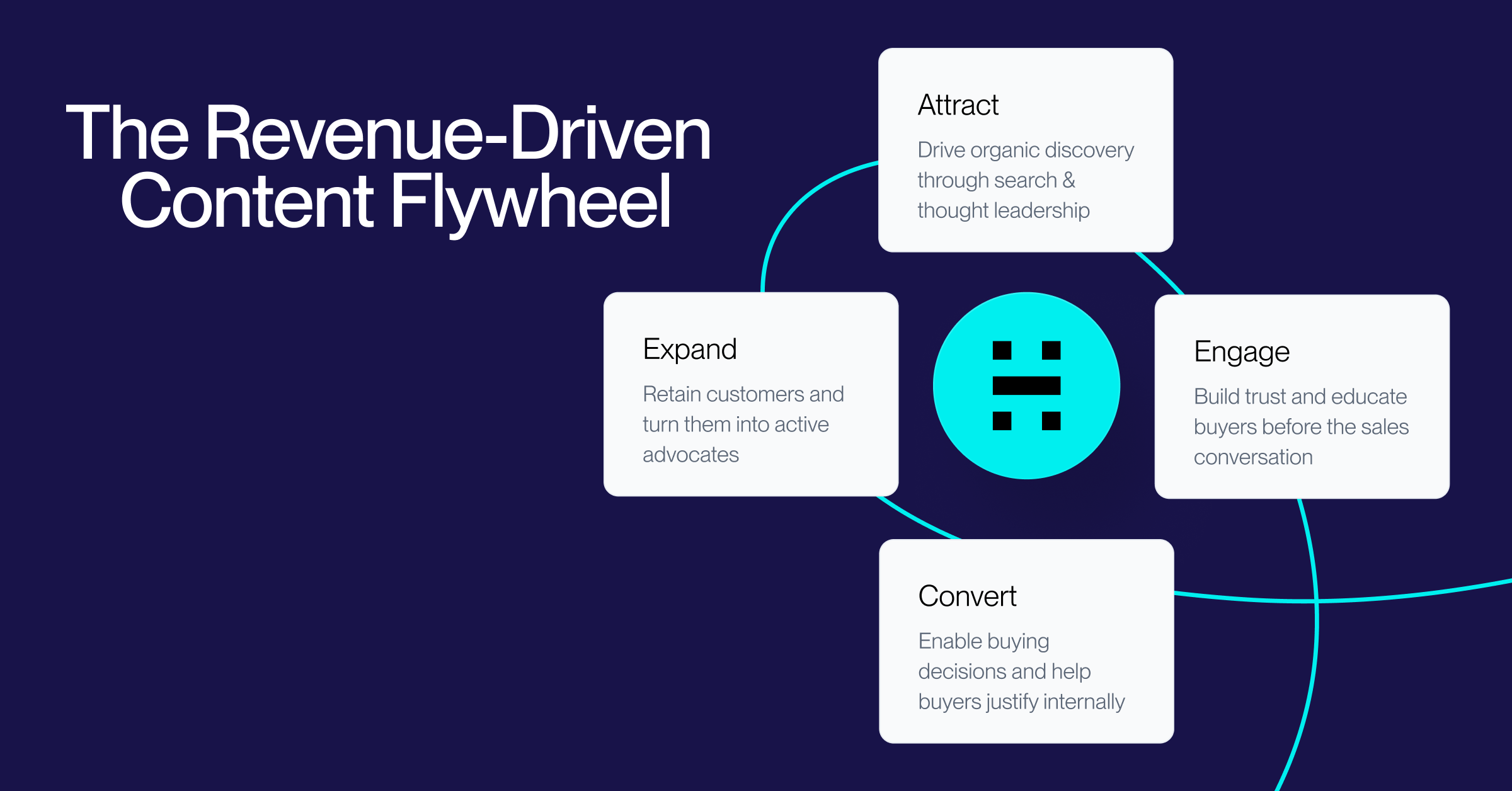
Creating the Revenue-Driven Content Flywheel: A Framework for B2B Content That Drives Pipeline
Learn how to build a revenue-driven content flywheel that connects content to pipeline and revenue. Replace the outdated funnel model with a compounding system that turns every asset into measurable ROI.
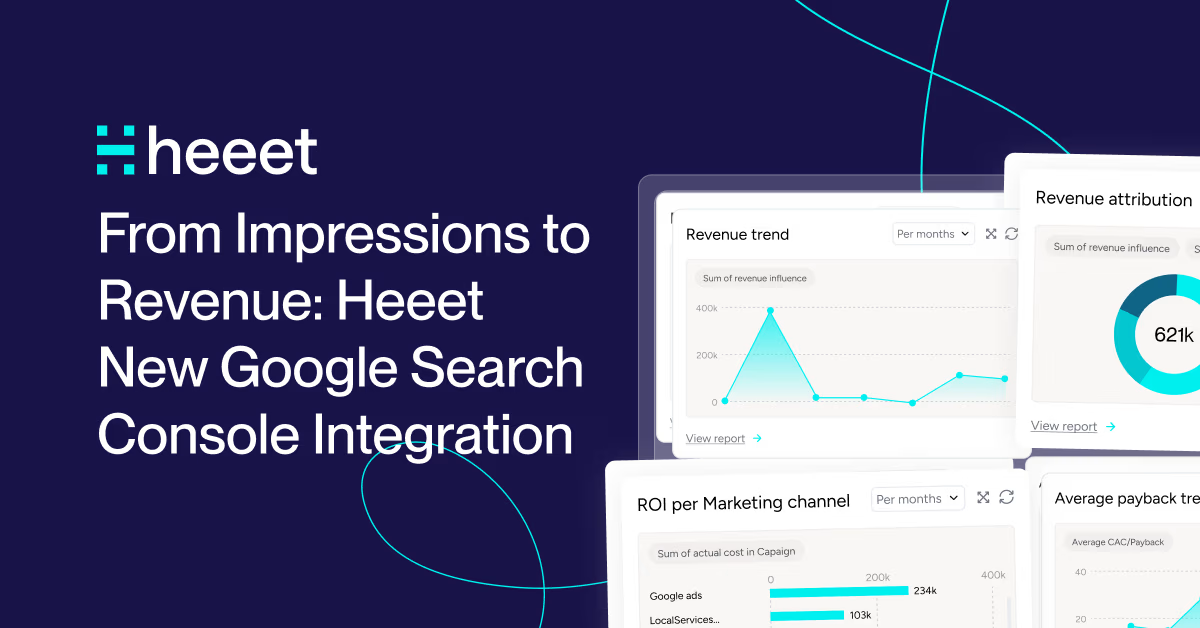
From Impressions to Revenue: Heeet New Google Search Console Integration
Connecting what happens in Google Search Console with actual revenue outcomes in Salesforce remains an elusive puzzle. That disconnect ends today.
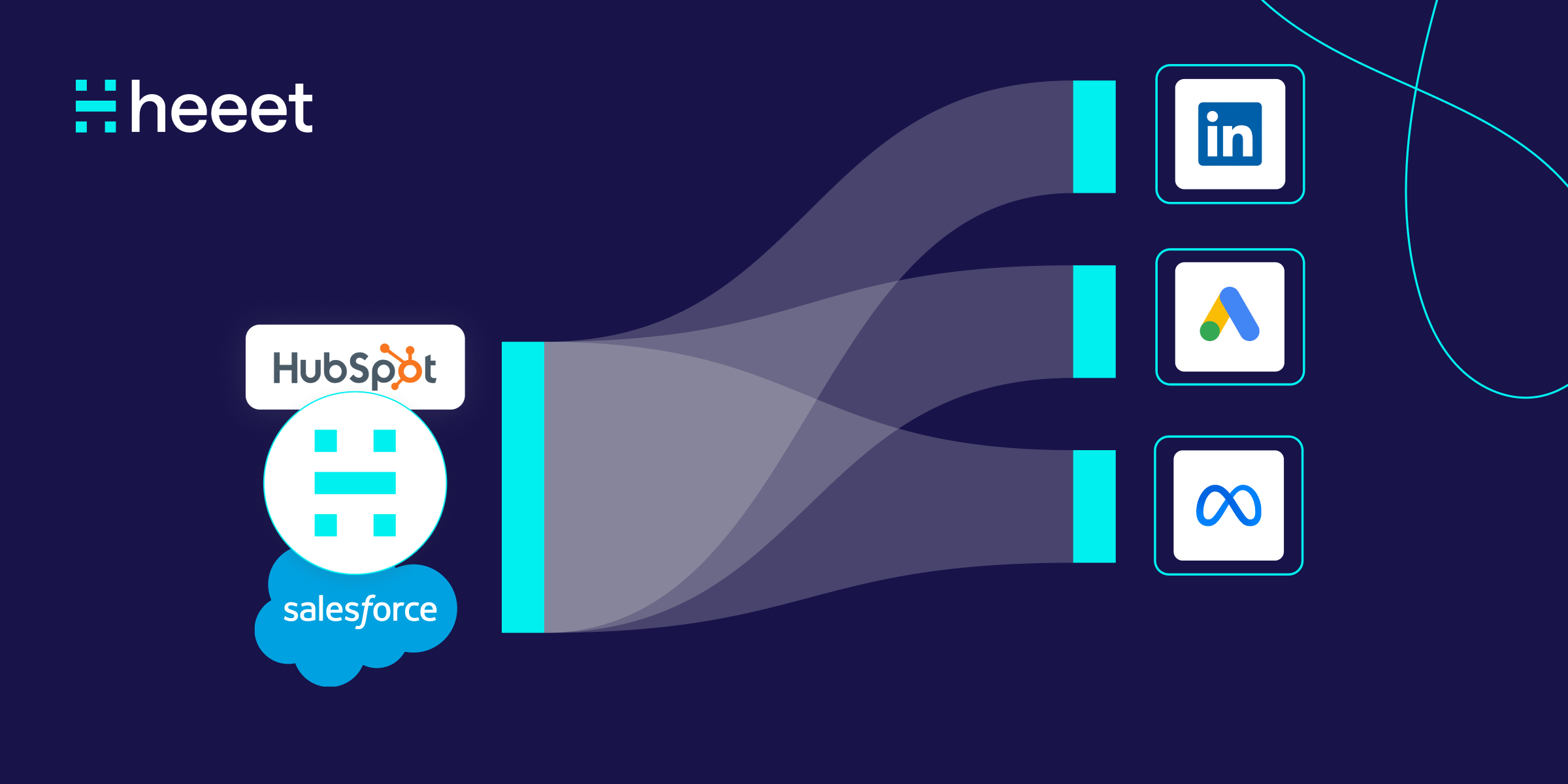
Revenue-Based Lookalike Audiences: Build Ads from CRM Data
Learn how to build higher-converting lookalike audiences using closed-won CRM revenue data instead of leads. A step-by-step guide for B2B GTM teams.
.svg)
Ready to track prospects from lead to close with Heeet?
Heeet gives marketers and sales professionals at IT & Security firms turn geuss work intro informed decisions that drive revenue while meeting the same secruity technical standards you provide your clients.