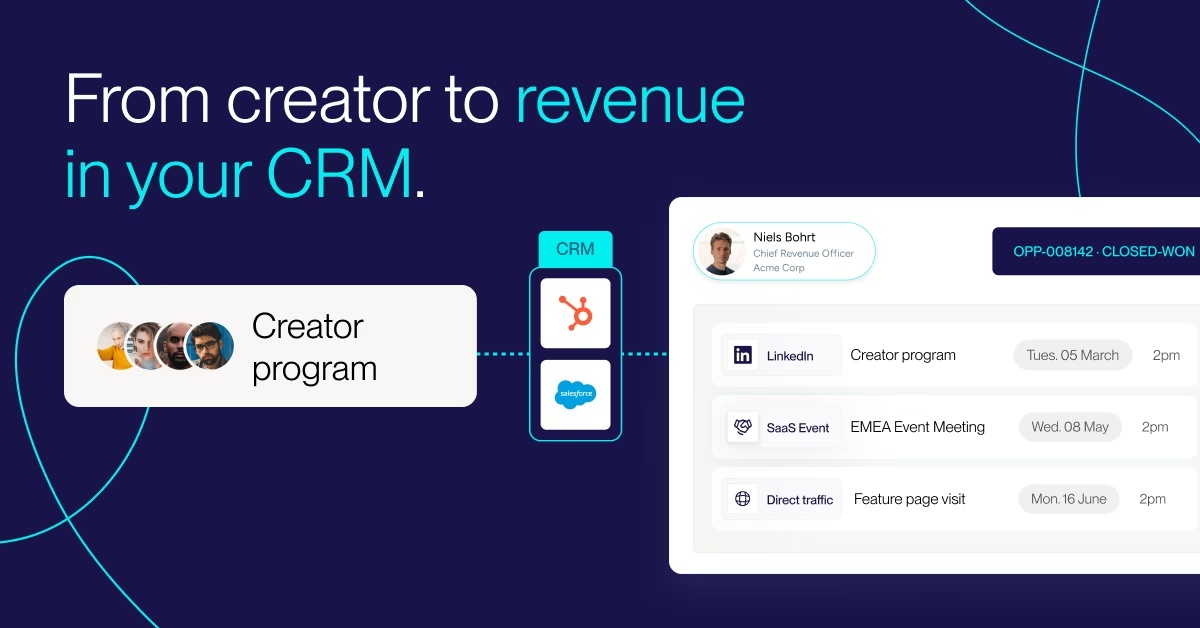

The obvious answer, and you would be right to mention it, is branding. That type of word of mouth impacts the bottom line.
You show impressions, likes, and 'engagement rate' all going up, but none of it touches an opportunity record unless it’s self attributed at conversion. You lack the straight line from which creator took a deal from initial awareness to the next stage on the journey to closed won.
That’s the same dilemma that more and more B2B marketers find themselves in. TopRank Marketing's 2025 research highlights that 47% of B2B marketers cited measuring and reporting results as one of their top influencer marketing challenges, just behind finding the right people, and 58% of brands in complex, regulated sectors cite proving ROI as their top challenge (IAB). The programmes are growing fast, but the proof is still catching up.
We created this guide to help you close the gap. We look at why B2B influencer programmes are exploding, how brands like Clay run theirs, what today's creator platforms can and can't measure and how you can bring the power of the creator into your CRM so it's sitting alongside pipeline and revenue.
more and more B2B marketers face
Why are B2B brands getting into influencer programmes?
B2B brands are getting into influencer programmes because buyers trust a person more than a logo. It’s the same reason LinkedIn rewards personal profiles more than company pages. People need a face, not a logo to tell them their personal experience with a product or service. LinkedIn's 2026 research found that 56% of B2B buyers who use creator content will use it as a deciding factor in the final stage of the buying process.
That number shows that creators aren't just feeding the top of the funnel. They're creating influence at the point where a buying committee is going to be comparing you against two other options.
Here's what's driving the shift:
- Buyers conduct research in feeds, forums, and AI, not your site: An expert going through the real workflow trumps a product page every time. It's proof from someone who doesn't get paid by us.
- LinkedIn is building better infrastructure for creators: In March 2026, they expanded their creator sponsorships and BrandLink video ads. Brands can now promote employee and creator posts as Thought Leader Ads (LinkedIn News). We’re also seeing collaborative posts with up to five different people.
- The creators are everyday operators: From what we’ve witnessed, the most effective B2B voices are the experts cultivating specialized smaller audiences giving tips and guidance on practical use cases that help their audience immediately. They're RevOps consultants, SDR managers, and agency founders who use your product weekly.
Tools like Clay and Lemlist didn't win LinkedIn by going after the celebrities. They tapped their employee base who became influencers in their own right, and power users and turned them into a distribution channel. They gave those power users a reason to build an audience.
But look at the gap. Marketers say creator programmes are essential to achieving measurable ROI. Nearly half of them say measurement is their biggest pain point. That tension can't go on.
What kind of B2B creators are the brands working with?
Most B2B influencer programmes mix the three types of creators: user generated creators (UGC), industry experts, and thought leaders. Each one moves the buyer differently, so you need a different success metric for each one. If you judge a thought leader on click-throughs, you'll likely kill your best creator. If you judge a UGC creator on brand lift, you'll have absolutely no idea whether they've converted anyone.
UGC creators
UGC creators publishing screen recordings, quick tips, 'how I set this up' type of clips. They're typically paid per asset or on commission. The content is very much geared towards driving direct response (clicks, sign-ups, free trials). You'd measure them on tracked conversions and cost per sourced lead.
Industry experts
This is what you see most on LinkedIn and more and more on X. Experts are the people your buyers are already following (the RevOps consultant, the outbound coach, the agency founder who builds GTM workflows for a living). When they include your tool in their guides, lead magnets, or include them diagrams showing the system they use and how your tool fits in it, it demonstrate how your tool works in their stack, it's a peer recommendation. They drive the demo requests and the evaluations. You measure them on sourced pipeline and on how often they appear in won deals.
Thought leaders
Thought leaders shape the way a category thinks, and thus has influence on leadership. They don't post link to demo pages or free trials. You see the influence weeks later when a VP of Sales tells your AE, "I saw x talk about y with z on this industry podcast." They drive consideration and trust. You measure them on influenced pipeline, self-reported attribution and engagement from target accounts.
Which B2B influencer programmes actually work?
The B2B influencer programmes that work treat the influencer as a partner, not an ad slot. Clay, Salesforce, Adobe, Nextiva and Cognism all took very different approaches. What they all have in common is that they first made the creator successful, then gave them the reasons and tools to talk about it.
Clay: turning power users into a GTM media network
Clay is the SaaS creator program benchmark and for good reason. Their Creators Program targets the top users who share Clay content. Members get production-quality content assets, Clay credits, LinkedIn ad spend behind their posts, and access to a private Slack community of 300+ creators.
The programme didn't start as a programme. As Dave Gerhardt describes in Exit Five, Clay saw early adopters (mostly freelancers and agencies) already building their audiences by posting their Clay workflows on LinkedIn. Clay just went in and said, "right."
- Three tiers of partners: Creators, Clay Experts (freelancers and agencies building on the platform), and top RevOps agencies serving the enterprise.
- Unscalable work first. We found the agencies by hand, reached out directly, and had the calls before we even thought about automating anything.
- Friction removed. Clay built tooling that turns a creator's voiceover into a branded screen recording. Shared templates, early feature access and promotion of creator profiles in their own paid ads.
The result was pretty obvious. Clay's LinkedIn following went from 8k to 40k in 10 months, then past 138k in another year. Gerhardt puts it: "Let's help you win, then tell people about it."
What's missing from the public narrative is a clear link from creator activity to closed revenue. Follower growth is a very good indicator of that. It's not a P&L.
Salesforce: community as an advocacy engine
Salesforce's Trailblazer community turned their customers and admins into a global advocacy network long before 'creator programme' was even a thing. Takeaway for smaller brands: your most credible creators may already be in your customer base.
Adobe and Nextiva: amplifying expert voices with paid
Adobe worked with TopRank Marketing on an EMEA campaign targeting over 900 accounts, creating the content together with the influencer. TopRank reports 2x the engagement of similar campaigns and a 150% lift in LinkedIn form completions.
Nextiva took a different approach. They ran videos from their own subject matter experts as LinkedIn Thought Leader Ads. TopRank's analysis attributes 5,600% growth in influenced pipeline to the programme (ContentGrip). That's an agency figure as far as we're concerned. It does, though, demonstrate the potential of expert content combined with paid amplification to drive pipeline.
Cognism: contracting a practitioner
Cognism engaged Ryan Reisert (an outbound practitioner) to produce regular content in 2022. Their team found that around 24% of the self-attributed content came from some form of influencer social activity (Cognism).
That stat is worth thinking about. A quarter of the buyers said a creator had an influence. Cognism's own write-up, however, goes on to say that you can't attribute leads to an influencer. The influence was there; the system to record it wasn't.
What tools do B2B teams use to find and run creator programs?
B2B teams use three types of tools for their creator programs: LinkedIn's own ad and creator products, creator discovery and campaign platforms and partner/payout platforms. Most programmes will use a combination of two or three. The table below compares them by function based on the vendors' public information as of October 2026.
A few patterns emerge. LinkedIn own the audience; they report on it internally. Discovery platforms (Favikon, Kolsquare, etc.) are very good at finding and managing creators. Performance platforms (Naano, Trybe, PartnerStack, etc.) go further in the conversion space, typically at the click, lead or order level.
All of them are useful, and each one measures the content, not the deal.
What attribution do these platforms currently provide, and where does it stop?
Creator platforms measure what happens to the content itself: reach, engagement, earned media value, clicks, and, in some cases, leads or orders. Their attribution ends at the first conversion. They don't see the value in your CRM, the buying committee behind it, or the deal that closes six months later.
That's not a flaw, these tools were built to manage creators. Most of them came from the B2C world where the journey is short. A shopper sees a video, clicks a link and buys. Last-click, order-level attribution (the model a UGC platform like Trybe runs on) fits that world perfectly.
B2B breaks that model in four places:
- The cycle is long: The impact from creator programmes often takes 6 to 12 months to manifest (Warmly). A 30-day click window misses it completely.
- The buyer is part of a committee: The champion who's watched a practitioner's tutorial will have to convince an entire team before making a purchase.
- Most influence never actually 'clicks': You've got thought leaders shaping opinions in the feed, on podcasts, in the DMs.
- Influence continues after the lead: A creator's post can re-engage a stalled opportunity or reassure a buyer in the later stages of evaluation.
These four issues will leave you a creator programme that doesn’t seem like it’s pulling its weight. Your CRM will show you a pile of 'Direct' and 'Organic Search' opportunities with no creator at all on the record.
The fix is getting the creator touchpoints into the system where the revenue already exists.
How do you measure a creator's ROI in the CRM?
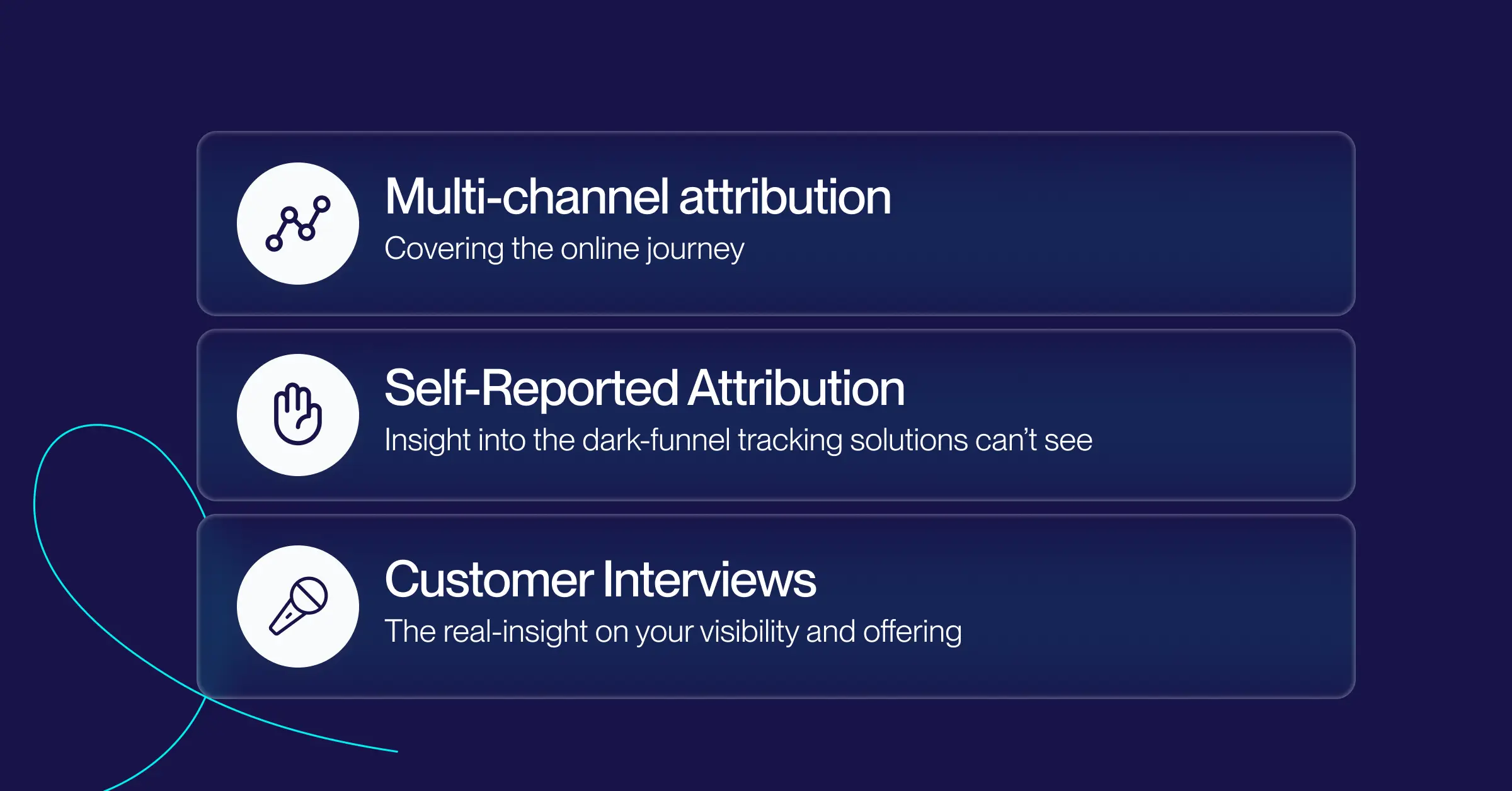
To measure creator ROI in the CRM, record every creator interaction as a touchpoint on the contact, then roll those touchpoints up to the account and opportunity. Use three layers: tracked clicks, declared mentions, and engagement signals. Together, all three cover what a single tracking link would miss.
Layer 1: Tracked touchpoints
Give each creator a unique tracked link (UTM source = creator name, medium = creator, campaign = program). Each creator is their own CRM campaign. The touch is recorded on their record when a prospect clicks and converts. That layer works really well for capturing UGC creators and practitioners.
Layer 2: Self-attributed touchpoints
Add a 'How did you hear about us?' field to your demo form and train your AEs to ask the same question on discovery calls. Treat each answer as a real touchpoint, mapped to the right creator campaign rather than free text nobody ever reports on. That's how you pick up thought leaders and podcast mentions. Cognism's 24% figure is a good reminder of just how much of this is unaccounted for.
Layer 3: Engagement touchpoints
Record contact-level engagement with creator content on LinkedIn: who from your target accounts reacted, commented or otherwise engaged with a sponsored creator post. Link it to the contact and the account. In the month before the deal moved, four people from an open opportunity engaged with a practitioner's post. Tools like Heeet among a bevy of others can get this done for you.
Four metrics that matter
Once creator touchpoints sit on CRM records, report on four numbers:
- Creator-sourced pipeline: opportunities where a creator touch was the first touchpoint recorded.
- Creator-influenced pipeline: opportunities with at least one creator touch at some point on the account before close.
- Cost per influenced opportunity: total program cost / influenced opportunities.
- Win rate and cycle length delta: how creator-touched deals perform against deals with no creator touch.
A worked example
The figures below are purely illustrative. Take a hypothetical quarterly programme with eight creators. It comes to $60k. $36k in creator fees, $18k in Thought Leader Ads running behind their posts and $6k in tooling.
- Sourced: 14 opportunities worth $210k. That's 3.5x pipeline on spend.
- Influenced: 41 opportunities worth $ 820k at a cost of c. $1,460 per influenced opportunity.
- Win rate: 31% on creator-touched deals v 22% baseline.
- Cycle length: 74 days v 96 days.
Now break it down by creator. That's where the decisions get made.
On a click report, Creator A looks like a total waste of $15k (one sourced opp). In the CRM, though, Creator A touches more pipeline than anyone. Creator B, with 10% of the audience, is your most efficient source of new deals. Creator C generates sign-ups that very rarely convert into anything substantial.
Same programme, but with three entirely different renewal decisions. You only see them when creator data sits next to revenue.
How does Heeet get the creator data onto the record?
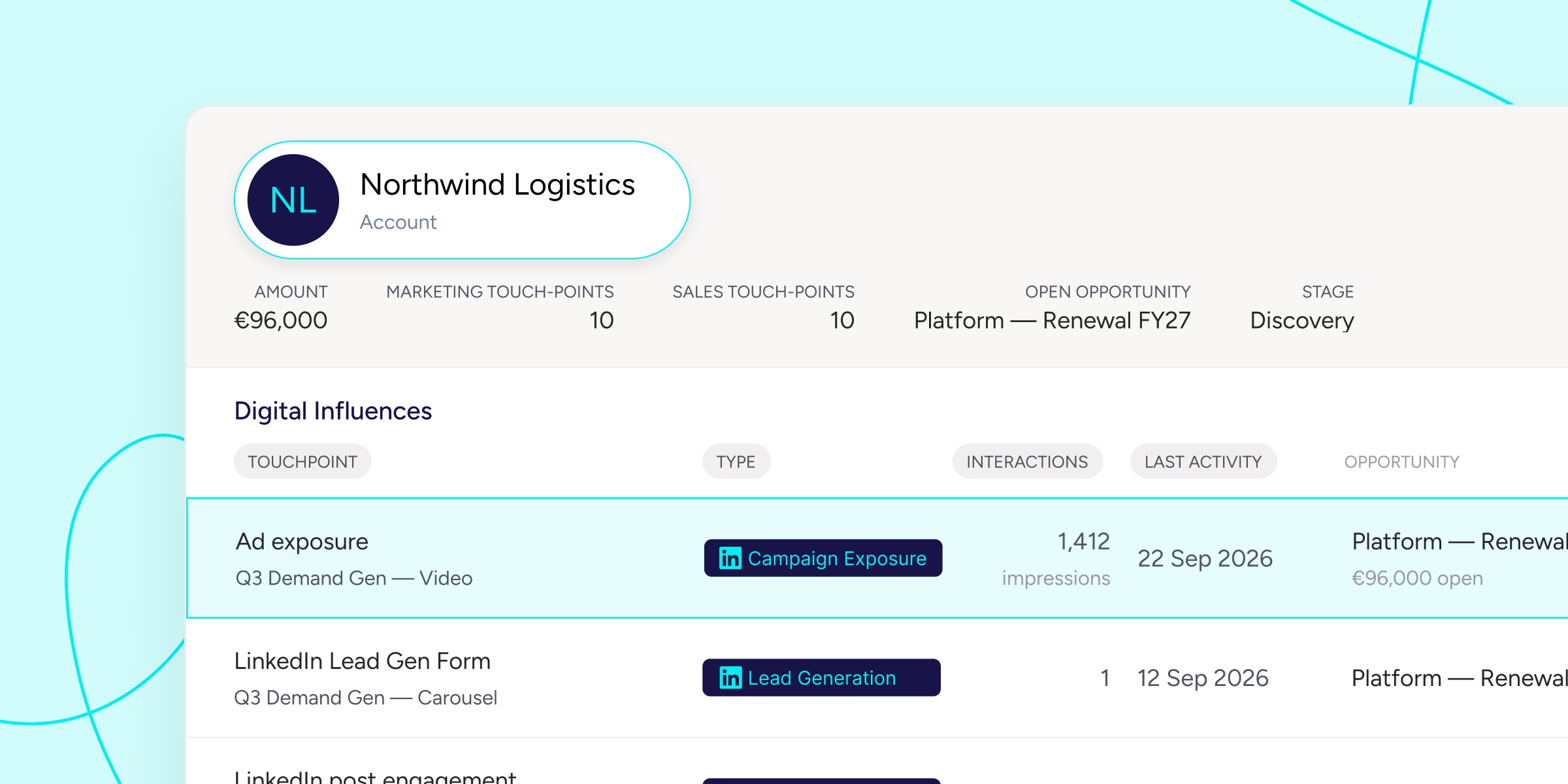
Heeet brings creator touchpoints directly into Salesforce and HubSpot on the contact, account, and opportunity records your revenue team already uses. All tracked links, self-reported answers and LinkedIn engagement become attributable touchpoints. Your creator data stays entirely within your CRM. You report on it in the same dashboards as every other channel.
Think of your creator platform as the place where the programme actually runs. Heeet is where the programme gets the credit. Kolsquare, Favikon and LinkedIn will tell you how a post has performed. Heeet will tell you which deals it touched.
Here's what that looks like in practice:
- Automatic campaigns per creator: Heeet will create your CRM campaigns and update member statuses automatically based on your tracking parameters: no manual imports, no spreadsheet of UTM links to reconcile at the end of the quarter.
- Self-reported attribution as a real touchpoint: "I heard about you on Sarah's podcast" is no longer just a note in a text field. It's recorded as a touchpoint on the contact and attributed to the correct creator just like every other digital interaction.
- Account-level roll-up: Every touchpoint from every contact rolls up to the account and the opportunity. You can see creator influence across the whole buying committee without having reps manually assign contact roles.
- Multi-touch attribution models: Compare first-touch, last-touch, and multi-touch views to see whether a creator is just opening the door or actually closing the deal. Explore multi-touch attribution in Salesforce.
- Cookieless, server-side tracking: The touchpoints will continue to record irrespective of browser settings, so creator traffic doesn't just disappear if a buyer has cookies blocked.
- Cost and ROI in the same view: Add in creator fees and amplification spend. Heeet calculates cost per lead, cost per opportunity and ROI at every funnel stage.
Ringover's paid channels are entirely reliant on that final capability. As Vincent Coulondres, Head of Growth at Ringover, says: "Thanks to Heeet, we have full funnel visibility. We can track every lead, we can analyze the performance of our campaigns, we can monitor our customer acquisition, and we can measure our ROI across Google, LinkedIn and Meta." The same is true of creators. If you've got a campaign with a cost, then you can assess it exactly like any other channel.
What journey and LinkedIn engagement data does Heeet add?
Heeet also brings in the context creator platforms can't see: the full journey each contact takes before and after the creator touch, plus contact-level LinkedIn engagement from your target accounts. That turns the creator touchpoint from a standalone event into a step in the buying story that your sales team can then act on.
The full customer journey around every creator touch.
A creator touch will rarely close the deal on its own. What matters is what happens after that. With Heeet, you can see the full sequence of activity on each contact record:
- Engages with a practitioner's LinkedIn post about outbound workflows
- Visits your integration page two days later
- Reads a case study, then your pricing page
- A colleague books a demo via a Google search.
- The opportunity closes in 68 days.
No journey; that deal is just "Google Ads sourced". With the journey, you can see the creator has opened the door and paid search has walked the buyer through it. Both channels get credit. The budget conversation is a lot more honest. See how Heeet tracks content influence.
Post-conversion influence
Heeet is tracking touchpoints post-MQL (after a contact becomes a lead) and post-open opportunity. That's where thought leaders do their work. If three of the stakeholders on a deal that's currently stalled all engage with a post from a creator on implementation, your AE should know about that today, not at the quarterly review. Read about post-acquisition marketing attribution.
LinkedIn engagement at the contact level
Heeet records organic LinkedIn engagement at the contact level and links it to the accounts in your CRM. For creator programmes, that's the perfect answer to questions that no click report can ever answer.
- Which target accounts interacted with this creator's content this quarter?
- Did we get engagement from the account before or after the opportunity opened?
- Which creators actually speak to decision-makers, not individual contributors?
Paired with the LinkedIn Ads data you get, this gives you one view of how paid amplification and organic creator content perform on the same accounts. Explore LinkedIn Ads attribution in Salesforce.
How do you report creator ROI to your CFO?
Report the creator ROI to your CFO the same way you'd report any other channel (cost, pipeline sourced, pipeline influenced, revenue closed), all pulled from the CRM. Include a creator-level breakdown and a clear time period. Your CFO doesn't need to love LinkedIn. They need the numbers that reconcile with the forecast.
As a CRO, I'll be brutally honest about what I see in board meetings. Creator programmes get cut when you defend them with engagement screenshots. They get expanded when the discussion starts with pipeline. Here's a simple monthly format that works:
- Program headline: Total spend, creator-sourced pipeline, creator-influenced pipeline and closed-won revenue influenced QTD.
- Efficiency: cost per sourced opportunity and cost per influenced opportunity v paid social and events.
- Deal quality: win rate and cycle length on creator-touched deals v/s your baseline.
- Creator leaderboard: each creator's cost, source and influenced pipeline, ranked by pipeline per dollar.
- Decisions: who to renew, who to scale with paid amplification and who to pause.
Set expectations around timing right from the outset. Awareness metrics will take 3-6 months to move. Pipeline typically takes 6-12 months to show up in volume. You'll want to assess a new creator after one quarter on the leading signals (target account engagement, self-reported mentions) and after 2-3 quarters on pipeline.
One more piece of advice: agree with Finance on your attribution model before the program begins. If you've got a clear definition in place from the outset of what "influenced" means (e.g. any creator touch on the account in the 180 days before opportunity creation), then there's no argument about it later on. That's why Sales and Marketing are always at odds over attribution and how it's defined. RevOps has the answer to that.
Frequently asked questions
What's a good ROI for B2B influencer marketing?
There's no single benchmark, as B2B influencer ROI varies widely depending on deal size and sales cycle. A good starting point, though, is whether the pipeline generated via the influencer covers the cost of the program by at least 3x over a 2-3 quarter period. Heeet lets you measure that directly in Salesforce or HubSpot by linking creator spend to the opportunities sourced and influenced.
How long does it take for B2B influencer programs to show pipeline?
Most B2B influencer programs show engagement and awareness gains within 3 to 6 months, with pipeline impact building over 6 to 12 months. Judge new creators on leading signals first, such as target-account engagement and self-reported mentions. Heeet tracks both from the first touchpoint, so you can see pipeline forming before it closes.
Can you track LinkedIn influencer posts in Salesforce?
Yes. Tracked links from creator posts can feed Salesforce campaigns. Heeet also records contact-level LinkedIn engagement and ties it to accounts and opportunities. That lets you see creator influence even when a buyer never clicks a link.
How do you attribute self-reported and dark social influence?
Capture it with a "How did you hear about us?" field on forms and a matching question on discovery calls. Then record each answer as a touchpoint mapped to the right creator, not as free text. Heeet does this natively, so self-reported influence sits alongside digital touchpoints in your attribution models.
Should you pay B2B creators a flat fee or commission?
Flat fees suit thought leaders whose influence rarely produces clicks, while commission or cost-per-lead deals suit UGC creators who drive direct conversions. Many B2B SaaS brands use a hybrid of a smaller fee plus performance bonuses. Heeet gives you the creator-level pipeline data to set and renegotiate those terms with evidence.
What's the difference between creator-sourced and creator-influenced pipeline?
Creator-sourced pipeline counts opportunities where a creator touch was the first recorded interaction. Creator-influenced pipeline counts any opportunity with at least one creator touch on the account before close. Heeet reports both, because judging creators on sourced pipeline alone undervalues thought leaders.
Stop defending creators with likes.
B2B influencer programs aren't a side experiment anymore. Clay built a GTM media network out of its own users. Practitioners with a few thousand followers are shaping shortlists. Your buyers listen to these people the moment they choose a vendor.
The programs that survive budget season will show their work. That means creator touchpoints on CRM records, influence rolled up to accounts, and a creator leaderboard built on pipeline, not impressions.
You don't need to rebuild your stack to get there. Keep running creators in the platforms you like. Then let your CRM do what it does best: tell you what turned into revenue.
Want to see your creator program in Salesforce or HubSpot? Book a Heeet demo, and we'll show you how creator touchpoints, LinkedIn engagement and self-reported attribution come together on one record.