
Read time :
Gated vs Ungated Content: The Case for Ungating Almost Everything For AI
The debate over content gating has long been contentious. It was widely supported as a way to generate leads. But when LLMs do all research for your prospects and clients, gating content can put you at a disadvantage.


In this article, I explain why 95% of content shouldn't be gated and identify the 5% you can still put behind a form. I'll also show how tracking technology has brought more of the customer journey into view for the B2B marketer, so you can measure your content's performance without locking up valuable research and expertise in the name of lead capture.
AI is shortening the research phase of the buyer journey
Leads of the past went through your blog, product pages and your pricing a dozen times before they ever filled a form. You had no insight into that journey.
Leads today are delegating that task to their LLM of choice so they can get the most detailed vendor comparison list without spending time browsing themselves. That's the research journey our leads describe to us when we ask the question in passing during a demo. More than a handful of times, we've also heard them say we were one of the few attribution solutions that didn't lock up their pricing behind a demo call.
When the demo does come, our leads today have gone through more of our content, or at least an AI-generated summary of it, than any of our customers two years ago. Not only are these leads better informed, but they're making decisions and converting faster. Yes, the B2B journey is still long, but it's definitely moving faster at Heeet, and we suspect the same is true for other B2B solutions.
Our own data comparing lead journeys from AI search vs. paid search showed that these leads:
- convert at a rate that is +68% higher
- Have a +141% higher close rate
- Turn into revenue 3x faster
- consume 17% less content before conversion
The acceleration of discovery and initial vendor lists generated by LLMs is exactly why content teams need to revisit gated versus ungated content more thoroughly than the typical middle-of-the-road approach of gating high-value, form-filling content and creating everything else for AI and search visibility.
I believe that even your high-value proprietary research that generated all those leads in the past is worth giving out without asking for the first and last name, company name, and business email.
Buyers don't want to speak to you right away
As the data below shows, people want to purchase without speaking with sales, so why hide the information they need to decide?
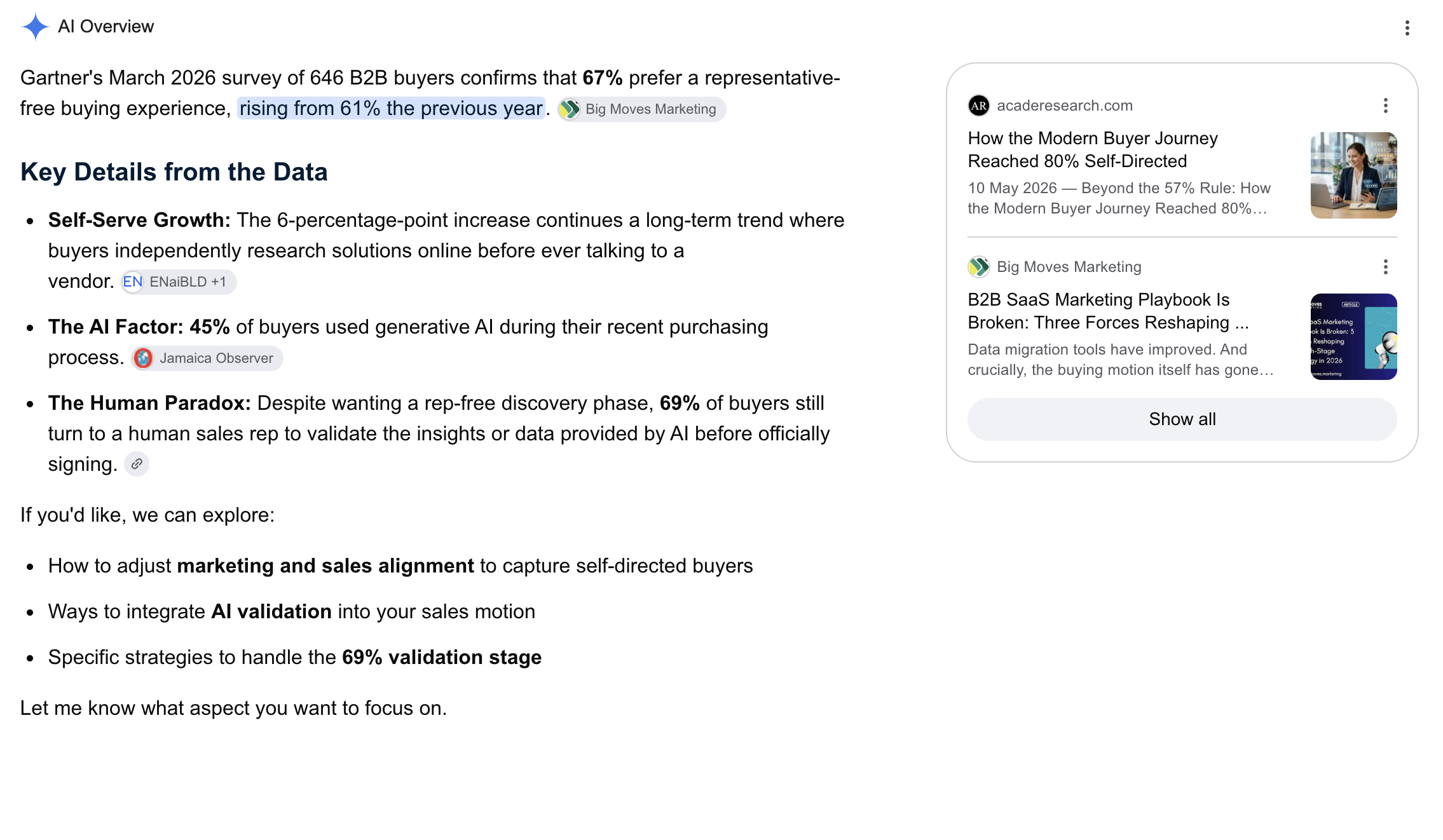
Published March 2026, Gartner's survey of B2B buyers showed that 67 percent preferred to purchase without speaking to sales; that's 6 percentage points higher than the year before. This trend shows a clear shift and the need for greater transparency and easier access.
Despite the desire of prospective buyers and the LLMs' thirst for access to pricing, most B2B companies still keep pricing details hidden behind the 'book a demo' option and require interested prospects to make that commitment to talk to sales when they are first comparing options.
Ungating could help your GEO
The dreaded form that far too often asks for too much "required" information was the principal reason I've discarded content gates in the past; giving LLMs access to the info prospective clients need is the latest reason on the list, and it connects directly to why ungating now matters.
It's funny to see companies rewrite all their top-of-funnel, low-value content in digestible chunks with titles that read like search queries for LLM crawlers, and at the same time place their high-value first-party data from their latest study behind a form. I have the same reaction when I don't see the slightest indication of pricing. The strategy makes less sense as dependence on LLMs increases. One way or another, industry blogs, forums, and media you don't own will cite your data if it's valuable, quote your pricing without the right context, and you miss out on some visibility.
Yes, zero-click influence may be the reason no one gets a click, but it shouldn't be the reason the cited information doesn't come straight from the source with your framing attached that allows you to shape perception.
This isn't a recommendation to pad GEO metrics that no one can trace to revenue. Instead, treat it as a branding play that follows from the visibility issue above.
What was the original reason for gating content?
The real issue behind the question 'should we gate this?' is not the form itself; it's what function you believe the form is still fulfilling.
Gating indeed addressed a real problem, and it's appropriate to admit that before criticizing it.
A decade ago, should a person read your best guide and then go on without further interaction, you would have nothing—no name, no means of contacting them, and no point of reference. It was almost impossible to trace an anonymous visitor from a blog post to a closed deal. That's why the form served three functions: it created leads you passed over to sales, it showed you what content is worth writing, and it provided the single identifying feature needed to piece together a customer's journey after the form fill.
All three jobs were important; however, they're not in a sound position in 2026, so the old logic no longer holds and the next question becomes whether the gate still adds value.
Tracking tech today can reveal what happened before the form fill, once it's filled, and afterward, so if you place the form in front of a report early in the journey, you may be hindering further progression. The extra gate essentially adds unnecessary friction and weakens the transition into the next stage of the buyer journey.
Being patient and giving the prospect all the information they're looking for so they can make a purchase on their own or finally contact sales will eventually give you the full journey you can measure and optimize with the right tools.
Why has the practice of offering restricted content ceased to be effective?
Gated content stopped working because buyers changed and the measurements caught up; today, buyers educate themselves using open content and public prices before contacting anyone, so the gate selects the wrong intent even though tools for measuring open content are finally available. The form has now become a tax on precisely the kind of qualified people you want, which is why the old practice no longer fits.
Four things broke at once.
The buyer already shops without you
As emphasized at the top of the article, your prospect can view your competitors' prices, take interactive product tours, read a dozen free breakdowns, and ask ChatGPT to compare the options, all without your form ever appearing. According to Gartner, 67% would prefer to do it that way. If everyone else in the market is showing off what they have while you're asking for an email address to share figures, you don't come across as exclusive; instead, you limit your visibility in AI and break the link to the broader argument.
The form is now favouring the incorrect intention
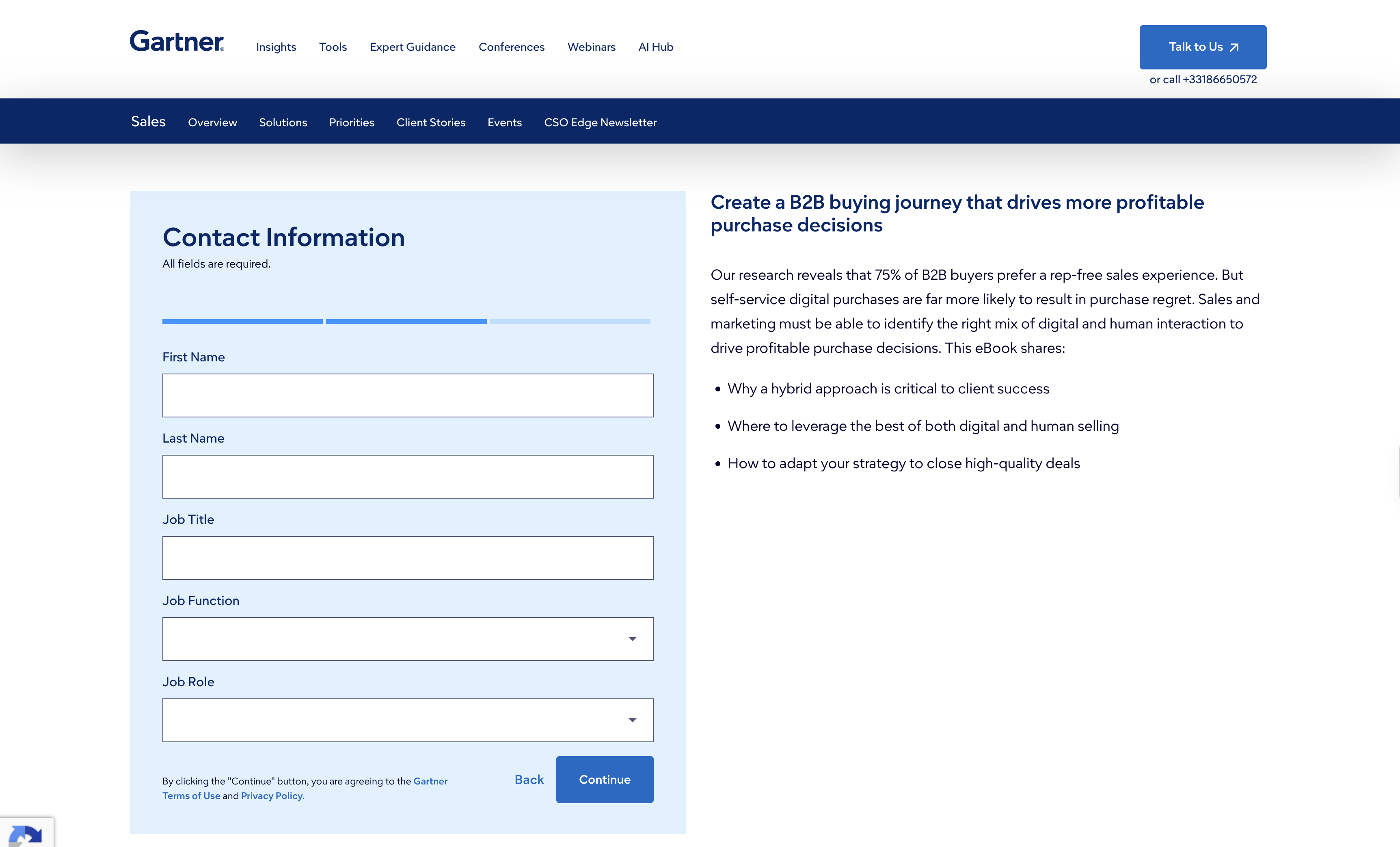
A gate doesn't screen out people who aren't interested in buying; instead, it selects based on how willing people are to provide their contact information. The kind of person willing to exchange their real contact details for an ebook is often a student, a competitor, or someone who will never make a purchase. Look at the Gartner figure in this article; I only gave my information to get the study and the full context of a figure that supports my argument in this article; I’m not in the market for Gartner solutions.
There's branding power in spreading your reports and studies so they get cited, but hiding the initial source behind a form is counterproductive. The three-step form asking for qualifying information like Job Function and Job Role may be overkill if you don’t have the weight of Gartner.
What’s also revealing is that when I searched for the study with the figure I was looking for, Gartner wasn’t even cited in the AI overview. These crawlable blog posts cite the same figures without a form blocking them.
Just as with the Gartner study, your gated content is picking up transactional intent- that is, the willingness to go ahead and complete a transaction to obtain a file- when what you really want is buyer intent; don't confuse the two. These are not the same kind of signal. One fills your CRM with rubbish; the other fills a pipeline, and that difference is why the form fails here.
Sorry, Gartner, my contact is not worth the space in your CRM.
The subsequent outreach has a repelling effect on the buyer
Everybody has gone through a pushy sales experience. You complete a form and, within an hour, an SDR appears in your inbox, and your phone starts ringing later that day, since the form-filling has been interpreted as a hand-raise. Gartner discovered that 73% of B2B buyers actively shun suppliers who send irrelevant outreach. So the gate not only lets the wrong people in but also triggers a reaction that drives the right ones away.
Gating quietly makes your content worse
If you're aware that a framework or study is going to be behind a gate, you write it to justify that gate. It expands into a 40-page 'ultimate guide' that no one completes. The incentive system rewards length rather than usefulness. If you remove the gate, the incentive changes: the piece then has to win attention on the open web and thus becomes sharper, shorter, and more opinionated. Gating too often turns good thinking into a PDF with too much fluff, and that is why the content itself suffers.
Don't block access to thought leadership in your reports either. The whole point of a founder's or an expert's point of view is that your ideal customer profile will see it and remember who said it. If you put your strongest argument behind a form, you've made it certain that the people you most want to reach will never read it. You've concealed the element that was meant to spread. If it was prepared for the gated content to support your high-value study, at the very least recycle the thought leadership on LinkedIn.
But if you turn off all the gates, how will you show it's working?
This argument is what has always kept the gates going, and it was once reasonable. You can't direct an anonymous reader to the sales page, and you can't write '5,000 blog readers' on a board slide. That's why the teams had more lead magnets behind forms, and that was understandable. It no longer fits, because the measurement problem has changed.
The gate could do the measuring because "anonymous" meant "invisible." Tracking technology has now covered that gap. Cookieless tracking will follow a visitor's actual journey throughout your site, and reveal the full journey when you get the form fill from leads with buyer intent. It will link that journey to the CRM record when they do convert, via a demo, sales interaction, an event, or even weeks later, so the form blocking your content no longer carries the burden.
That is the function of the Content Marketing ROI feature in Salesforce and HubSpot. Once a lead converts, Heeet displays the full list of content the individual had browsed before completing the form, tags the lead with the topics they engaged with, and shows which personas are reading which content. This is how you connect ungated content to outcomes: see which posts kept appearing in journeys that led to a closure, and use that to judge what content is actually influencing results.
Ringover's entire content operation is based on this principle. Fátima Muñoz Peribáñez, who is in charge of their SEO, can refer to Salesforce to show the actual influence of organic content on the pipeline, instead of sessions or rankings.
The need for a gate early in the funnel to see the journey is less urgent; prospects will raise their hand when they're ready. Instead, the journey needs to be linked to the record in the CRM where deals and revenue are closed.
Which metrics show that content is generating revenue
Three metrics show the revenue influence of ungated content with metrics leadership can put budget behind. Each metric links a content asset to closed deals already stored in your CRM.
The amount of pipeline influenced by the content is the leading figure—that is, which content came into contact with opportunities before they were created. Unlike "40,000 pageviews", the statement "Our comparison guide influenced $1.2M in pipeline last quarter" makes a difference in a budget review.
Revenue influence is like the metric above, but it attributes closed revenue from opportunities influenced by content after they become opportunities.
Content velocity shows whether people who engage with more or certain content close faster. If deals in which people have engaged with content close meaningfully faster than in other cases, that proves reading speeds up the buying process, not merely that it comes before it.
You can go further and calculate the ROI of your content if you can pinpoint the production cost for each content type and the revenue it generates. Since a blog cluster and a webinar series can produce the same amount of pipeline with very different production costs, this figure automatically adjusts your budget.
What is missing from that list are form fills, gated downloads, and marketing-qualified leads; none of the metrics that demonstrate revenue impact require a gate to be produced.
How can you create a content strategy that converts without gating?
You don't ungate all your content all at once; it's a strategy that follows a particular order. Here is the sequence I would follow.
Begin by creating content for specific audiences rather than for a particular keyword. Select two or three real-life ICPs and the markets in which they operate, then address the questions that each one is currently asking. A RevOps lead at a French scale-up is not asking the same questions as a demand gen manager at a US SaaS company, so no general guide can satisfy both.
Make sure that your experts state their views openly and publicly. This includes the POV articles, the opposing opinions, and the ones that say 'this is what we actually think about attribution'. These pieces should be free to read, clearly attributed, and structured so that they can be quoted by a person or cited by an AI assistant. Heads up: this is where LinkedIn works great and is a channel growing in importance across LLMs, despite the AI slop transition period we're currently going through.
Before you publish, set up tracking and ensure you have a cookieless tracking solution and content attribution native to your CRM system, so that on the day you publish, each reading will be linked to the sales pipeline if they convert and become an opportunity.
Only then should you introduce outreach to complete your allbound strategy. This is where email and sales establish their value, and where the difference from the previous model is most evident. Rather than having an SDR jump in as soon as a form is submitted, you wait for behaviour. For example, if someone reads three posts on pricing and then goes back to a product page, this pattern triggers an email sequence that covers the specific topic they have been looking at, rather than sending a general newsletter.
When you get strong signals like a return visit to the product page or repeated engagement with lower-funnel content, sales follows up with the relevant information. This kind of outreach is generally received better because it's timely and relevant.
Completing these steps speeds up the cycle rather than slowing it down. When the buyer comes in, they are well informed, and when the sales rep speaks to them, they've already been given the necessary information. Less time is spent on surface-level feature explanations during discovery calls, and more time is spent on closing.
Should you ever gate content?
Yes, a gate is justifiable if the exchange is fair; for example, if you've spent money on original research that you know generates huge interest, produced a genuinely useful interactive tool, or run webinars and event registrations that require a name. It is perfectly acceptable to impose such requirements when the lead receives something worthwhile in return.
Just make sure you're not gating top- and middle-of-funnel content. Not your POV. Not your educational content. Not the pieces designed to build preference and get cited before a buyer is ready to talk. Gate the destination, if you must. Never gate the path that leads there.
Where this leaves you
Buyers are coming to their own conclusion by reading your material, or skip you altogether because of AI. The only real option is whether they reach their decision based on your content or somebody else's, so making it readily available helps you stay visible and considered, continuously shaping the perception of your brand. You need to do this alongside your press and third-party review initiatives to increase your overall share of voice in LLMs that are shaping your prospects' decisions before they convert.
When they start checking your site out for themselves and eventually convert with the right intent, you can measure your content's influence right from your CRM. So stop thinking in terms of gates. Monitor the entire journey. Let your most promising ideas go as far as possible, and let the data show which ones returned with pipeline.
Other articles
Content Marketing ROI Analytics: Measure & Prove ROI in 2026
Learn how to measure content marketing ROI and connect every blog post, landing page, and asset to pipeline and revenue.
.avif)
Proving and Protecting SEO ROI in the Age of Scaled AI Content with Agents
SEO ROI means proving organic search drives pipeline, and catching drops before Google Core Updates or AI-content tanks erase it. Measure organic revenue influence in Salesforce.
Creating the Revenue-Driven Content Flywheel: A Framework for B2B Content That Drives Pipeline
Learn how to build a revenue-driven content flywheel that connects content to pipeline and revenue. Replace the outdated funnel model with a compounding system that turns every asset into measurable ROI.
.svg)
Ready to track prospects from lead to close with Heeet?
Heeet gives marketers and sales professionals at IT & Security firms turn geuss work intro informed decisions that drive revenue while meeting the same secruity technical standards you provide your clients.