Read time :
Content attribution to production brief: the pages in your closed-won journeys, handed to AirOps
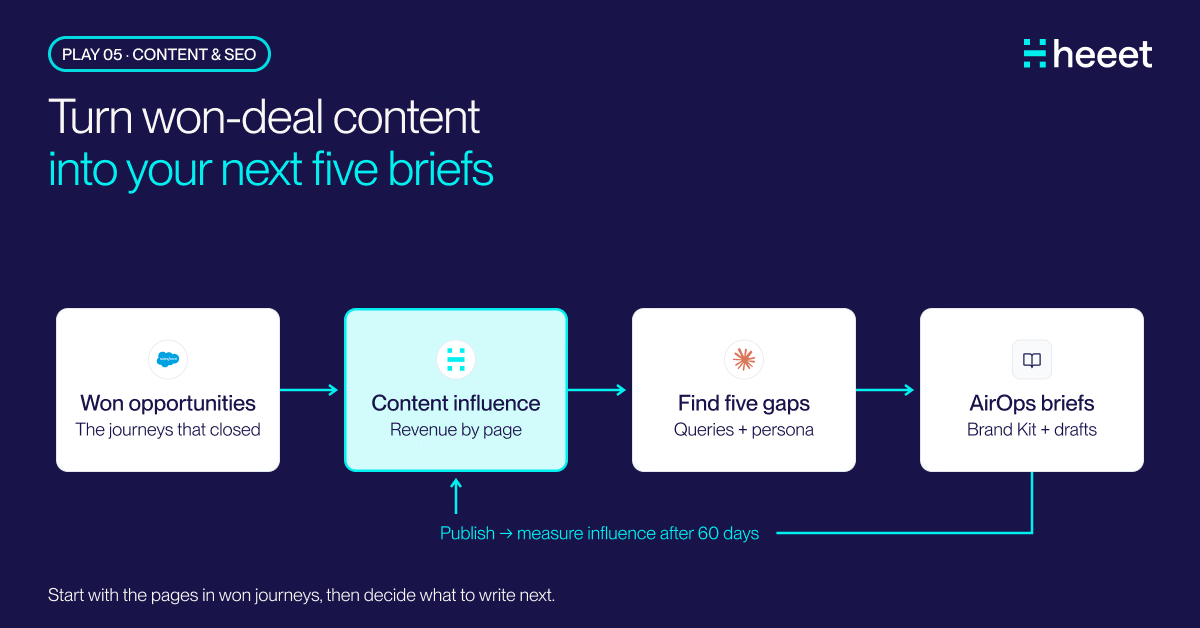
Content attribution in Salesforce shows which pages appear in closed-won journeys. Claude turns the gaps into five briefs and AirOps produces the drafts.


Last updated: 20 October 2026
Fátima Muñoz Peribáñez runs SEO at Ringover. Half of Ringover's inbound leads arrive through her channel. A quarter of the sales pipeline starts with an SEO-sourced lead. She can also see, page by page inside Salesforce, which articles those leads read before they converted, and that leads who read certain pieces converted twice as fast as the rest. Her line in the case study is short: Heeet is "a must-have for SEO analytics in Salesforce."
Content attribution answers the first question, which pages earn revenue. It doesn't answer the second: which pages to write next. That gap is where most content teams go back to a keyword tool and start again from search volume, as if the revenue data had never existed. This play keeps the revenue data in charge. Claude reads the pages in your closed-won journeys and the search queries that led to them, finds what's missing, and hands AirOps five briefs for Q4 2026 with your Brand Kit attached.
What do you need to run this play?
The content or SEO lead, once a quarter, with a lighter monthly version for the digest.
- Heeet with content tracking on: page views and page actions (downloads of ungated documents), plus Exact Search Query. Optional: the Google Search Console connector, and production cost entered on your main assets.
- Claude connected to Salesforce: Salesforce in Claude, or Claude Desktop or Claude Code with the Salesforce Hosted MCP server (
sobject-reads). - The AirOps Claude connector, with at least one Brand Kit configured. As of October 2026 it reads your AI search visibility, Page360 and brand context, and can create action Grids of pages to work on. Drafting happens inside AirOps.
What signal does this play run on?
Heeet records three kinds of content influence on a Lead or Contact: a page viewed, a page action such as a brochure or white paper downloaded, and an organic LinkedIn engagement. Each carries the asset, the date and its position in the journey: before the lead existed, between lead and Opportunity, or while the Opportunity was open. Per asset, Heeet rolls up leads engaged, the persona split of those readers from your own CRM fields, conversion rate by persona, and pipeline and revenue influenced. If someone entered production cost on the asset, ROI comes with it.
Next to that sits the exact search query Heeet stored on the Lead. The page tells you what they read. The query tells you what they wanted when they found it.
One more input since 12 October 2026: Heeet writes revenue under four attribution models on every Marketing Influence each night (First Touch, Last Touch, Linear and U-Shaped). That matters more for content than for any other channel. A guide read between the first visit and the demo request gets nothing under first or last touch, however many deals it helped close.
Where each person sees it
| Who | Where they work | What Heeet gives them |
|---|---|---|
| Content or SEO lead | Claude, connected to Salesforce | The pages in won and lost journeys, with revenue, persona and the queries behind them |
| Writer or agency | AirOps | An action Grid of five briefs, with target queries, persona and internal links |
| AE or SDR | The Salesforce Lead or Account | Lead Intelligence talking points that name the content this lead already read |
| Head of marketing | The weekly digest in Slack | The top assets by revenue influenced, and ROI where production cost is entered |
How do you turn content attribution into production briefs?
Step 1: rank the pages that appear in won deals
Using Heeet's content influence records (run get_object_schema on the
influence object first): for every Opportunity closed-won in the last 180
days, list each content asset that appears in its journey. Per asset return:
number of won Opportunities it appears in, the journey stage where it was read
(pre-lead, lead to Opportunity, or Opportunity open), closed-won revenue
influenced under the Linear model, the same under First Touch, the persona
split of readers using our Title or Persona field, and production cost if
present. Sort by Linear revenue influenced.
Then run the same table for closed-lost Opportunities, so I can see which
pages appear in both.
Expected output: 30 to 100 assets, with a handful carrying most of the revenue and a longer tail that appears once. The closed-lost table is the interesting one. A page that shows up in lost deals more than won ones isn't doing its job. And a page that ranks high under Linear but near zero under First Touch is a mid-journey page: judge it on what it does after the first visit, not on how many people it brings in.
Step 2: pull the queries behind those reads
For the Leads who read the top 15 assets, list the exact search queries Heeet
stored on the Lead, grouped by asset, with counts. Where the Search Console
connector has data, add impressions and average position for each query.
Step 3: find the five gaps
Cluster the queries and asset topics. Propose five new pieces where all three
hold: the topic appears in won journeys; the query has impressions but we rank
outside the top 10 or have no page; and the persona who reads it converts above
our median. For each: a working title, the target query, the journey stage it
serves, the persona, and the two existing assets that should link to it.
Step 4: hand the briefs to AirOps
With the AirOps connector on:
Create an action Grid named "Closed-won content gaps, Q4 2026" containing the
five pages above with their target queries, persona and journey-stage notes,
and the internal links to include. Use our Brand Kit. Add the two existing
assets each new page should reference.
Run your content workflow against the Grid inside AirOps, review the drafts, publish.
Step 5: publish so Heeet can read it back
Clean URLs, no gating, and the same UTM convention as everything else if you promote the pieces through paid or email (Play 20 covers the convention). Enter production cost on each new asset in Heeet so Step 6 can report ROI as well as influence.
Step 6: sixty days later
For the five pages published on [date], show leads engaged, persona split,
Opportunities influenced and revenue influenced to date, next to the median for
existing assets of the same age.
Which pages deserve a sequel, and which deserve a rewrite?
A page that appears in won journeys before the lead existed, with a query that has impressions and a weak ranking, deserves a sequel: more pages on the same cluster, linked from it. A page that appears in lost journeys more often than won ones deserves a rewrite, because it is answering the question badly or answering the wrong one. And a page with many readers and no revenue deserves a persona check first. In a demo on 14 April 2026, Romain Blanc used demo data to show one asset converting 30% of the CFOs who read it and 15% of the CMOs. Same page, two audiences, one decision about who to promote it to.
Why do won journeys make better briefs than keyword volume?
Search volume tells you what people type. Journeys tell you what buyers read before they paid. Nel's case study describes prospects visiting the company's resources page several times before they ever submitted a form; those pages were doing sales work with no credit. Ringover found pieces that halved time to convert. And in a demo on 13 April 2026, Romain described attaching agency or freelancer production cost to an asset so a content team can show whether the spend produced pipeline, which is content ROI in the CFO's sense of the word rather than the traffic sense.
How do you make it recurring?
Quarterly for the full run. Monthly, ask Claude for the top ten assets by revenue influenced in the last 30 days and drop the list into the weekly digest (Play 7). Once the five pages are 60 days old, decide whether the cluster gets another five.
Share the same top ten with sales. Lead Intelligence already lists the content each lead read in its talking points. A rep who knows which pages show up in won deals knows which link to send next.
Related
- Plays: Pre-call brief with the full buyer journey (Play 2) · Turn the exact search queries behind won deals into SEO briefs (Play 16) · Find which LinkedIn posts create pipeline and repurpose them (Play 23) · Measure AI search's share of pipeline (Play 24)
- Features: Content Marketing ROI · SEO ROI and influence · Exact Search Query · Lead Intelligence
- Connector: Google Search Console
- Reading: Content marketing analytics: the complete guide to measuring content ROI · The revenue-driven content flywheel · Measure how your customers engaged with your content
FAQ
Does Heeet see the pages someone read before they became a lead?
Yes, for anyone who eventually converts. The journey is held in the visitor's browser and written to Salesforce at the form fill, all prior page views included. Visitors who never convert never appear, which is the trade you make for cookieless tracking.
What counts as a content asset?
Any page or page action you track: articles, guides, pricing, comparison pages, downloads. Group them in Heeet by type if you want the tables in Step 1 to read by format.
Which attribution model should content be judged on?
Linear for most pages, because content does its work between the first visit and the deal. Check First Touch separately for pages meant to bring new people in. Heeet stores both on every influence, so you don't have to pick one for the whole team.
Do I need AirOps?
No. The five briefs from Step 3 work in any tool or a Google Doc. AirOps is the write path in this play because its connector accepts the pages and Brand Kit directly, so nothing is retyped.
Can I attach agency cost to a page?
Yes. Production cost is a field on the content asset in Heeet. It feeds the ROI in Steps 1 and 6.
Does this cover pages cited in ChatGPT or Perplexity?
Partly. Heeet labels sessions from AI engines by referrer, so those reads appear in Step 1. Measuring AI search's share of pipeline and briefing for citations is Play 24.
Other articles

Claude for Sales: Pre-Call Brief With the Buyer Journey
Claude for sales preps the call from CRM data. One more prompt adds the buyer journey Heeet writes to the same records, for the whole buying committee.

Marketing Budget Allocation by Cost per Pipeline Opportunity
Marketing budget allocation on the right denominator: Claude reads campaign cost and pipeline from Salesforce, tests it under two models and writes the log.

Weekly Marketing Report in Slack by Claude From Salesforce
A weekly marketing report both teams trust: Claude reads pipeline created and influenced, spend, CPL and closed deals from Salesforce, then posts to Slack.

Ready to track prospects from lead to close with Heeet?
Heeet gives marketers and sales professionals at IT & Security firms turn geuss work intro informed decisions that drive revenue while meeting the same secruity technical standards you provide your clients.