Read time :
CRM retargeting for stalled pipeline: a live Salesforce audience on LinkedIn
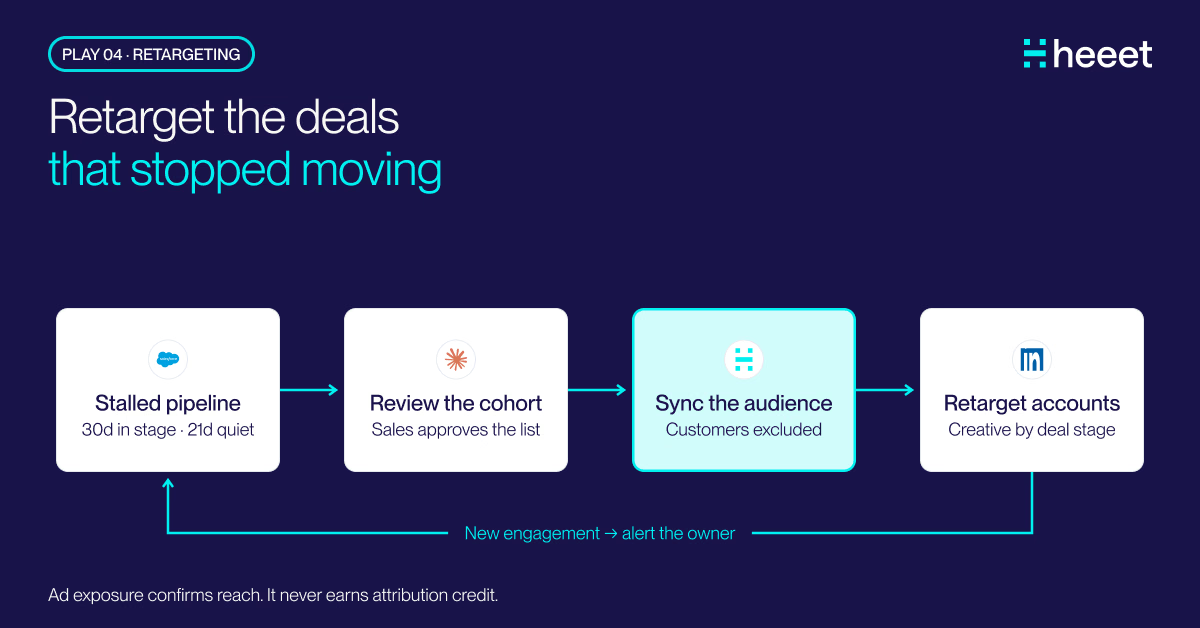
CRM retargeting for stalled deals: Claude finds the opportunities that stopped moving, Heeet keeps their accounts in a live LinkedIn audience, customers out.


Last updated: 20 October 2026
Retargeting is for strangers who bounced.
That's how most Campaign Manager accounts are built: a website audience of anonymous visitors, a matched audience uploaded as a CSV in January and never refreshed, and a creative that assumes nobody in it has heard of you. It's the version of retargeting the ad platform sells, because the ad platform can only see who visited.
The audience closest to revenue is somewhere else. It's the open Opportunities that haven't changed stage in a month, at accounts where nobody has opened an email or read a page in three weeks. Your CRM knows every one of them by name. On 13 April 2026, Romain Blanc showed Cognite's team the mechanism that turns that list into an ad audience: a trigger in Heeet that pushes a Salesforce segment to LinkedIn or Google the moment a record qualifies, and pulls it back out the moment it stops. CRM retargeting, run from the pipeline instead of the website, is that trigger pointed at your stalled deals.
What do you need to run this play?
Paid marketing runs it. Sales approves the list and gets the alerts.
- Heeet's Audience Activation Engine with LinkedIn connected. Segments come from Salesforce reports, fields and stages, stay in sync, and can suppress customers and closed-lost accounts automatically.
- Heeet's LinkedIn Ads connector, so campaign cost and account-level ad exposure land in Salesforce.
- Claude connected to Salesforce: Salesforce in Claude, or Claude Desktop or Claude Code with the Salesforce Hosted MCP server (
sobject-reads). - Campaign Manager access for the creatives.
- Slack, for the review step and the alerts.
What signal does this play run on?
Three things, two on the Opportunity and one on the Account.
The stage hasn't changed in 30 days. Nobody at the account has produced a Heeet influence in 21 days: no page view, no email click, no LinkedIn engagement, no event. Leave ad exposure rows out of that count. Once your ads run, exposure appears on every account in the audience, and you don't want the ads themselves to mark a deal as active.
The third is the people. Heeet holds influence at the Account level within the opportunity window, so the audience includes the four colleagues who read the security page in June and were never added as Contact Roles. The champion who went quiet is one person. The committee around her is the audience.
Where each person sees it
| Who | Where they work | What Heeet gives them |
|---|---|---|
| Paid marketer | Claude, connected to Salesforce | The stalled deals and their accounts, with days since the last real touch |
| Account owner | Slack, then the Salesforce Account | An alert when a stalled account wakes up, and the Lead Intelligence summary of what it did |
| Paid marketer, again | LinkedIn Campaign Manager | A company audience that adds and drops accounts as deals stall and move |
| Sales manager | The Opportunity record | Ad reach and re-engagement on the deal itself, with the campaign's cost |
How do you run CRM retargeting on stalled pipeline?
Step 1: find the deals that went quiet
List open Opportunities whose stage has not changed for 30 days or more, with
stage, amount, owner, days in stage and the date of the most recent Heeet
influence on the Account, excluding ad exposure records. Keep only those with
no influence in the last 21 days. Then list every Contact on those Accounts:
title, whether they hold a Contact Role on the Opportunity, and their own last
influence date.
Expected output: for a mid-market pipeline, 20 to 60 deals and 80 to 200 people. Read the owners column. If one rep owns half the list, the problem isn't marketing's to fix.
Step 2: let sales strike names
Post the deal list to the pipeline channel. Owners remove deals that are quiet for a known reason: legal review, a signed order waiting for a PO, a buyer on leave. What stays becomes the segment. Save it as a Salesforce report, "Stalled pipeline accounts": stage age over 30 days, no non-exposure influence in 21 days, not a customer, not closed-lost in the last 90 days.
Step 3: sync the accounts to LinkedIn
In the Audience Activation Engine, create the audience. Source: the Step 2 report. Destination: a LinkedIn company Matched Audience. Suppression: customers and recent closed-lost.
Use companies, not contacts. LinkedIn won't serve a Matched Audience under 300 matched members, and 150 contacts rarely gets there. Forty accounts do, because LinkedIn matches everyone it knows at those companies. In Campaign Manager, layer job function and seniority on top to keep the reach to the buying committee.
From here the audience maintains itself. A deal that moves stage drops its account out, and a newly stalled deal adds one. No CSV. No upload date, and no one remembering to refresh it.
Step 4: one message per stage
For each Opportunity stage in the stalled segment, propose one ad message and
three variants. Discovery: proof, using one of our published case studies in
the reader's industry. Proposal: pricing transparency and the security page.
Negotiation: a customer quote about time to value. Intro text under 150
characters, headline under 70. Never "still interested?".
Build one campaign per stage in Campaign Manager against the audience. Claude can't do this part, and shouldn't: LinkedIn has no official Ads MCP.
Step 5: check the ads reached the accounts
After two weeks, ask Claude:
For each Account in the stalled segment, show the Heeet LinkedIn ad exposure
records from the last 14 days: campaign, impressions and last activity date.
List the Accounts with no exposure at all.
Heeet matches LinkedIn's company-level impressions to your Accounts by web domain and writes them on the Account and the Opportunity. An account with no exposure either has a blank domain field or sits outside your job-function filter. Fix it there before judging the creative. Exposure is a delivery record only. It never earns attribution credit.
Step 6: tell the owner when an account wakes up
Every weekday at 9:00, check the stalled segment for any new Heeet influence
since yesterday, excluding ad exposure: an ad click, a page view, an email
click, a LinkedIn engagement. For each, post to Slack: the account, the deal,
the owner, what happened and a link to the Account.
The owner opens the Account and reads the Lead Intelligence summary before picking up the phone: what the account did, the recommended next step and the talking points. A stalled deal that clicks your pricing-transparency ad on Tuesday deserves a call on Tuesday.
Step 7: measure the cohort after 30 days
Take the stalled cohort as of [start date]. For each Opportunity: did the
stage advance, did it close, and did the Account produce a new Heeet
influence in the window, excluding exposure? Group by owner. Add the LinkedIn
campaign's cost and its Accounts Reached figure from the Campaign record.
Heeet syncs the campaign's cost every hour, and ad clicks from known people land as touchpoints on the deal. The re-engagement shows up on the Opportunity itself, not in a platform report someone has to reconcile.
What if the audience is still too small?
Widen the definition before you widen the audience. Move the stage-age threshold to 21 days, or include every open Opportunity past discovery. If that still won't clear LinkedIn's floor, send the same report to Google Ads as a Customer Match list, which serves from 100 members. Or flip the logic and use the segment as a suppression list, so cold campaigns stop spending on people sales is already talking to.
The entry rule stays fixed either way. Thirty days without a stage change. Twenty-one days without a real touch. Never a customer.
Why does retargeting the pipeline work?
A buying committee that stopped replying didn't stop scrolling. Those people are the cheapest audience you own: known, in-market by definition, and quiet. The stage tells you what they're stuck on, so the creative can be specific. And because the audience is the pipeline as of this hour, it never drifts the way a January CSV does.
There's a reporting benefit for marketing too. In a demo in November 2025, the CMO of a Paris influencer-marketing platform described her blind spot as everything after the MQL: once a deal belonged to sales, marketing had no way to show its contribution. Every re-engagement this play produces lands on the Opportunity as an influence with the campaign's cost attached. That's the mid-cycle contribution she couldn't prove.
How do you make it recurring?
The audience runs itself, and so does the morning alert. Review the creative by stage once a month. Once a quarter, hold out a fifth of stalled deals by owner for 90 days and compare stage velocity with and without the ads. It's the only honest test, and it costs nothing but discipline.
Related
- Plays: Warm outbound to LinkedIn engagers (Play 1) · Stop paying to acquire your own customers with Google Ads suppression (Play 9) · Run ABM on LinkedIn from Salesforce deal fields (Play 15) · Flag deals going quiet (Play 19)
- Features: Audience Activation Engine · LinkedIn Engagement · Lead Intelligence · Customer Journeys
- Connectors and docs: LinkedIn · LinkedIn Ads connector setup
- Reading: Audience Activation Engine, explained · Activating CRM data to optimise ad spend
FAQ
Does Heeet upload a CSV to LinkedIn?
No. The Audience Activation Engine syncs the segment through LinkedIn's Matched Audiences and keeps it current, adding accounts as they qualify and removing them as they stop.
Why sync companies instead of contacts?
LinkedIn needs 300 matched members before an audience serves. A stalled-deal contact list is usually smaller. A company list matches everyone LinkedIn knows at those accounts, and Campaign Manager's job and seniority filters keep it to the committee.
Will customers or lost accounts see the ads?
Not if you add the suppression in Step 3. Suppression updates with the CRM: a deal that closes today leaves the audience at the next sync.
Does ad exposure count as marketing influence?
No. Exposure records are excluded from every attribution calculation Heeet runs. This play uses them to confirm delivery, and leaves them out of the "no touch in 21 days" rule.
Is using CRM data for ad targeting a privacy issue?
It's a separate processing activity from Heeet's cookieless tracking, with its own legal basis to confirm with your DPO. Heeet doesn't store your prospects' personal data, but the audience sync does move CRM data to an ad platform. That decision is yours to document.
Other articles

Warm Outbound to LinkedIn Engagers Already in Your Salesforce
A warm outbound play: find the LinkedIn engagers already in Salesforce, read their journey, write from the post they engaged with and retarget the quiet ones.
Closed-Lost Reactivation the Moment a Lost Deal Comes Back
Closed-lost reactivation on a real signal: Heeet writes the return visit onto the Contact, Claude reads the loss reason, lemlist sends the follow-up.

Weekly Marketing Report in Slack by Claude From Salesforce
A weekly marketing report both teams trust: Claude reads pipeline created and influenced, spend, CPL and closed deals from Salesforce, then posts to Slack.

Ready to track prospects from lead to close with Heeet?
Heeet gives marketers and sales professionals at IT & Security firms turn geuss work intro informed decisions that drive revenue while meeting the same secruity technical standards you provide your clients.